EquityStat Named a Top Tool for DIY Investors by Kiplinger Magazine

A Trusted Recommendation for Individual Investors

Kiplinger Magazine Names EquityStat A Great Tool For DIY Investors

Kiplinger Magazine — one of the most respected names in personal finance — recently recognized EquityStat as one of the top tools for DIY stock investors. To build their list, Kiplinger consulted seasoned investors and long‑time Wall Street observers, selecting only platforms that deliver real value, clarity, and actionable insights.

Their verdict: EquityStat stands out as a powerful, easy‑to‑use portfolio tracking solution for everyday investors.

Why Kiplinger Highlighted EquityStat

In their review of top investing tools, Kiplinger emphasized several strengths that make EquityStat especially useful for self‑directed investors:

1. Fast, Simple Portfolio Setup

Kiplinger noted that EquityStat makes it incredibly easy to build a stock‑tracking portfolio. Investors can add holdings quickly, organize multiple portfolios, and start analyzing performance in minutes — without the clutter or complexity found in many other tools.

2. Robust Performance Metrics

According to Kiplinger’s analysis, EquityStat provides a wide range of performance indicators that help investors understand how their stocks, ETFs, and mutual funds are truly performing. These include:

  • Daily gain/loss
  • Total return
  • Annualized return
  • Realized gains
  • Cost basis
  • Long‑term performance trends

These metrics give DIY investors the clarity they need to make informed decisions.

3. Clean, Intuitive Interface

Kiplinger also praised EquityStat’s clean, streamlined design. The interface avoids unnecessary distractions and focuses on what matters most: clear data, easy navigation, and fast access to performance insights.

Why This Recognition Matters

Being named one of Kiplinger’s top tools reinforces what many investors already know: EquityStat is a reliable, transparent, and user‑friendly platform for tracking investments.

For individual investors — especially those managing their own portfolios without an advisor — having a tool that is both powerful and easy to use is essential. Kiplinger’s endorsement highlights EquityStat’s ability to deliver exactly that.

You can read the article here.

https://www.kiplinger.com/investing/great-tools-for-diy-stock-investors

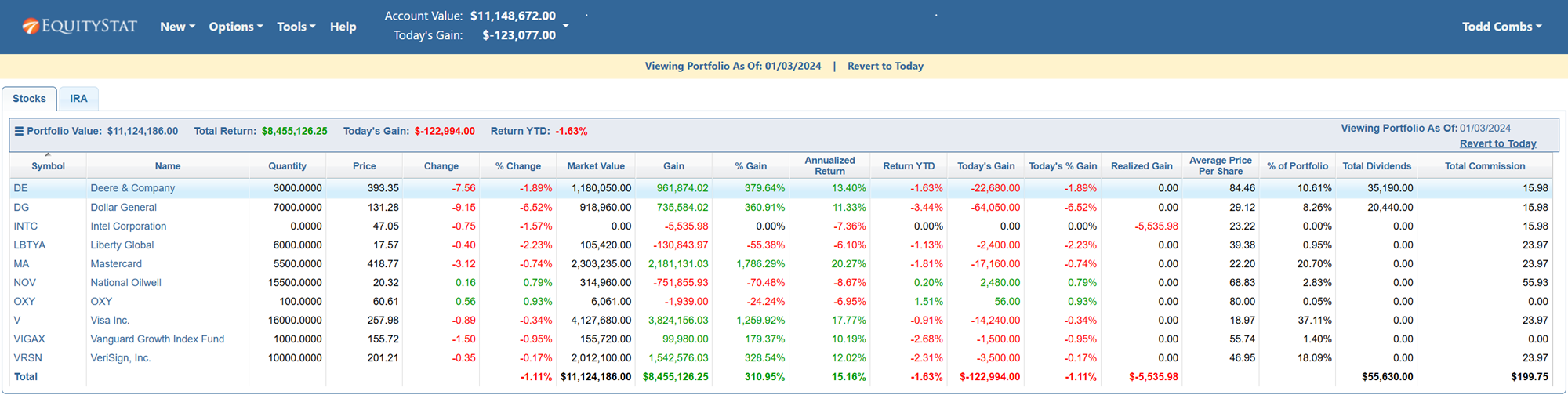
Explore Your Past Portfolio Performance with EquityStat’s “View On Date” Feature

Investing is not just about tracking today’s numbers—it’s about understanding your portfolio’s journey over time. That’s why EquityStat, your all-in-one stock portfolio tracker, is excited to introduce a powerful new feature: View On Date. Now, you can look back at your holdings and portfolio performance on any past date, giving you deeper insight into your investment strategy.

Introducing “View On Date”

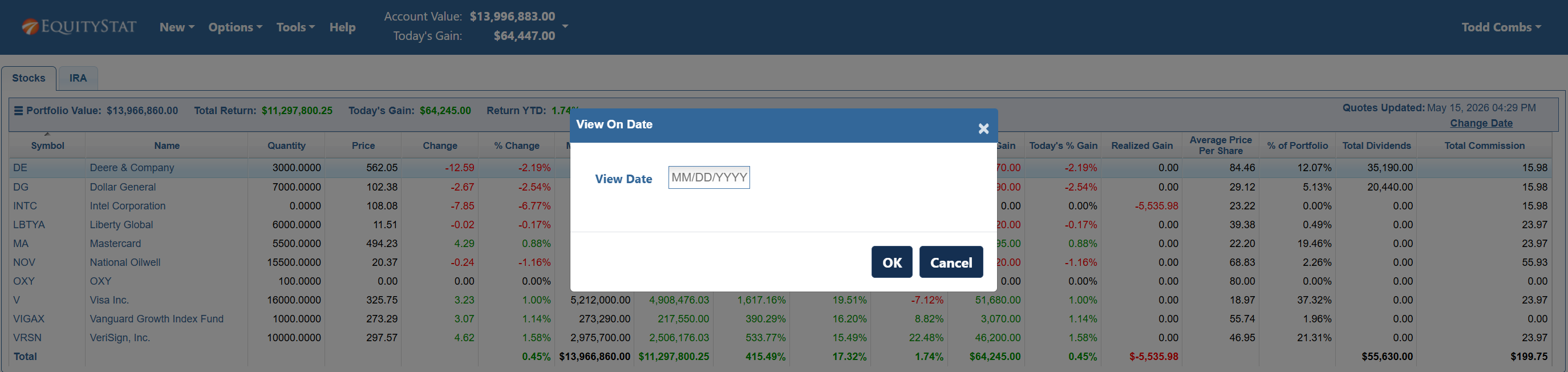
The View On Date feature allows you to examine your portfolio exactly as it appeared on a specific past date. When you select a past date:

  • Only the investments you held on that date will be displayed.
  • Performance metrics are calculated using the closing prices from that date, giving you an accurate snapshot of your historical portfolio performance.

Whether you’re reviewing historical performance, analyzing past trades, or comparing growth over time, this tool gives you precise insight into your investment history.

How to Use “View On Date”

View your EquityStat stock portfolio on a past date.
  1. Via the Options Menu:
    • Click the Options menu at the top of your portfolio dashboard.
    • Select View On Date from the dropdown.
    • Enter the past date you want to review in the dialog box.

  2. Using the Change Date Link:
    • Underneath the “Quotes Updated” date, click Change Date to select a past date.

  3. Portfolio Analysis for Past Dates:
    • In the upper right-hand corner of your portfolio dashboard, click the View On Date link to access historical portfolio analysis.

Once you’re viewing your portfolio on a past date, a banner message at the top of the page will show the date you’re analyzing. To return to your current holdings, simply click Revert To Today.

View your EquityStat stock portfolio on a past date.

Why Investors Will Love This Feature

  • Historical Insights: Understand how your portfolio has performed over weeks, months, or even years.
  • Performance Analysis: Evaluate the impact of past decisions to refine your investment strategy.
  • Simplified Tracking: No more manual tracking or spreadsheets—see past performance directly in EquityStat.

This feature makes EquityStat not just a real-time portfolio tracker, but a historical analysis tool that empowers investors to make smarter decisions.

Start Exploring Your Portfolio History Today

With EquityStat’s View On Date feature, you have complete control over your portfolio insights—past, present, and future. Stay informed, track your progress, and make confident investment decisions all from a single platform.

2025 IRS Form 8949: How to Quickly Generate Your Capital Gains Report with EquityStat

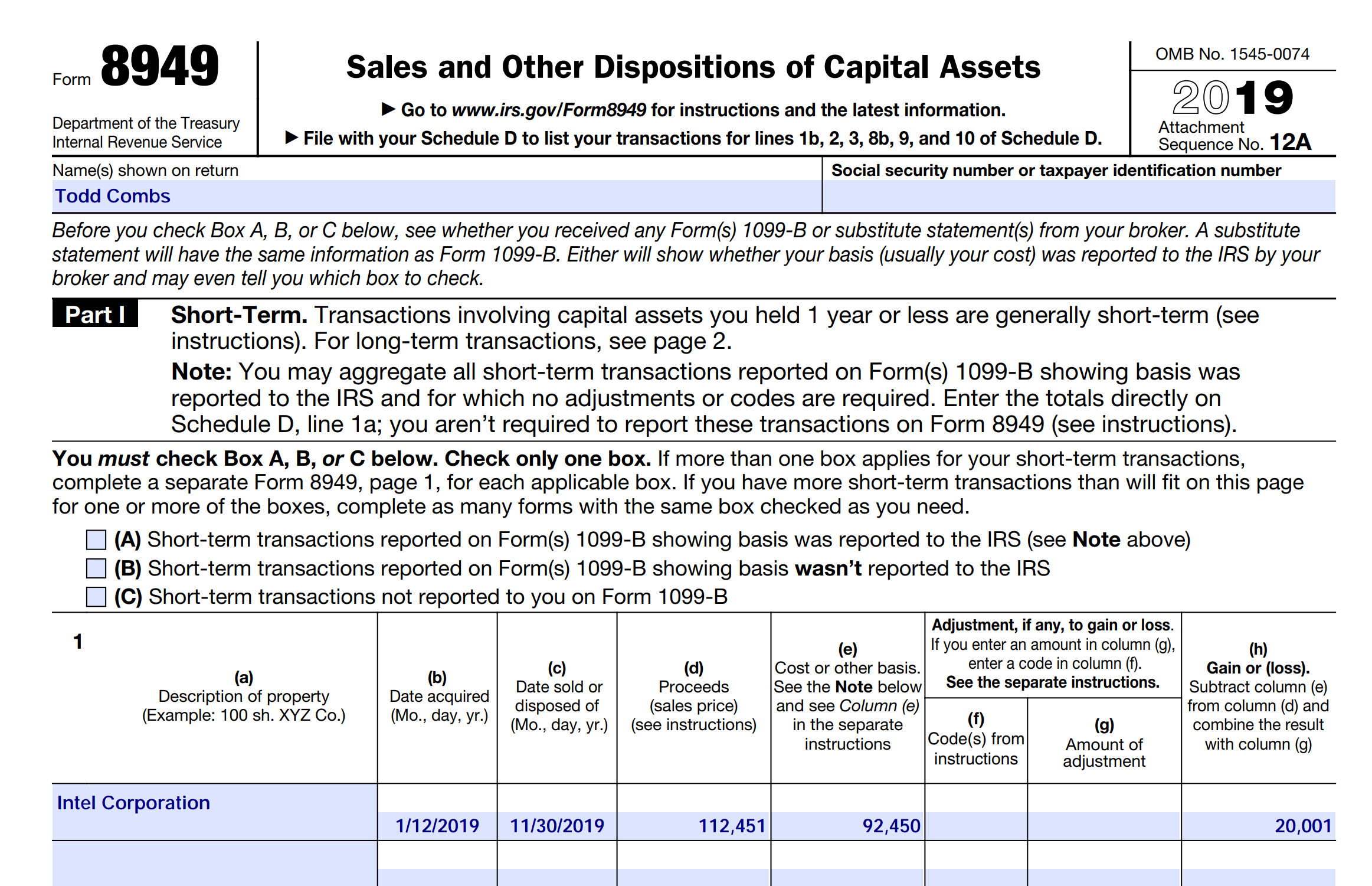
If you sold stocks, ETFs, mutual funds, or other investments during 2025, you’ll need to report your gains and losses on IRS Form 8949 when filing your 2025 tax return. To make this process faster and more accurate, EquityStat now provides an automated Form 8949 generator.

What Is IRS Form 8949?

IRS Form 8949 is the official document used to report:

  • Short‑term capital gains and losses (assets held for one year or less)
  • Long‑term capital gains and losses (assets held for more than one year)

If you sold any taxable investment in 2025 — including stocks, mutual funds, ETFs — this form will help your tax preparer produce your tax return.

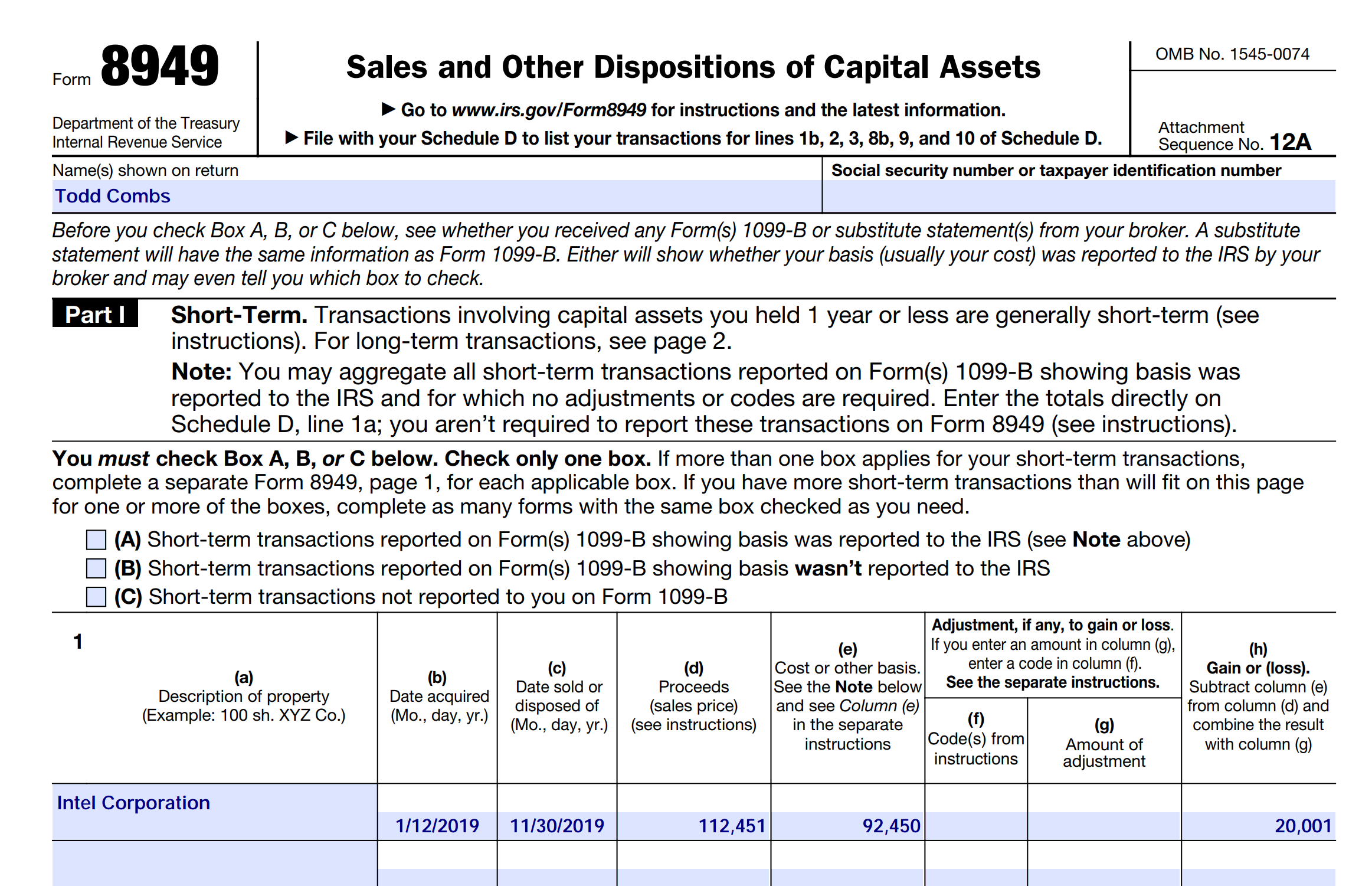
Generate tax form 8949 with EquityStat

Generate Your 2025 Form 8949 Automatically in EquityStat

EquityStat’s updated tools now support instant creation of the 2025 Form 8949, helping you avoid manual calculations and spreadsheet errors.

How to Generate Form 8949 in EquityStat

  1. Open the Tools menu in your EquityStat dashboard
  2. Select Generate IRS Form 8949
  3. Choose the tax year you want to generate Form 8949 for
  4. Click Generate on the Form 8949 page

Within seconds, EquityStat calculates:

  • Short‑term gains and losses
  • Long‑term gains and losses
  • Adjusted cost basis
  • Totals required for Schedule D

A PDF formatted exactly to IRS specifications is created and ready for download.

What You Can Do With Your Generated Form 8949

Your completed PDF can be:

  • Uploaded directly into your tax software
  • Sent to your accountant or tax preparer
  • Printed and included with a paper tax return

This ensures your capital‑gains reporting is complete, accurate, and compliant.

Why Investors Choose EquityStat for Form 8949

EquityStat is built for both high‑volume traders and long‑term investors who want reliable tax reporting. Key benefits include:

  • Accurate cost‑basis tracking
  • Automatic gain/loss calculations
  • Fast PDF generation
  • Support for stocks, ETFs, and mutual funds
  • Ideal for 2025 tax‑filing deadlines

Who Should Generate Form 8949?

You should create Form 8949 if you:

  • Sold stocks or ETFs in 2025
  • Sold mutual funds or index funds
  • Need a clean, IRS‑ready summary of gains and losses

If you had any investment sales in 2025, EquityStat’s Form 8949 generator saves time and reduces the risk of filing errors.

Example: What Your Form 8949 Output Includes

Your generated PDF contains:

  • Part I: Short‑term transactions
  • Part II: Long‑term transactions
  • Totals for gains and losses
  • IRS‑compliant formatting and layout

This ensures your tax return is complete and ready for submission.

‘Tis the Season For Dividends and Capital Gains

As year-end dividends and capital gains distributions arrive, you can easily track them using EquityStat’s portfolio manager.

With EquityStat’s powerful stock portfolio manager, handling these critical financial events across all your brokerage accounts is seamless and intuitive.

How to Record Distributions

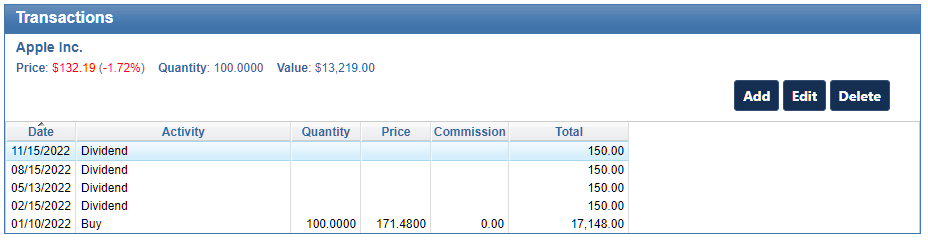
Add dividend, short-term capital gains and long-term capital gains to your EquityStat stock portfolio.
Transaction Panel Example

1. Select the investment from your portfolio list.
2. In the Transaction panel, click the Add button
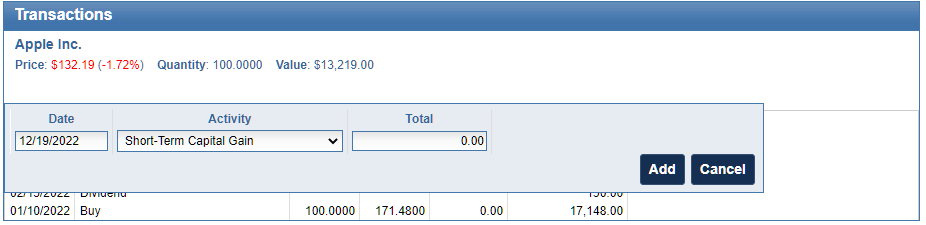
3. Use the Activity dropdown to select the distribution type:
a. Cash Payments – Select Dividend, Short-Term Capital Gain, or Long-Term Capital Gain
b. Reinvestements – Select the “Re-Invested” version of these options if the funds were used to purchase more shares.
4. Enter the distribution details and click Add.

Add dividend, short-term capital gains and long-term capital gains to your EquityStat stock portfolio.
Example of entering a short-term capital gain.

How to View Your Dividend Totals
Knowledge is power. EquityStat helps you get a complete picture of dividends:

  • Customize Your View: Instantly see the Total Dividends (including capital gains) paid by each investment. Simply access the Options menu at the top and select Change Columns to add this key metric to your main portfolio display.
  • Analyze Your Entire Account: Get big-picture insights on your total income over time. The Analyze Portfolio page, found under the Tools menu, provides comprehensive, graphical performance metrics for your entire account or specific portfolios, helping you make better-informed decisions.

2024 8949 IRS Tax Form Released

How to Generate Your Capital Gains and Losses Report

If you sold stocks or other investments in 2024, the IRS requires you to report your short‑term and long‑term capital gains and losses using IRS Form 8949. EquityStat now offers a fast, accurate way to generate this form automatically—perfect for tax filing season.

What is IRS Form 8949

IRS Form 8949 is used to report:

  • Short‑term capital gains/losses (assets held 1 year or less)
  • Long‑term capital gains/losses (assets held more than 1 year)

If you sold stocks, ETFs, mutual funds, crypto, or other investments in 2024, you must include this form with your tax return.

Generate the 2024 IRS Form 8949

EquityStat supports automatic creation of the 2023 Form 8949, making tax prep easier and more accurate.

How to Generate Form 8949 in EquityStat

  1. Open the Tools menu.
  2. Select Generate Form 8949.
  3. On the Form 8949 page, click Generate.
  4. EquityStat instantly calculates:
    • Short‑term gains/losses
    • Long‑term gains/losses
  5. A PDF version of IRS Form 8949 is created for download.

This PDF is formatted exactly as required by the IRS.

What You Can Do With the Generated Form 8949

  • Send it directly to your tax preparer
  • Upload it to your tax software
  • Print and include it with your paper tax return

Why Use EquityStat for Form 8949?

  • Accurate capital gains calculations
  • Automatic cost‑basis tracking
  • Fast PDF generation
  • Ideal for active traders and long‑term investors
  • Perfect for 2023 tax filing deadlines

Who Should Generate Form 8949?

You should generate this form if you:

  • Sold stocks in 2023
  • Sold ETFs or mutual funds
  • Sold crypto assets
  • Need a clean, IRS‑ready gains/losses report

If you had any investment sales in 2024, EquityStat’s Form 8949 generator saves time and reduces errors.

Example: IRS Form 8949 Output

Generate IRS Form 8949 to track your investment gains and losses for your taxes.
Form 8949 Example

Your generated PDF includes:

  • Short‑term transactions (Part I)
  • Long‑term transactions (Part II)
  • Totals for gains and losses
  • IRS‑compliant formatting

This ensures your tax filing is complete and accurate.

Start Your 2024 Form 8949 Now

If you sold investments in 2023 and need to calculate your gains or losses, use EquityStat’s Generate Form 8949 tool today.

Best and Worst Stocks of 2024

The stock market ended 2024 near record highs. The Nasdaq Composite rallied by 30%, while the S&P 500 climbed over 24%. The blue-chip Dow Jones rose a more modest 13%. The S&P 500 clinched 57 records, making it one of the top five years for most all-time highs recorded by the benchmark index.

Technology and Communications Services were the standout sectors, thanks to the artificial intelligence boom. Big Tech stocks, including Nvidia, Tesla, Alphabet, Amazon, Apple, Microsoft, and Meta, posted significant gains. Nvidia, in particular, rallied more than 175%

Here are the best performing stocks of 2024.

Best performing stocks of 2024

Here are the worst performing stocks of 2024.

Worst performing stocks of 2024

You can read more about the best and worst performing stocks here and here.

Note, if you want to share your portfolio in image format like you see above, go to here.

How to Import Your Yahoo Finance Portfolio Into EquityStat

If you are looking for an alternative to Yahoo Finance Portfolio, you can easily import your Yahoo Finance Portfolio into EquityStat.  Recently, we enhanced our import feature to work with Yahoo portfolios.

To import your Yahoo portfolio into EquityStat, just follow these easy steps.

Step #1
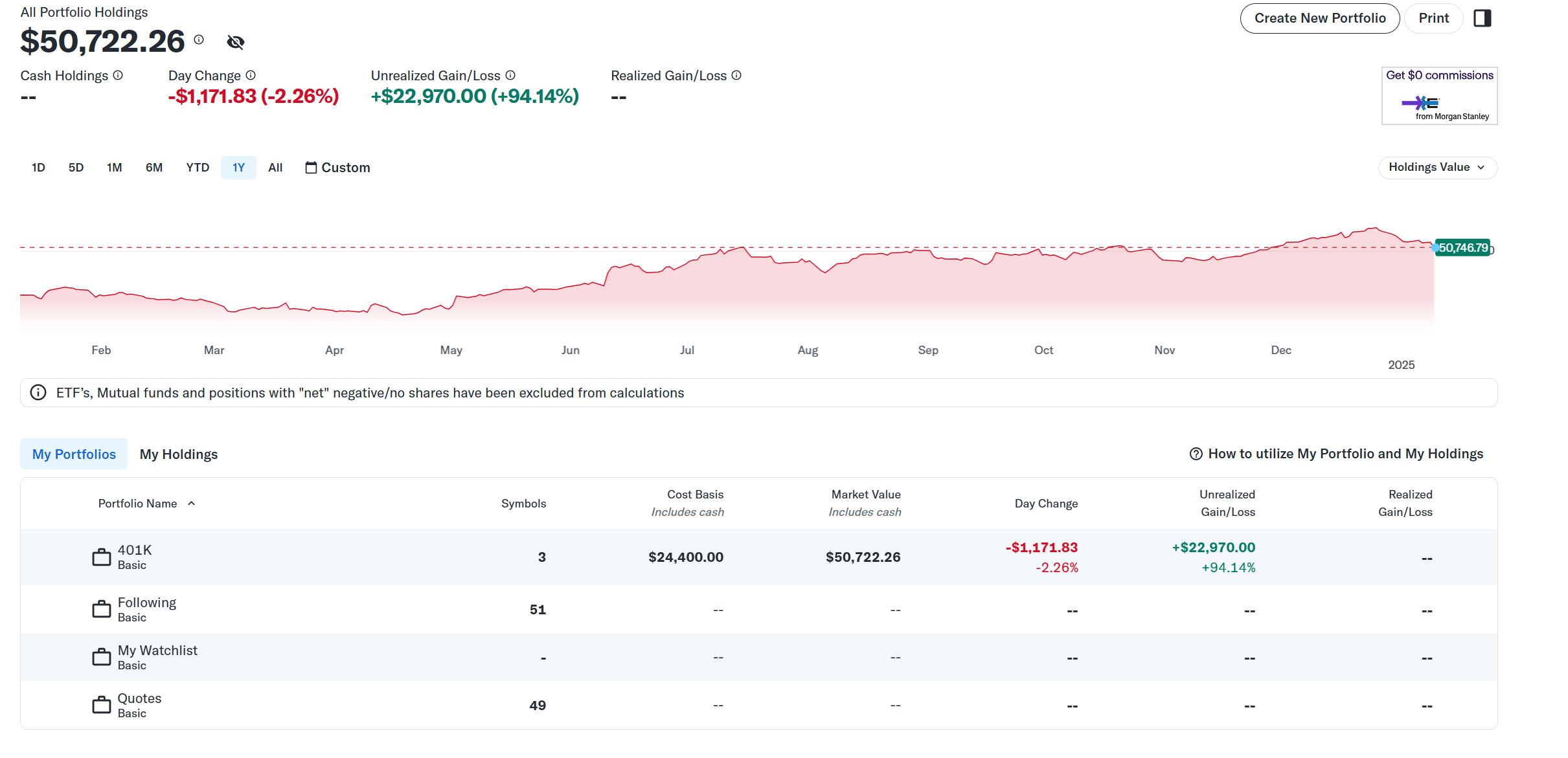
Login to your Yahoo Finance Portfolio and click on a portfolio with holdings.

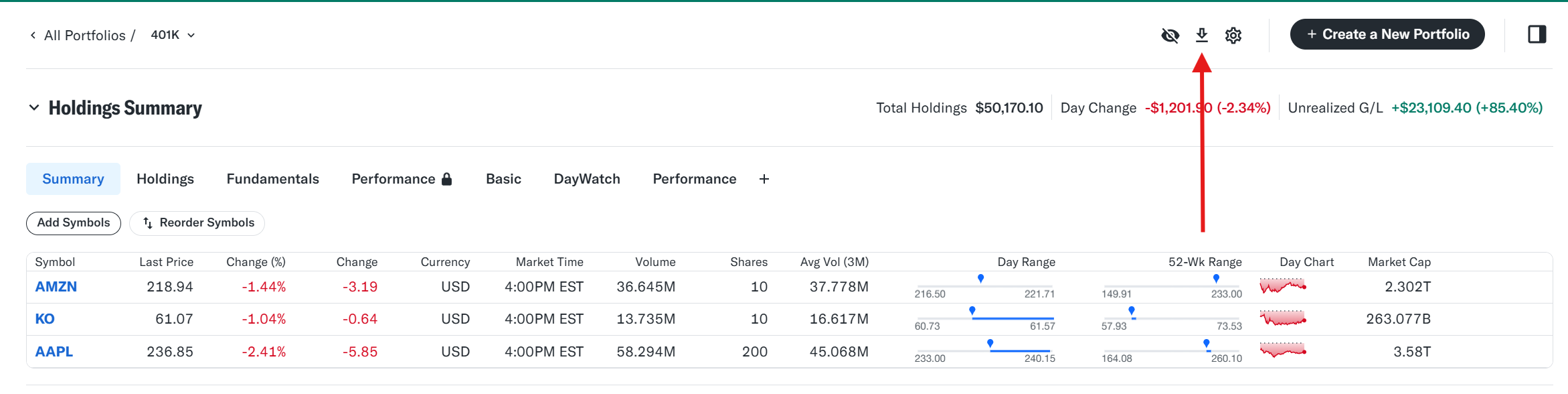
Yahoo Finance Portfolio example

Step #2
On page that displays your holdings, click the down arrow icon in the upper right hand corner.

You will then be prompted to either Print the portfolio or Save the portfolio as a CSV. Choose the Save option. Your CSV file will then be saved to your Downloads folder on your computer.

Step #3
Login to your EquityStat account and click the New menu at the top and choose Import Transactions from the drop down menu. Choose the portfolio you want to import into. Next, choose the file you saved in Step #2.

If you have any questions, contact our support by clicking here.


Alphabet/Google Dividend

On June 17, 2024, Alphabet (GOOGL/GOOG) will pay a $0.20 dividend per share. This is the first dividend paid by Alphabet in the history of the company.

With EquityStat’s stock portfolio manager, it is easy to add and track your dividends.

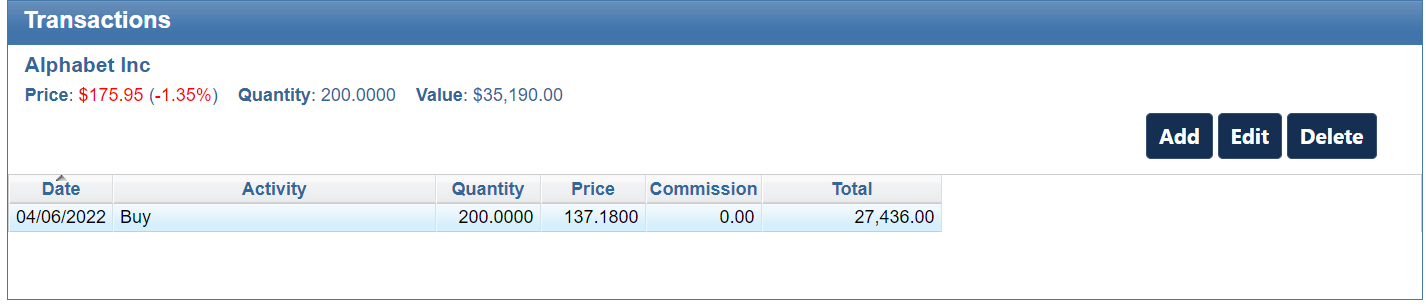
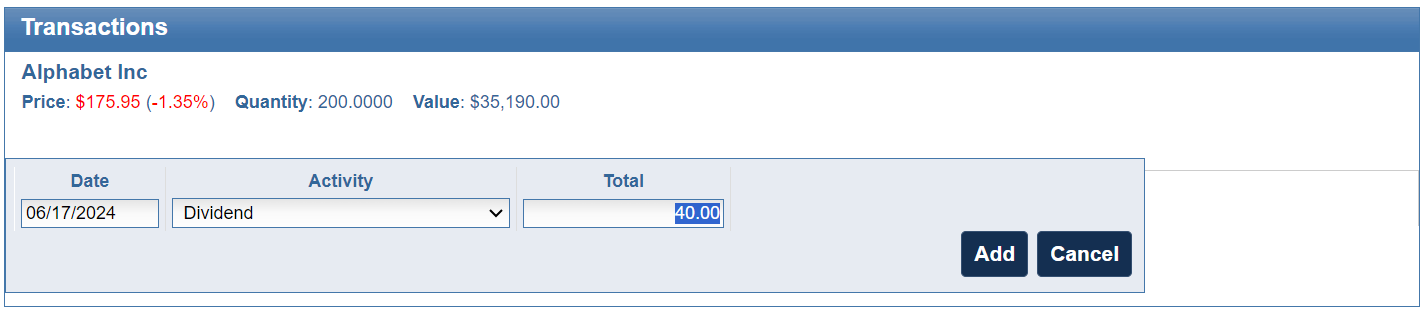
To add a dividend to your Alphabet investment, first select this investment in your investment panel. Then in the transactions panel, click the Add button to add a new transaction.

Add dividends to your EquityStat portfolio.
Alphabet dividend transactions example

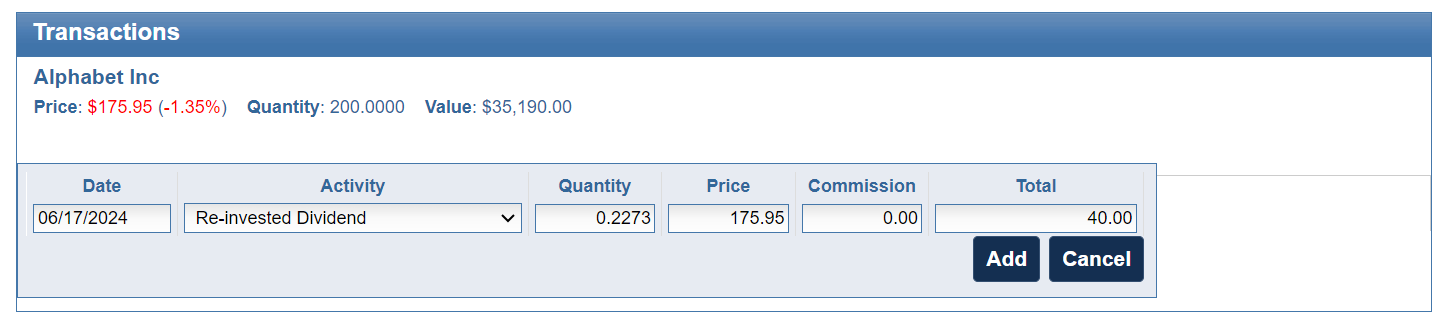
Next, select either Dividend or Re-invested Dividend from the Activity drop down. If you didn’t re-invest the dividend, just enter the dividend amount in the Total field.

Add Alphabet dividend to your EquityStat portfolio.
Add Alphabet dividend transaction example

If you re-invested your Alphabet dividend, choose Re-invested Dividend from the Activity drop down. Enter the number of shares you purchased in the Quantity field and enter the price you paid for the shares.

Add a re-invested Alphabet dividend.
Add a Re-invested Dividend example

Once you have entered your dividend information, click the Add button to save the dividend transaction to your portfolio.

You can follow many of these same steps if you have a different investment that pays a dividend.

NVIDIA Stock Split in EquityStat

Nvidia’s (NVDA) stock is set to split on June 7th, 2024. It is a 10 for 1 stock split. So, for each share you own before the split, you get 10 shares.

If you owned Nvidia (NVDA) stock before the split and you are tracking this stock in your EquityStat portfolio, how do you record the split?

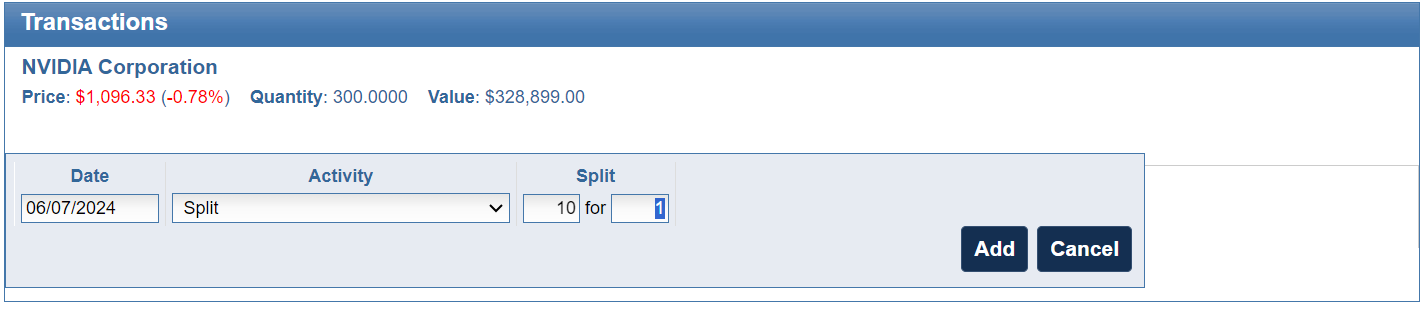
First, select the Nvidia stock in your investment panel. Next, in the transaction panel, click the Add button to add a new transaction. In the Activity drop down, choose a “Split” transaction. Enter how many shares were split, in this case it is a 10 for 1 split, and click the Add button to save the transaction.

EquityStat split Nvidia stock.
Nvidia stock split transaction

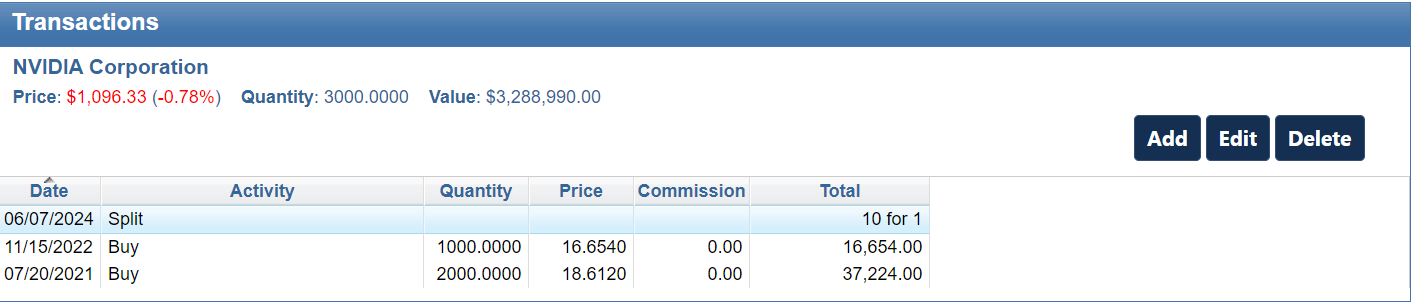
When the split transaction is saved, each transaction will be adjusted to reflect this split. The number of shares will be increased ten times and the price will be divided by ten.

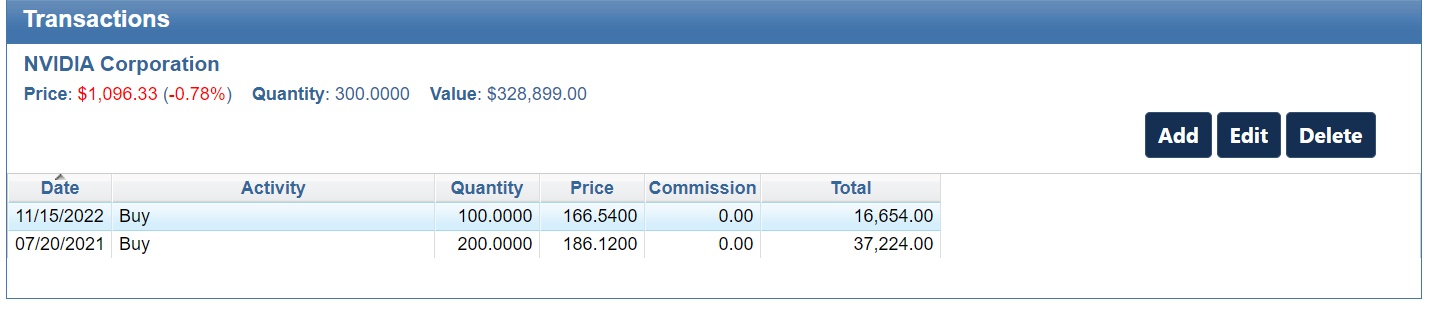
For example, if you had the following transactions before the split.

Nvidia transactions before the split in EquityStat stock portfolio tracker.
Nvidia transactions before the split.

After the split your transactions will look like this.

Nvidia transactions after the split in EquityStat stock portfolio tracker.
Nvidia after the split

Notice that before the split there were two buy transactions. After the split, the number of shares has increased 10 times and the price has been reduced by a factor of ten. For example, the initial buy on 07/21/2021 was for a quantity of 200 shares. After the split, the purchased quantity is 2000 shares. The price the shares were bought on 07/21/2021 was $186.12. After the split, the price paid was $18.61. These adjustments are all automatically done when you enter the split transaction.

If you have other stocks that have split, you can use the same steps to record your split. Just make sure that you enter the correct split information.

New Mobile Feature – Investment Symbol Search

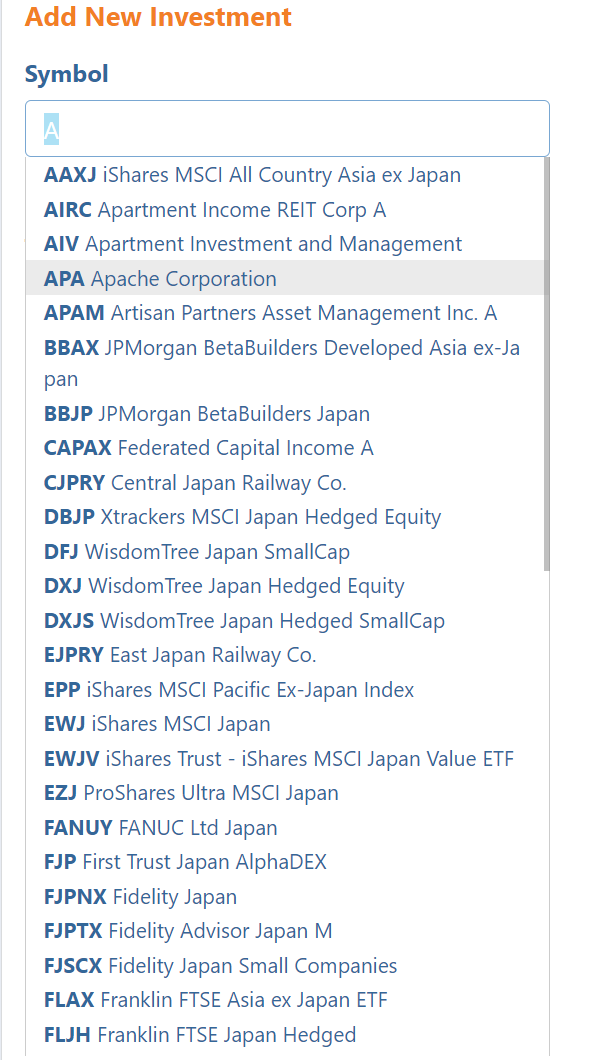
We have recently added a new feature to the mobile device user interface. When adding a new investment to your portfolio, you can easily lookup the investment to add. In the past when you added an investment to your portfolio, you needed to know the investment symbol. Now, in the Symbol field you can start typing, which will display all symbols and investment names that matches the text as you type. With this new feature the mobile phone user interface works similar to the desktop user interface.

Lookup a symbol when adding a new investment to your EquityStat stock portfolio on a mobile device.
Example of the new symbol lookup when adding a new investment on a mobile device.

For example, as seen in the screen shot above, if you start typing “A” in the symbol field you will get a list of symbols and investments that match this text. This will make finding your investment symbol much easier.

To choose a symbol, select the line that has the investment you want to add to your portfolio.

If you don’t find your symbol listed, just type in the symbol and tab to the next field. The symbol will then be checked to make sure it is a valid symbol. If it is not a valid symbol for an investment, you will get an “Invalid Symbol” message.

2023 8949 IRS Tax Form Released

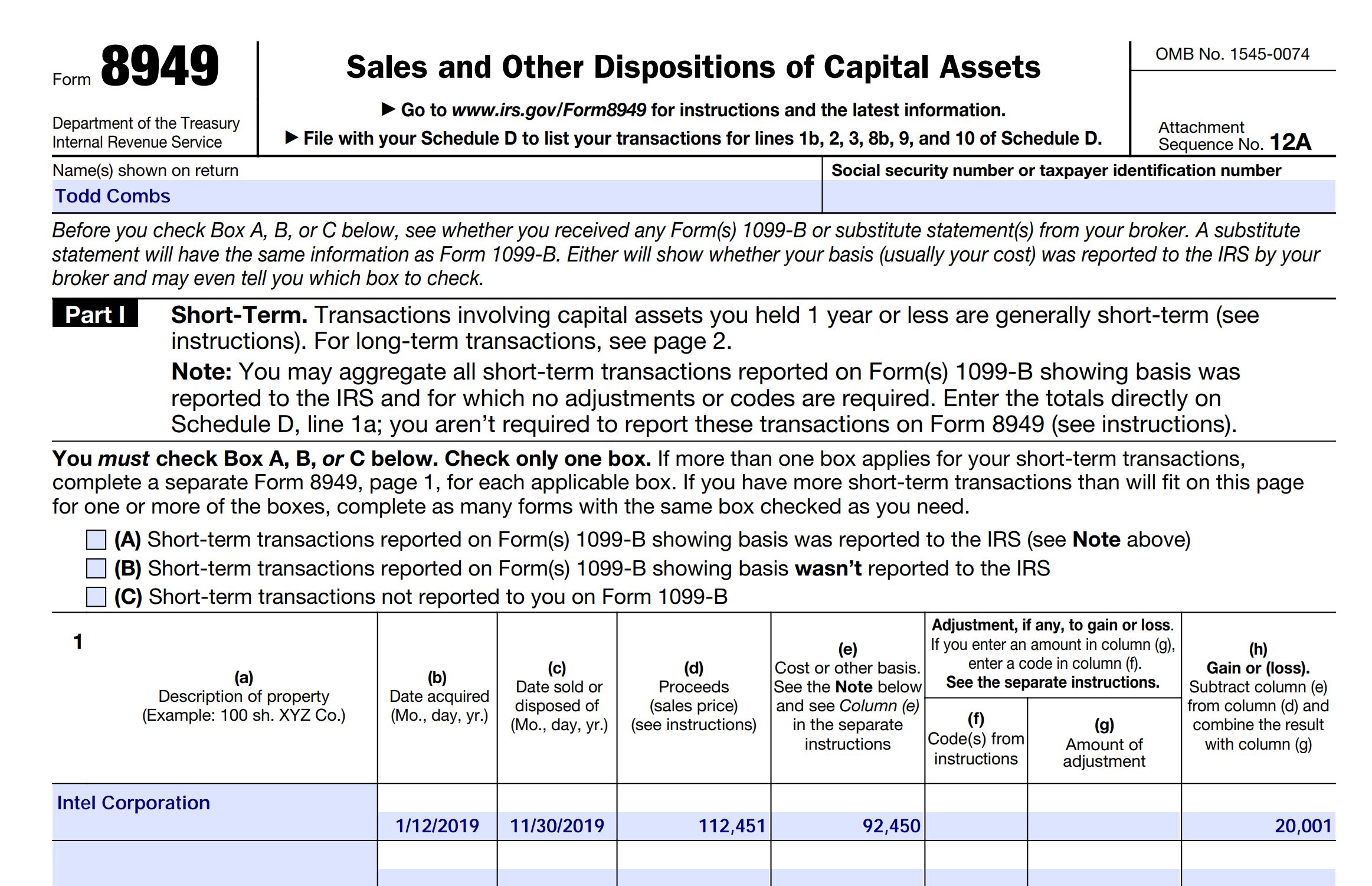
We just released the 2023 8949 IRS tax form.  IRS Form 8949 is a form that reports your short and long term gains/losses for any sold investments in the tax year.  If you had any investment sales in 2023, this form is a great way to easily calculate your losses/gains from this investment sale.

To generate Form 8949 click the Tools menu and choose the “Generate Form 8949” menuitem. On the “Generate Form 8949” page, click the Generate button. Your short-term and long-term gains/losses on any investment sales will then be calculated. Then a pdf format of IRS Form 8949 will be generated. This form has a short-term gains/losses section and long-term gains/losses section, which is what you need when filing your taxes.

Calculate your gains/losses on any stock sale with EquityStat and generate IRS Form 8949.
IRS Form 8949 Example

Once this pdf form is generated, you can then send this pdf file to your tax preparer or print a copy of it.

New Feature – Share Your Portfolio

Have you ever wanted to display what stocks you own on a webpage? Or maybe you want to show what stocks you recommend on an online investment forum?  What about sharing your stock portfolio on X, Facebook or email?

With our new Share Portfolio feature you can do all of this.  

To get started sharing your portfolio, click the Tools menu at the top and choose Share Portfolio from the drop down menu.

On the Share Portfolio page, choose the portfolio you want to share and click the Generate button. An image of your portfolio will then be generated. You can then link to this image on a website or social media post. You can also download the image and send the image in an email or also use the image file in a social media post.

For example, here is an image of a portfolio for Berkshire Hathaway’s top stocks.

If you link to an image, the image will display the most recent prices for the stocks in your portfolio. If you share the image file, the prices will be the current price when the image was generated.

You can also choose what columns to display in the image by clicking the Select Columns link and then choosing the columns you want to display.

Stock Market Eye Stock Portfolio Tracker Discontinued

If you haven’t heard, Stock Market Eye’s stock portfolio manager has been discontinued. If you were a previous user of Stock Market Eye’s stock portfolio manager and want an alternative, consider EquityStat’s portfolio manager.

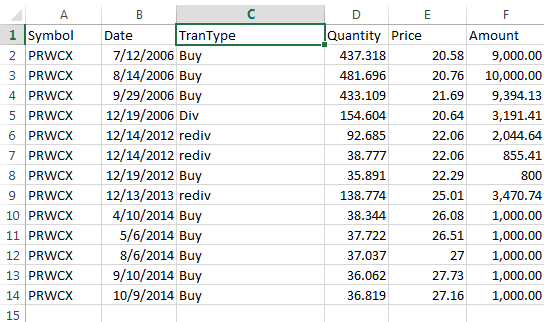
To transfer your data from Stock Market Eye to EquityStat, just export the data to an excel spreadsheet or csv file. Once you have exported your data, follow these directions to format your file and upload your data to EquityStat.

https://www.equitystat.com/wordpress/?p=93

If you need any help importing your transactions into EquityState, please contact us using our support page

You can also manually enter your transactions into EquityStat too.

In addition if there is any feature that you liked in Stock Market Eye’s stock portfolio manager that is missing in EquityStat, let us know. We will seriously consider adding this feature as well as any other feature you might find useful.  Our goal is to keep enhancing EquityStat to give our users the features and services they want!

If you have any questions, please contact us using our support page.  We will answer any questions or comments you have.

Tech Times Recognizes EquityStat as the Best Investment Portfolio Management Software

In its annual review of financial technology tools, Tech Times named EquityStat the Best Investment Portfolio Management Software. This recognition highlights EquityStat’s growing influence in the fintech space and its commitment to helping investors make smarter, data‑driven decisions. As more individuals seek reliable tools to track and optimize their investments, EquityStat continues to stand out as a trusted platform for both new and experienced investors.

A Modern Solution for Today’s Investors
The investment landscape has changed dramatically over the past decade. With market volatility, rapid economic shifts, and an increasing number of retail investors entering the market, the need for accurate, real‑time portfolio tracking has never been greater. EquityStat addresses these challenges by offering a streamlined, intuitive platform that gives investors the insights they need to stay ahead.

Tech Times highlighted several reasons why EquityStat earned the top ranking:

Clean, user‑friendly interface Whether you’re a beginner or a seasoned investor, EquityStat makes portfolio management simple and accessible.

Real‑time market and portfolio data Investors can monitor performance instantly, allowing them to react quickly to market changes.

Advanced performance analytics EquityStat provides detailed metrics, trend analysis, and historical comparisons that help users understand how their investments are performing over time.

Personalized portfolio insights The platform adapts to each user’s investment style, risk tolerance, and long‑term goals.

Designed for Investors at Every Level

One of the reasons EquityStat has gained such a strong following is its ability to serve a wide range of investors. Beginners appreciate the platform’s simplicity and educational value, while experienced investors rely on its precision and analytical depth.

EquityStat is especially valuable for:

  • Long‑term investors tracking retirement portfolios
  • Active traders monitoring daily performance
  • Tech‑sector investors who need fast, accurate data
  • Individuals managing multiple brokerage accounts
  • Anyone seeking a clearer picture of their financial progress

By consolidating data and providing actionable insights, EquityStat helps users make informed decisions that support long‑term financial growth.

Why Tech Times’ Recognition Matters

Tech Times is known for its in‑depth reviews of technology products and software solutions. Its annual rankings influence consumer decisions and highlight the tools that deliver real value. Being named the best investment portfolio management software places EquityStat among the most trusted and innovative platforms in the fintech industry.

This recognition also reinforces EquityStat’s mission: to empower everyday investors with the same level of insight and clarity that professional analysts rely on.

You can read the entire article here.

https://www.techtimes.com/articles/294138/20230724/top-5-best-investment-portfolio-management-software-2023.htm

New Feature in EquityStat’s Stock Portfolio Tracker

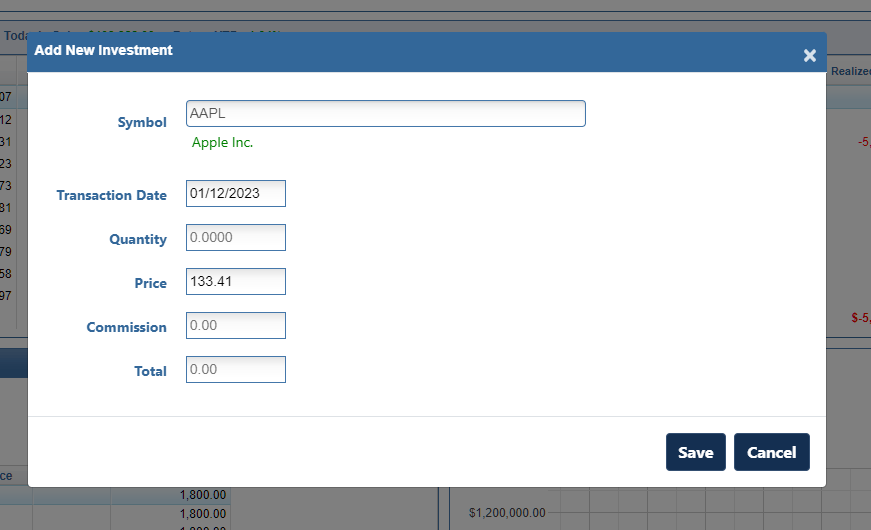
We have added a new feature to our Stock Portfolio Tracker application. When you enter a new stock/investment or add a new transaction for an existing stock/investment, the price of the investment is automatically displayed in the Price field. The price that is displayed is the closing or current price for the date of the transaction. If this price is not correct, you can override the price by entering the correct price.

This feature was designed in case you don’t know the exact price you purchased or sold a stock for, the price is automatically filled in for you and you don’t have to look it up. If you do know the exact price, you can override the filled in price with the correct price.

EquityStat Stock Portfolio Tracker New Feature - Auto Price
Example of Auto Price

For example, if your purchased Apple stock on January 12, 2023 the price of $134.56 will automatically be filled in since this was the closing price on January 12th. If you purchased Apple for a lower or higher price, you can edit the price to the correct price.

This feature also comes in handy when you want to see what price a stock was trading for a past date. Just select the stock, enter the date and you will see the price for that date.

2022 8949 IRS Tax Form Released

We just released the 2022 8949 IRS tax form.  IRS Form 8949 is a form that reports your short and long term gains/losses for any sold investments in the tax year.  If you had any investment sales in 2022, this form is a great way to easily calculate your losses/gains from this investment sale.

To generate Form 8949 click the Tools menu and choose the “Generate Form 8949” menuitem. On the “Generate Form 8949” page, click the Generate button. Your short-term and long-term gains/losses on any investment sales will then be calculated. Then a pdf format of IRS Form 8949 will be generated. This form has a short-term gains/losses section and long-term gains/losses section, which is what you need when filing your taxes.

Calculate your gains/losses on any stock sale with EquityStat and generate IRS Form 8949.
IRS Form 8949 Example

Once this pdf form is generated, you can then send this pdf file to your tax preparer or print a copy of it.

New Feature – Investment Symbol Search

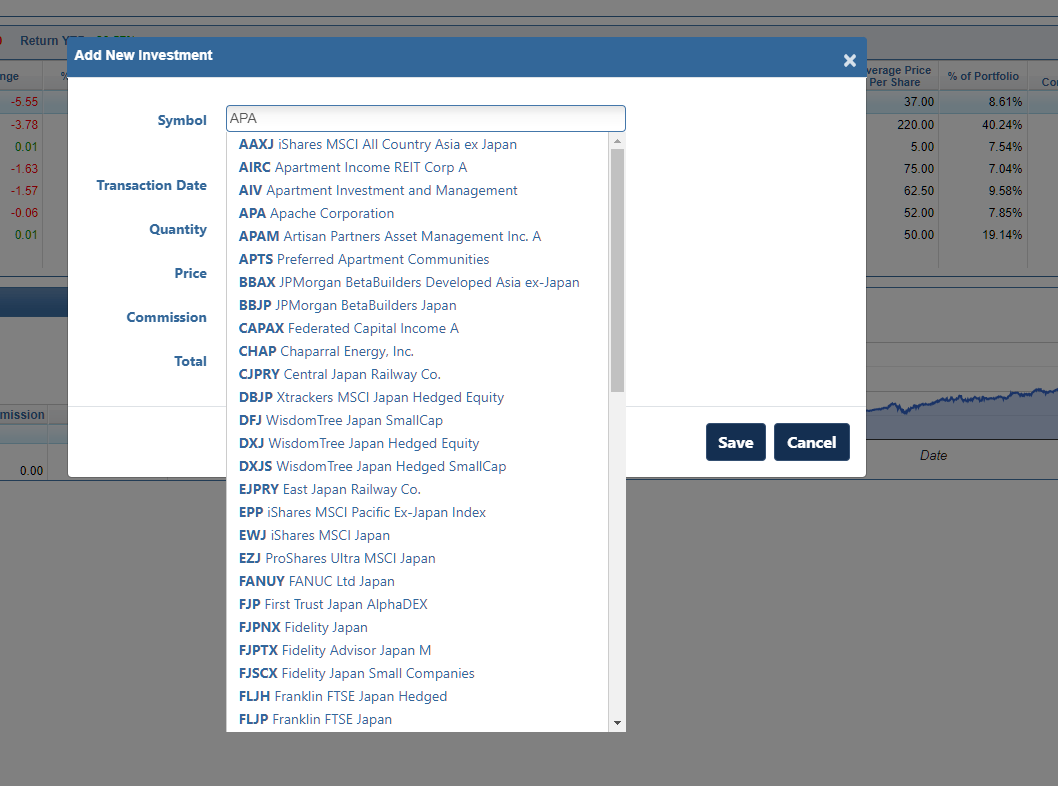
We have recently added a new feature. When adding a new investment to your portfolio, you can easily lookup the investment to add. In the past when you added an investment to your portfolio, you needed to know the investment symbol. Now, in the Symbol field you can start typing, which will display all symbols and investment names that matches the text as you type.

Lookup a symbol when adding a new investment to your EquityStat stock portfolio.
Example of the new symbol lookup when adding a new investment

For example, as seen in the screen shot above, if you start typing “APA” in the symbol field you will get a list of symbols and investments that match this text. This will make finding your investment symbol much easier.

To choose a symbol, select the line that has the investment you want to add to your portfolio.

If you don’t find your symbol listed, just type in the symbol and tab to the next field. The symbol will then be checked to make sure it is a valid symbol. If it is not a valid symbol for an investment, you will get an “Invalid Symbol” message.

EquityStat: The Best Alternative to Morningstar’s Legacy Portfolio Manager

Looking for a Replacement for Morningstar’s Legacy Portfolio Manager?

Morningstar has discontinued its legacy portfolio tracker, leaving many investors searching for a reliable, easy‑to‑use alternative. EquityStat is a powerful, intuitive stock portfolio tracker built by investors — and it’s one of the best replacements available today.

Why EquityStat Is the Ideal Morningstar Alternative

EquityStat offers a clean, simple interface and robust performance tracking tools designed for everyday investors and active traders.

Key Benefits

  • Track all your investment accounts in one place
  • View real‑time portfolio value and gain/loss
  • Analyze individual stocks, ETFs, and mutual funds
  • See today’s gain/loss, lifetime return, realized gains, and annualized return
  • Review every transaction for each investment
  • Import transactions manually or via spreadsheet
  • Create multiple portfolios for better organization
  • View performance graphs and analyze holdings

What You Can Track With EquityStat

EquityStat provides detailed analytics for each investment, including:

  • Daily gain/loss
  • Percentage return since purchase
  • Realized gains
  • Annualized return
  • Transaction history
  • Portfolio‑level and account‑level performance

Portfolio Analysis Tools

EquityStat includes a powerful Portfolio Analysis page that helps you:

  • Compare performance across multiple portfolios
  • Identify top‑ and bottom‑performing investments
  • View performance charts over time
  • Analyze holdings and allocation

This is especially useful for investors managing multiple accounts or diversified portfolios.

Analyze your stock portfolio
Example of EquityStat’s Portfolio Analyze Page

Importing Your Morningstar Legacy Portfolio

If you previously used Morningstar’s legacy portfolio manager, EquityStat makes it simple to transition.

  • Import your transactions manually
  • Or upload them using a spreadsheet
  • Need help? Contact EquityStat support for assistance

You’ll be up and running quickly with your full investment history intact.

Why Investors Choose EquityStat

  • Built by investors, for investors
  • Simple, intuitive interface
  • Accurate performance calculations
  • Fast, reliable, and easy to use
  • Ideal for stock, ETF, and mutual fund tracking
  • A strong alternative to Morningstar’s discontinued tool

If you’re disappointed to see Morningstar’s legacy portfolio manager go, EquityStat is the perfect replacement.

If you need help importing your Morningstar Legacy portfolio manager into EquityStat, contact our support staff here.

Tesla Stock Split in EquityStat

Tesla’s (TSLA) stock split on August 25, 2022. It is a 3 for 1 stock split. So, for each share you own before the split, you get 2 shares.

If you owned Tesla (TSLA) stock before the split and you are tracking this stock in your EquityStat portfolio, how do you record the split?

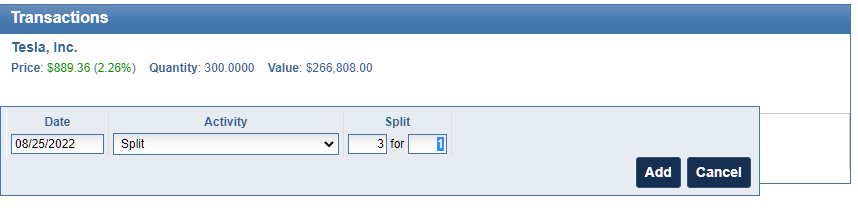
First, select the Tesla stock in your investment panel. Next, in the transaction panel, click the Add button to add a new transaction. In the Activity drop down, choose a “Split” transaction. Enter how many shares were split, in this case it is a 3 for 1 split, and click the Add button to save the transaction.

EquityStat split Tesla stock
Tesla Split Transaction

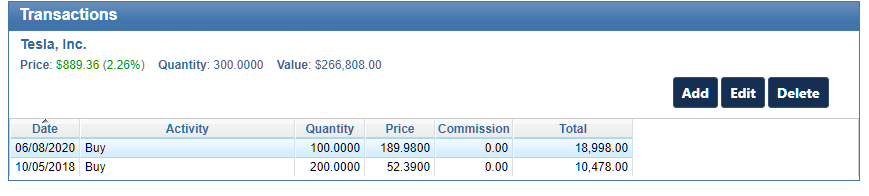
When the split transaction is saved, each transaction will be adjusted to reflect this split. The number of shares will be increased three times and the price will be divided by three.

For example, if you had the following transactions before the split.

Tesla transactions before the split in EquityStat stock portfolio tracker.
Tesla transactions before the split.

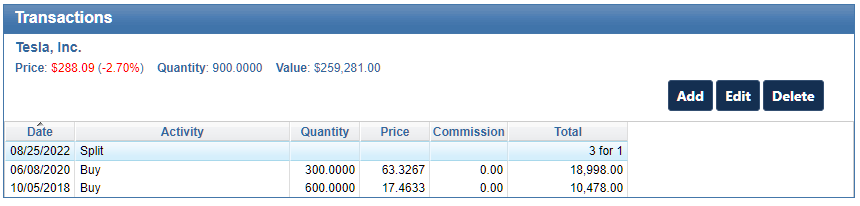
After the split your transactions will look like this.

Tesla transactions after the split in EquityStat stock portfolio tracker.
Tesla transactions after the split

Notice that before the split there were two buy transactions. After the split, the number of shares has increased 3 times and the price has been reduced by a factor of three. For example, the initial buy on 10/25/2018 was for a quantity of 200 shares. After the split, the purchased quantity is 600 shares. The price the shares were bought on 10/25/2018 was $52.39. After the split, the price paid was $17.46. These adjustments are all automatically done when you enter the split transaction.

If you have other stocks that have split, you can use the same steps to record your split. Just make sure that you enter the correct split information.

EquityStat User Interface Changes

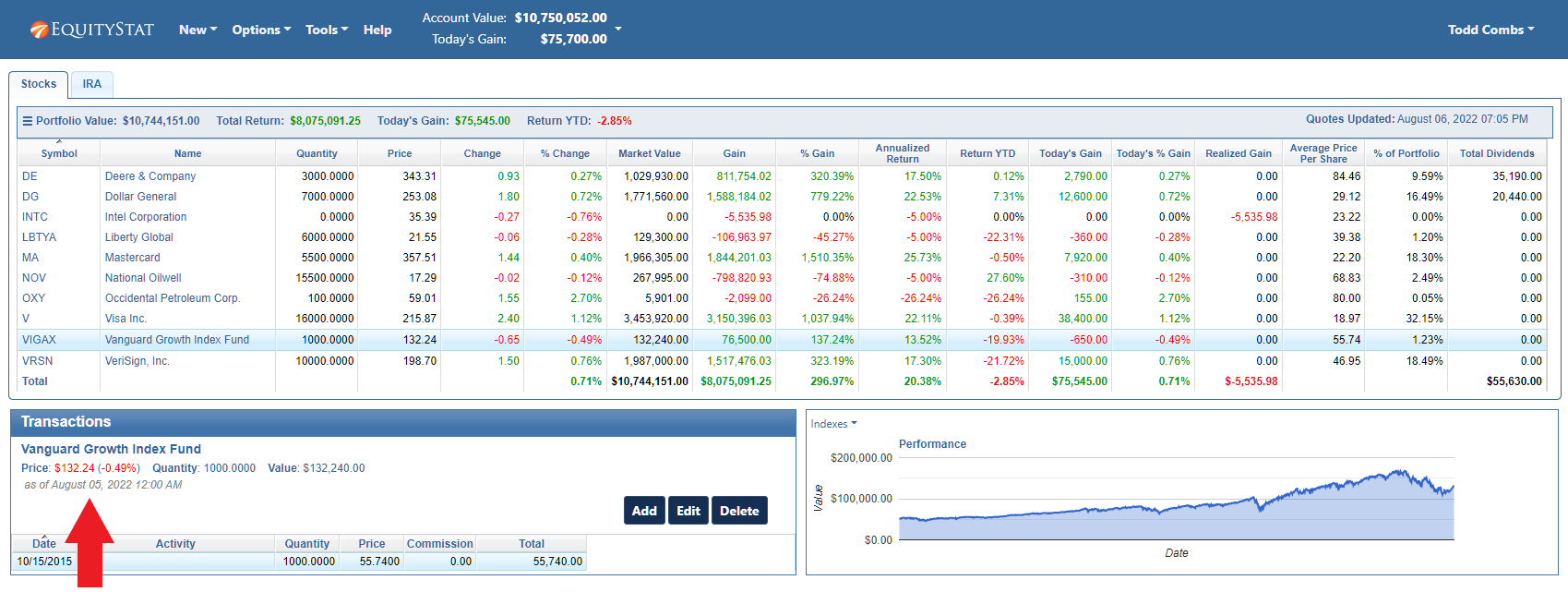
In the transaction panel, we now display the date the mutual fund price was last updated. Mutual fund prices are updated after market close. When viewing the price, you don’t know if the price is from the previous day or it is the current price. So, for mutual funds we have added the date the price was updated. This way you can know if the price is the current price or the price from the previous day.

EquityStat Mutual Fund Price Date

We have also added the percent change for the price for all investments and display the price in green if the price is up and red if the price is down.

Also, you can click on the name of the investment to view additional information about the investment on MSN Money.

Google Stock Split in EquityStat

Google’s (GOOG/GOOGL) stock is scheduled to split on July 15, 2022. It is a 20 for 1 stock split. So, for each share you own before the split, you get 20 shares.

If you owned Google (GOOG/GOOGL) stock before the split and you are tracking this stock in your EquityStat portfolio, how do you record the split?

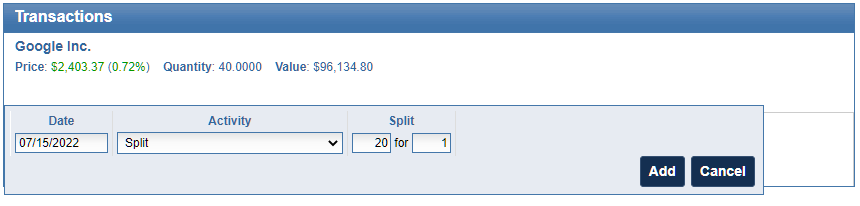
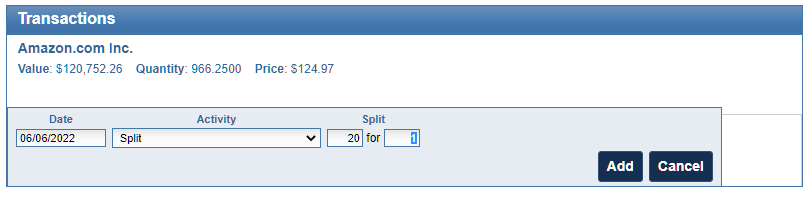
First, select the Google stock in your investment panel. Next, in the transaction panel, click the Add button to add a new transaction. In the Activity drop down, choose a “Split” transaction. Enter how many shares were split, in this case it is a 20 for 1 split, and click the Add button to save the transaction.

Add a split transaction in EquityStat's investment portfolio tracker.
Adding a split transaction in your EquityStat stock portfolio tracker

When the split transaction is saved, each transaction will be adjusted to reflect this split. The number of shares will be increased twenty times and the price will be divided by twenty.

For example, if you had the following transactions before the split.

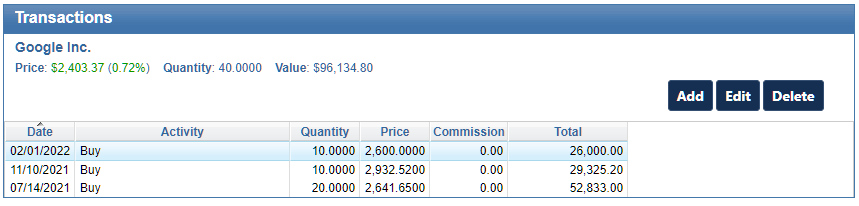
EquityStat transactions for Google (GOOG) before the 20 for 1 split
Google transactions before the split

After the split your transactions will look like this.

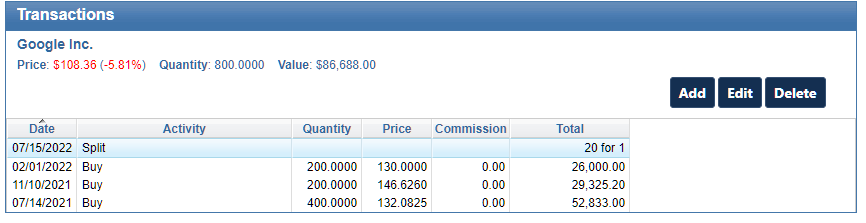
EquityStat transactions for Google (GOOG) after the 20 for 1 split
Google transactions after the split

Notice that before the split there were three buy transactions. After the split, the number of shares has increased 20 times and the price has been reduced by a factor of twenty. For example, the initial buy on 7/14/2021 was for a quantity of 20 shares. After the split, the purchased quantity is 400 shares. The price the shares were bought on 7/14/2021 was $2641.65. After the split, the price paid was $132.08. These adjustments are all automatically done when you enter the split transaction.

If you have other stocks that have split, you can use the same steps to record your split. Just make sure that you enter the correct split information.

Refresh User Interface For Mobile Phones

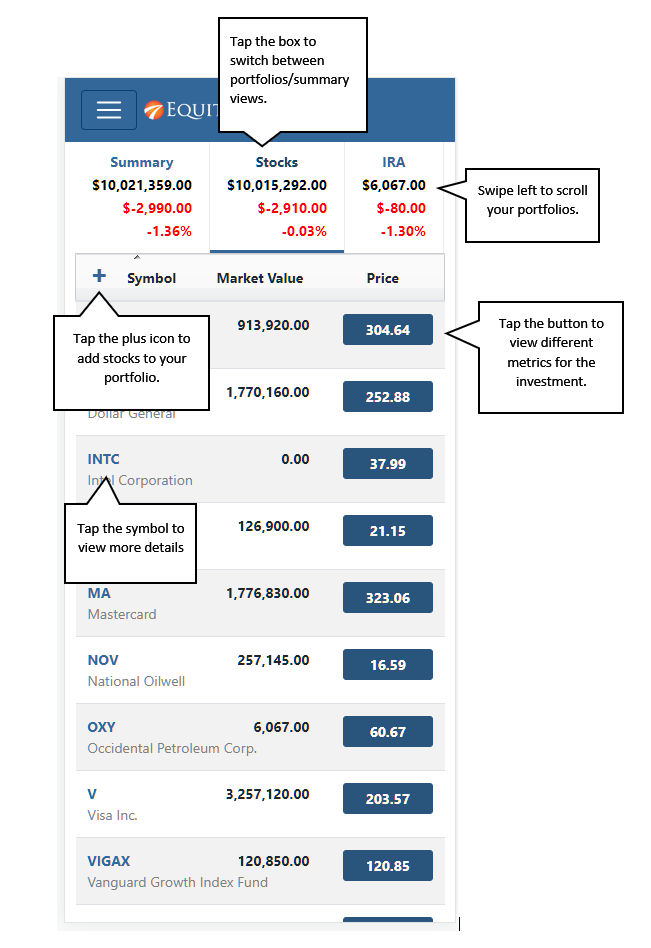
We have recently refreshed the user interface of your EquityStat portfolio on mobile devices. The user interface now looks, feels and works like a mobile app. If you have ever used the Weather Channel App or the ESPN App on your mobile phone, EquityStat works very similar.

To view your EquityStat account on a mobile phone, open up the phone’s web browser, go to www.equitystat.com and login to your account.

EquityStat stock portfolio tracker on a mobile phone.
Example EquityStat Account on a Mobile Phone.

You will then see a list of all your portfolios at the top. You can swipe left at the top to scroll through all of your portfolios. Tap a “portfolio box” to see the investments in each portfolio.

To see details about a specific investment, tap the symbol for the investment. To view metrics about a specific investment tap the price button. Continue tapping the button to cycle through all of the investment metrics.

To add a new investment to your portfolio, tap the plus icon.

Splitting a Stock in EquityStat

Amazon’s (AMZN) stock recently split. It was a 20 for 1 stock split. So, for each share you owned before the split, you got 20 shares.

If you owned Amazon (AMZN) stock before the split and you are tracking this stock in your EquityStat portfolio, how do you record the split?

First, select the Amazon stock in your investment panel. Next, in the transaction panel, click the Add button to add a new transaction. In the Activity drop down, choose a “Split” transaction. Enter how many shares were split, in this case it is a 20 for 1 split, and click the Add button to save the transaction.

Add a split transaction in EquityStat's investment portfolio tracker.
Adding a split transaction in your EquityStat portfolio

When the split transaction is saved, each transaction will be adjusted to reflect this split. The number of shares will be increased twenty times and the price will be divided by twenty.

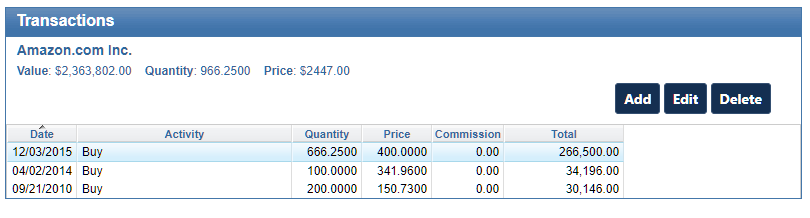
For example, if you had the following transactions before the split.

EquityStat transactions for Amazon (AMZN) before the 20 for 1 split
Amazon transactions before the split

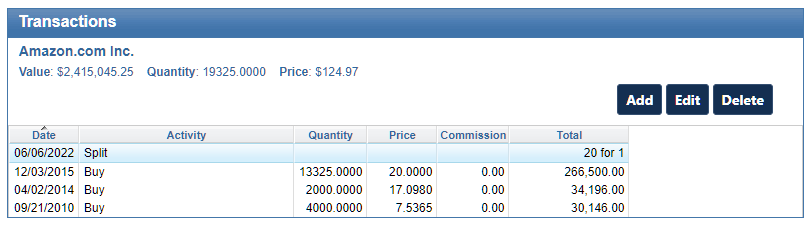
After the split your transactions will look like this.

EquityStat transactions for Amazon (AMZN) after the 20 for 1 split
Amazon transactions after the split

Notice that before the split there were three buy transactions. After the split, the number of shares has increased 20 times and the price has been reduced by a factor of twenty. For example, the initial buy on 4/02/2014 was for a quantity of 100 shares. After the split, the purchased quantity is 2000 shares. The price the shares were bought on 4/02/2014 was $341.96. After the split, the price paid was $17.098. These adjustments are all automatically done when you enter the split transaction.

If you have other stocks that have split, you can use the same steps to record your split. Just make sure that you enter the correct split information.

Feature Highlight – Compare Your Investment Performance to the Dow Jones, the Nasdaq or the S&P 500 Index

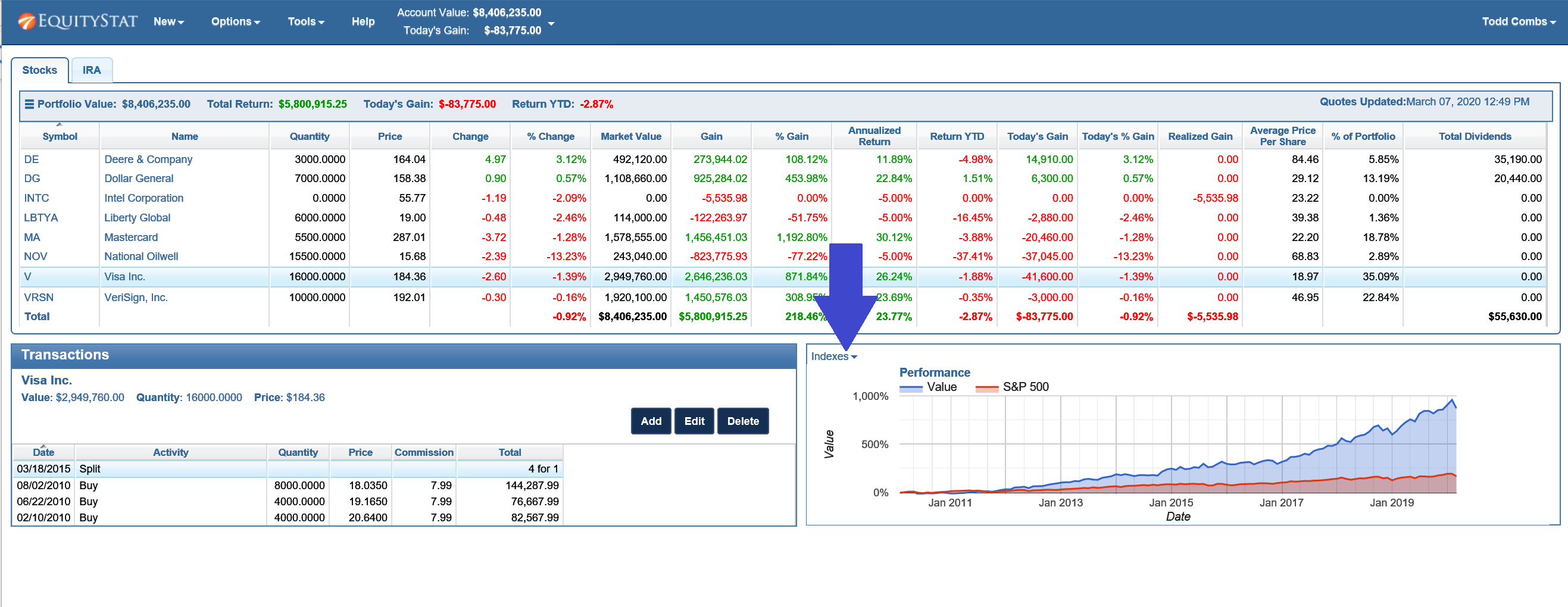
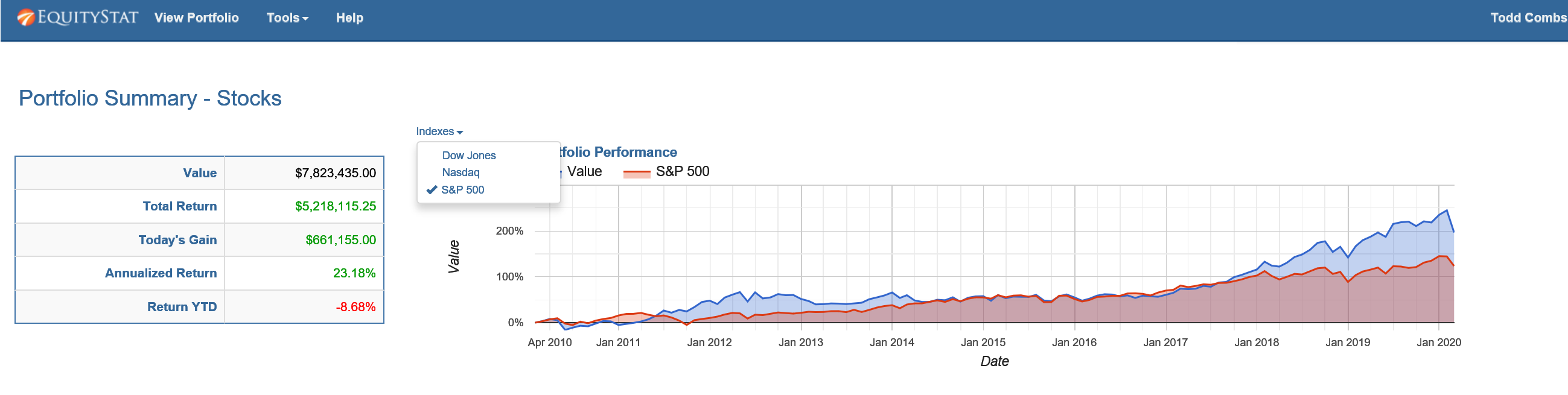
If you want to see how your investment performance is doing compared to an index, you can easily add an index to your investment’s performance graph.

To do this, select the index you want to compare, by clicking on the Indexes drop down menu link in the upper left hand corner of the performance graph.

Compare Stock Performance to Indexes
Compare Investment Performance to Indexes

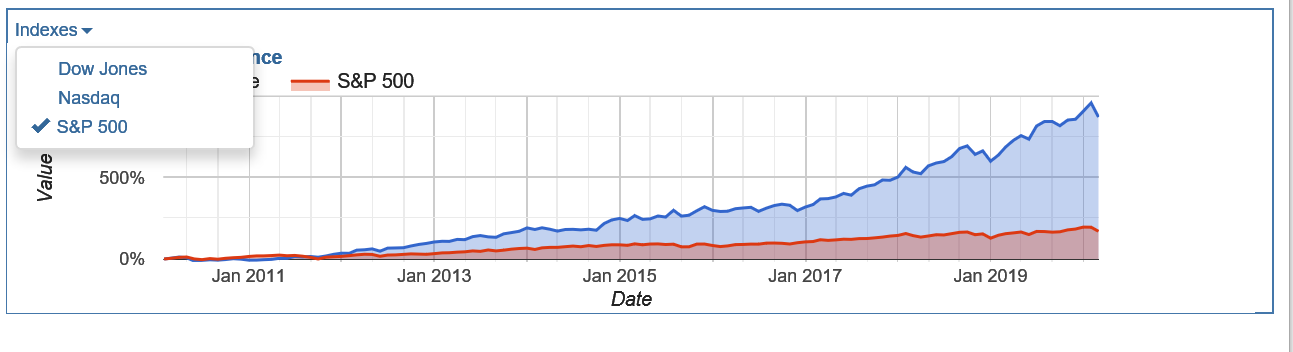
When you click on the Indexes drop down menu link, you can choose from a list of indexes.

Choose to compare your stock's performance to the Dow Jones index, the Nasdaq index or the S&P 500 index
Choose to compare your stock’s performance to the Dow Jones index, the Nasdaq index or the S&P 500 index

Choose the Dow Jones index, the Nasdaq index or the S&P 500 index. You can choose one index or multiple indexes. When you choose an index, you will see a checkbox next to the index.

Once an index is chosen, you will see the index in your performance graph and how it compares to your investment’s performance.

To remove an index, click on the Indexes drop down link and select the index again. This will remove the checkbox from the index menu item and remove the index from your performance graph.

You can also compare your account/portfolio performance to an index. To do this, go to the Portfolio Analysis page by choosing the Tools menu at the top and selecting Analyze Portfolio from the drop down menu. From the Portfolio Analysis page, click the Indexes link above the performance graph and choose the index or indexes you want to compare.

Choose to compare your account/portfolio performance to the Dow Jones index, the Nasdaq index or the S&P 500 index

Best Stock of 2017

The best S&P 500 stock of 2017 was Align Technology.  It was up 135.6%.

You can see the list of best stocks here:

https://www.benzinga.com/general/education/17/12/10968828/10-best-stocks-of-2017

How did your investments do in 2017?  What was your best stock?  If you are not tracking your investment’s performance, consider using EquityStat.  With EquityStat you can track the overall performance of your portfolio/account as well as the performance of each individual investment.  EquityStat tracks the annualized return, year to date return, daily gain, overall gain and many other metrics of your investments.  With these metrics you can easily determine what are your best investments.

Many online brokerages and mutual funds track an individual stock or mutual fund’s performance but you cannot get the overall return of all your stocks or mutual funds.  With EquityStat not only can you get the return each investment, you can also get the return for your entire account.  This way you know how well your investments are performing at any time.


How to import your Google Finance Portfolio into EquityStat

As you know, Google Finance is discontinuing their portfolio manager.  If you are looking for an alternative you can easily import your Google portfolio into EquityStat.  Just follow these easy steps.
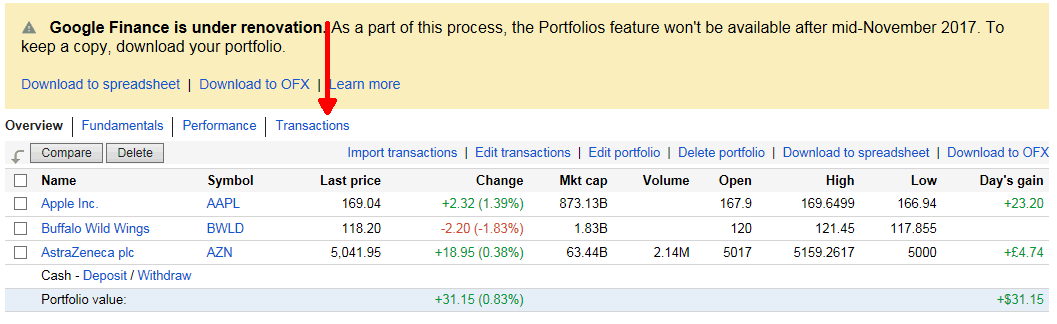
Step #1

Login to your Google Finance portfolio and click the Transactions link.

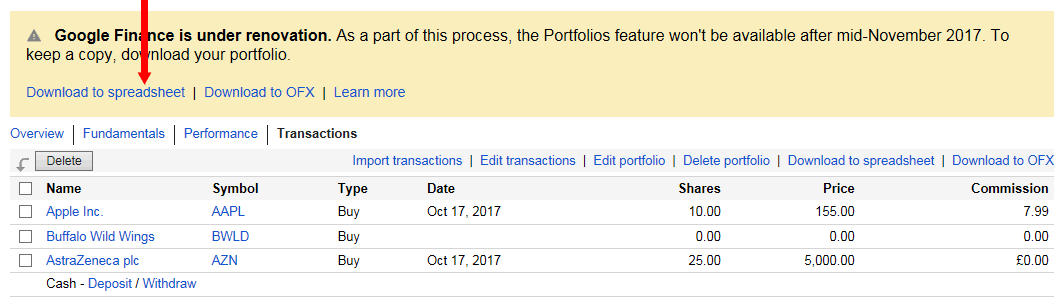
Step #2

On the Google Finance transactions page, click the Download to Spreadsheet link and save the downloaded file to your hard drive.

Step #3

Login to your EquityStat account and click the New menu at the top and choose Import Transactions from the drop down menu.

Step #4

On the import page, click the Browse button to locate the file saved in Step #2.  Next, click the Import button to import the file.  You will then see a summary of the transactions to be imported.  Correct any errors and verify what the import will do.  Click the Import Data button to import the Google Finance portfolio transactions into EquityStat.

Google Finance Portfolios Are Going Away — Here’s the Best Alternative

Google Finance Is Discontinuing Its Portfolio Manager

Google has officially discontinued the Google Finance stock portfolio manager, leaving many investors searching for a reliable replacement. If you relied on Google Finance to track your stocks, ETFs, or mutual funds, EquityStat offers a powerful, easy‑to‑use alternative with many of the same features — and more.

Why EquityStat Is a Strong Replacement for Google Finance Portfolios

EquityStat provides a clean, intuitive interface designed for investors who want accurate performance tracking without complexity.

Key Features Comparable to Google Finance

  • View the total value of your portfolio
  • Track daily gain/loss
  • See percentage gain since purchase
  • Review realized gains
  • View annualized return for each investment
  • Track stocks, ETFs, and mutual funds
  • Access complete transaction history for each holding

EquityStat gives you the same visibility you had in Google Finance — plus deeper analytics.

Importing Your Google Finance Portfolio Into EquityStat

Transitioning from Google Finance is simple.

You can import your portfolio by:

  • Manually entering transactions, or
  • Uploading a spreadsheet with your historical data

If you need help, EquityStat’s support team can guide you through the process.

More Tools to Manage and Analyze Your Portfolio

EquityStat includes additional features that go beyond what Google Finance offered:

  • Create multiple portfolios
  • View performance graphs over time
  • Analyze portfolio holdings and allocation
  • Edit or delete transactions at any time
  • Track performance across all your investments in one place

These tools help you understand your portfolio’s performance with greater accuracy and detail.

Why Investors Choose EquityStat To Replace Google Finance

  • Simple, fast, and user‑friendly
  • Accurate performance calculations
  • Ideal for long‑term investors and active traders
  • Built specifically for stock, ETF, and mutual fund tracking
  • A dependable replacement for Google Finance’s discontinued portfolio manager

If you miss the old Google Finance portfolio tool, EquityStat is one of the best alternatives available today.

Print Your Stock Portfolio

How to Print Your Portfolio

To begin, open your EquityStat account and navigate to the Tools menu located at the top of the screen. From the dropdown list, select Print Portfolio. This will take you to a dedicated printing page designed specifically for generating portfolio reports.

Choose What You Want to Print

On the print page, you’ll see options that let you decide exactly which portfolio—or portfolios—you want to include.

  • You can print a single portfolio if you only need information for one set of investments.
  • Or, if you manage several portfolios, you can choose to print all of them at once, making it easy to create a complete snapshot of your entire investment landscape.

This flexibility is especially helpful for users who track different strategies, accounts, or goals and want a consolidated view.

Generate a PDF

Example of the EquityStat portfolio printing page used to create PDF or printed reports.
Print Portfolio Example

Once you’ve selected your portfolio(s), click the Print button. EquityStat will automatically generate a PDF file containing your portfolio details. From there, you can:

  • Print the PDF directly to your home or office printer
  • Save the file to your computer for record‑keeping
  • Email or share the PDF with advisors, accountants, or anyone else who needs access

The PDF format ensures your portfolio is neatly formatted, easy to read, and consistent every time you print it.

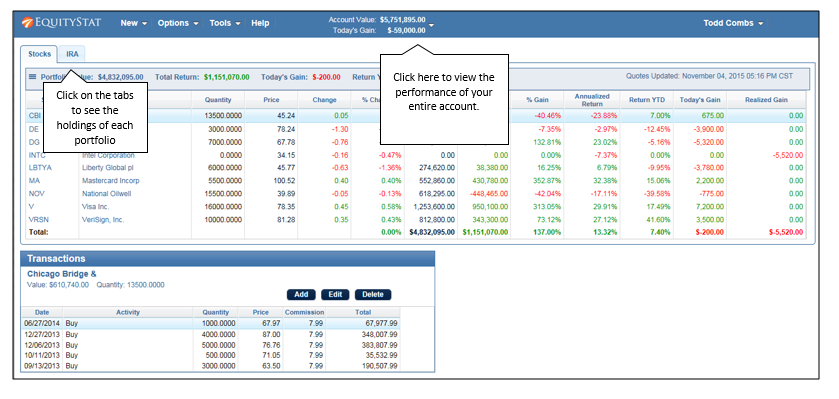
Enhancing EquityStat to Better Support Modern Investors

The addition of this print feature is just one example of how we continue to evolve EquityStat to meet the needs of modern investors. Many users rely on printed reports for meetings, tax preparation, long‑term planning, or simply for peace of mind. By offering a fast, reliable way to generate PDFs or hard copies of your portfolios, we aim to make your investment management experience smoother, more flexible, and better aligned with the way you prefer to work.


EquityStat – An Alternative to Yahoo Finance Stock Portfolio

We are hearing from a lot of frustrated Yahoo Finance Portfolio users. The latest changes to “improve” the portfolio manager have actually made the product worse. If you are looking for an alternative to Yahoo Finance stock portfolio, we encourage you to take a look at EquityStat’s portfolio manager.
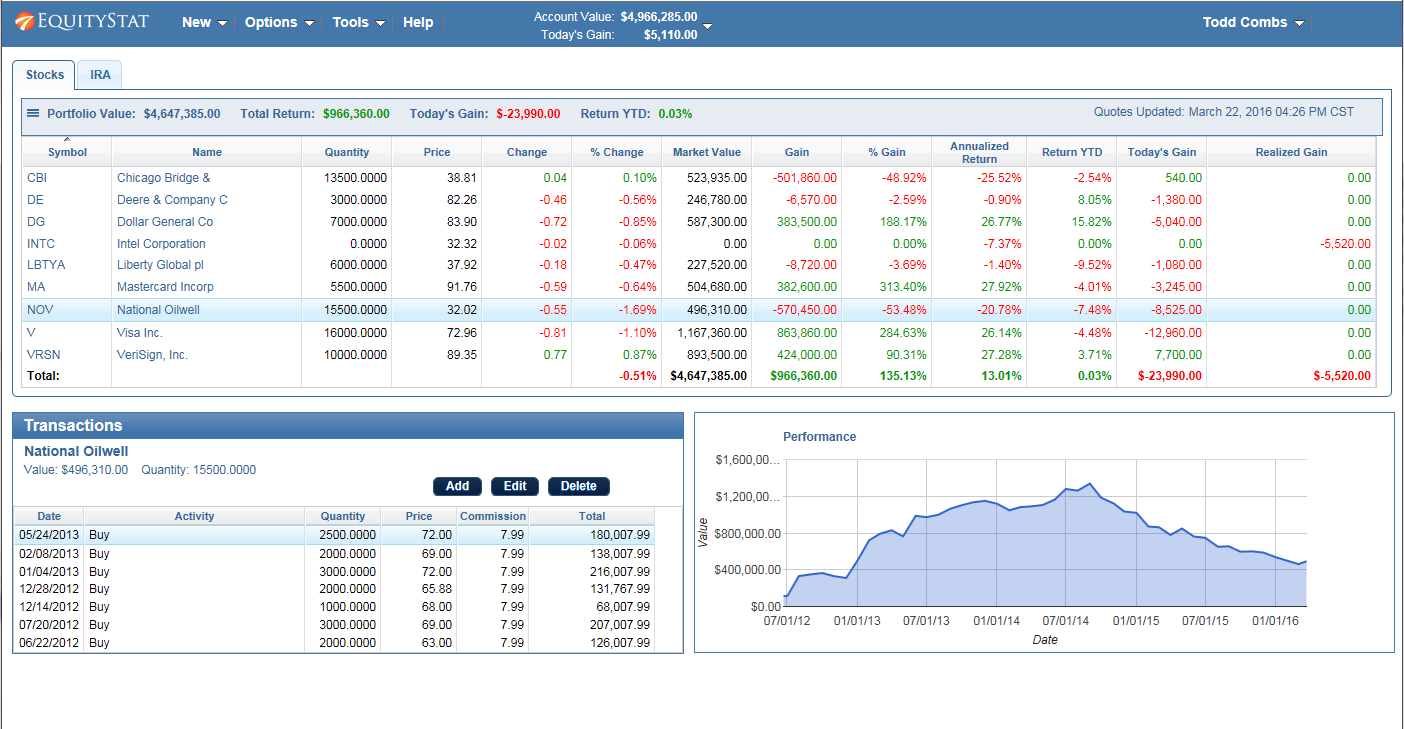
EquityStat was founded by investors. As investors we understand what other investors are looking for in a portfolio manager. For example, one of our goals was to make EquityStat’s Portfolio manager show as much information on your screen without you having to constantly scroll around to see your data. Unlike Yahoo, EquityStat does not show ads, so this gives us more room to show more information about your investments and how they are performing.
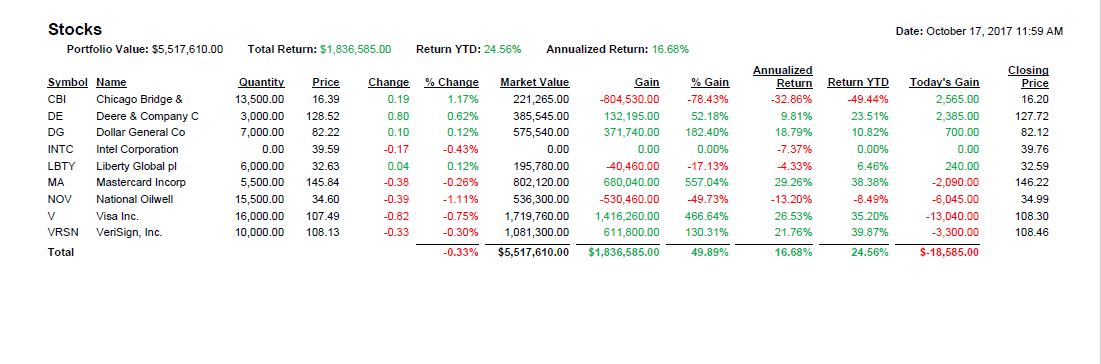
EquityStat Financial Stock Portfolio
Stock Portfolio Example

You can learn more about the similarities and differences between Yahoo Finance’s portfolio manager  and EquityStat’s portfolio manager here.

In addition if there is any feature that you liked in Yahoo Finance’s portfolio manager that is missing in EquityStat, let us know. We will seriously consider adding this feature as well as any other feature you might find useful. Our goal is to keep enhancing EquityStat to give our users the features and services they want!

View Your Portfolio On Your Mobile Device

We have recently added the ability to view your portfolio on your mobile device. To view your portfolio on your mobile phone, launch your phone’s web browser and go to www.equitystat.com. Next, login to your EquityStat account. You will then see a scaled version of your portfolio designed to display on your mobile device.

Watch the following video to learn more about the features of the mobile portfolio manager.

Yahoo Finance Portfolio Manager Changes — Best Alternatives and How EquityStat Compares

Yahoo Finance Has Changed Its Portfolio Manager

Yahoo Finance recently updated its investment portfolio manager, and many long‑time users are finding the new version harder to use or missing key features. If you relied on Yahoo Finance to track your stocks, ETFs, or mutual funds, EquityStat offers a powerful, easy‑to‑use alternative with more flexibility and better performance tracking.

Why Many Investors Are Looking for a Yahoo Finance Alternative

Yahoo Finance’s portfolio manager was once one of the most popular online tools for tracking investments. But recent changes have removed features, altered layouts, and made the interface less intuitive for many users.

If you’re searching for a replacement that feels familiar but offers more control, EquityStat is designed for exactly that.

EquityStat: A Modern, Feature‑Rich Alternative to Yahoo Finance Portfolios

EquityStat includes many of the same features Yahoo Finance users expect — plus several advanced tools Yahoo does not offer.

Core Features Similar to Yahoo Finance

  • Track stocks, ETFs, and mutual funds
  • View current portfolio value
  • Monitor daily gain/loss
  • See percentage gain since purchase
  • Review realized gains
  • Access full transaction history

These features make the transition from Yahoo Finance smooth and familiar.

Features EquityStat Offers That Yahoo Finance Does Not

EquityStat includes several powerful tools that go beyond Yahoo’s capabilities:

1. Clear, At‑a‑Glance Portfolio Performance

At the top of your dashboard, you immediately see:

  • Total portfolio value
  • Total return
  • Today’s gain/loss

No extra clicks. No digging through menus.

2. Create Multiple Portfolios

Organize your investments into separate portfolios such as:

  • Personal brokerage
  • 401(k) or IRA
  • Joint accounts
  • Taxable vs. tax‑advantaged accounts

Track each portfolio individually or view your entire account’s performance.

3. Less Scrolling, More Data

EquityStat automatically adjusts to your screen size, making it easier to view all your data without endless scrolling — something Yahoo’s layout struggles with.

4. Detailed Performance Calculations

For each investment, portfolio, and your overall account, you can view:

  • Current market value
  • Total gain
  • Today’s gain
  • Annualized return
  • Cost basis
  • And more

These metrics help you understand exactly how your investments are performing.

5. Full Transaction Management

For each investment, you can easily:

  • View all transactions
  • Add new transactions
  • Edit existing entries
  • Delete incorrect entries

Everything is grouped neatly for fast access.

6. Hide or Show Sold Investments

Toggle between:

  • A clean view of current holdings, or
  • A full historical view including sold positions

Perfect for tax planning and performance review.

7. Customize Your Portfolio Columns

Add or remove data columns such as:

  • 52‑week high
  • 52‑week low
  • Dividend yield
  • Market cap
  • Sector

Build the exact view you want — something Yahoo Finance does not allow.

8. Import Your Data Easily

Upload your transactions using:

  • A spreadsheet
  • A CSV file

No need to re‑enter years of history manually.

9. Generate IRS Tax Forms

If you sold investments, EquityStat can generate IRS Form 8949, which tax preparers use to calculate capital gains. Yahoo Finance does not offer this.

10. Export Your Data for Safekeeping

Download your transactions to a spreadsheet for backup or offline analysis.

11. 24/7 Support

Have a question? EquityStat’s support team is available 24 hours a day, 7 days a week.

12. Works on Any Device

Because EquityStat is built with modern web technology, you can access your portfolio on:

  • Desktop
  • Laptop
  • Tablet
  • Mobile phone

No plugins. No compatibility issues.

EquityStat and Taxes

It’s that dreaded time of year – tax time. EquityStat’s portfolio manager has several tools to help investors with their taxes.

If you sold any shares last year, you can use EquityStat to generate IRS Form 8949.  IRS Form 8949 is a form that shows your short-term  and long-term capital gains on any investment sale.  EquityStat will automatically calculate these capital gains.  It will then generate a PDF of Form 8949 with all needed information that the IRS requires.  You can then give this form to your tax preparer when you are preparing your taxes.  To generate IRS Form 8949, click the Tools menu and then choose the Generate Form 8949 menuitem.

Use EquityStat To Print IRS Form 8949
IRS Form 8949 Example

Another tool to help you with your taxes is the ability to export your investment’s transactions to a spreadsheet. To export your transactions, click the Tools menu and then choose the Export Transactions menuitem. When you export your transactions, you will get a spreadsheet showing each transaction for the investment including the type of transaction it is (e.g. Buy, Sell, Dividend, etc). With this information, your tax preparer can calculate your taxable capital-gains and taxable dividends for all of your investments.

2016 8949 IRS Tax Form Released

We just released the 2016 8949 IRS tax forms.  IRS Form 8949 is a form that reports your short and long term gains for any sold investments in the tax year.  You can give Form 8949 to your tax preparer which assists in preparing Schedule D on your tax return.  To generate Form 8949 click the Tools menu and choose the “Generate Form 8949” menuitem.

Print IRS Form 8949 with EquityStat's Investment Portfolio Manager
IRS Form 8949

EquityStat Receives Nomination for Benzinga Fintech Award

EquityStat is proud to announce that it has been nominated for a technology award in the annual Benzinga Fintech Awards, a nationally recognized program that highlights the most innovative companies shaping the future of financial technology. This nomination reflects EquityStat’s commitment to delivering a clear, unified, and accessible portfolio‑tracking experience for investors.

About Benzinga

Benzinga is one of the leading financial media and data companies in the United States. Known for its fast, actionable market news and deep coverage of fintech innovation, Benzinga reaches millions of investors, traders, and financial professionals every month. The platform is widely respected for identifying emerging technologies and spotlighting companies that are transforming how people interact with financial markets.

About the Benzinga Fintech Awards

The Benzinga Fintech Awards recognize companies that are redefining the financial services industry through technology, accessibility, and user‑focused design. The awards highlight platforms that:

  • Improve the investing experience
  • Increase financial transparency
  • Simplify complex financial tasks
  • Empower everyday investors
  • Advance innovation in fintech

A nomination places a company among the most forward‑thinking and impactful fintech innovators in the market.

Why EquityStat Was Nominated

EquityStat was nominated for its ability to solve one of the most persistent challenges facing modern investors: fragmented investment data spread across multiple accounts and institutions. The platform provides a unified, real‑time portfolio‑tracking solution that allows users to view all their holdings in one place.

Key capabilities highlighted in the nomination include:

  • A single dashboard for all investment accounts
  • Real‑time stock, ETF, and mutual fund quotes
  • Automatic portfolio valuation
  • Performance tracking for each individual investment
  • Historical charts and long‑term performance trends
  • A clean, intuitive interface accessible from any device

This nomination underscores EquityStat’s mission to make investment tracking simple, accurate, and accessible for all investors.

Click here to read the full article.


Worst Stock of 2016

According to the Wall Street Journal the worst S&P 500 stock of 2016 was Endo International.  It was down 73%.

You can see the list of worst stocks here:

http://blogs.wsj.com/briefly/2016/12/30/5-worst-performers-in-the-sp-500-in-2016/

How did your investments do in 2016?  What was your worst stock?  If you are not tracking your investment’s performance, consider using EquityStat.  With EquityStat you can track the overall performance of your portfolio/account as well as the performance of each individual investment.  EquityStat tracks the annualized return, year to date return, daily gain, overall gain and many other metrics of your investments.  With these metrics you can easily determine what are your best investments.

Many online brokerages and mutual funds track an individual stock or mutual fund’s performance but you cannot get the overall return of all your stocks or mutual funds.  With EquityStat not only can you get the return each investment, you can also get the return for your entire account.  This way you know how well your investments are performing at any time.

Best Stock of 2016

According to the Wall Street Journal the best S&P 500 stock of 2016 was Nvdia.  It was up 224%.

You can see the list of best stocks here:

http://blogs.wsj.com/briefly/2016/12/30/5-best-performers-in-the-sp-500-in-2016/

How did your investments do in 2016?  What was your best stock?  If you are not tracking your investment’s performance, consider using EquityStat.  With EquityStat you can track the overall performance of your portfolio/account as well as the performance of each individual investment.  EquityStat tracks the annualized return, year to date return, daily gain, overall gain and many other metrics of your investments.  With these metrics you can easily determine what are your best investments.

Many online brokerages and mutual funds track an individual stock or mutual fund’s performance but you cannot get the overall return of all your stocks or mutual funds.  With EquityStat not only can you get the return each investment, you can also get the return for your entire account.  This way you know how well your investments are performing at any time.


New Feature – Cash Transactions

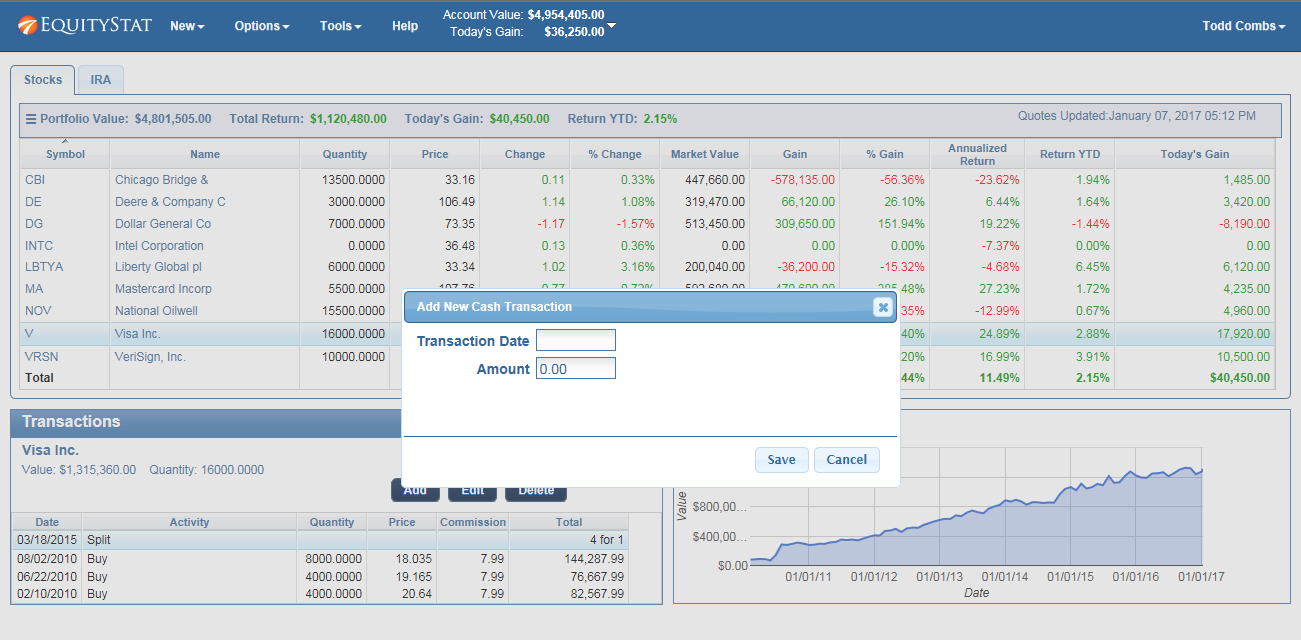
We have recently added a new feature.   You can now add cash transactions to your portfolio.  To add a cash transaction, click the New menu and then choose the “New Cash Transaction” menuitem from the drop down menu.  In the popup dialog, add the date of the cash transaction and the amount of the transaction.

Add Cash to Your EquityStat Portfolio
Add Cash To Your Investment Portfolio

Once you have added a cash transaction, any non-reinvested dividends added to your other investments will be added to your cash.

How did your investments perform in 2016?

How did your investments do in 2016?  What was your best stock?  What was your worst?

If you are not tracking your investment’s performance, consider using EquityStat.  With EquityStat you can track the overall performance of your portfolio as well as the performance of each individual investment.  EquityStat tracks the annualized return, daily gain, overall gain and many other metrics of your investments.  With these metrics you can easily determine what are your best investments and what are your worst investments.

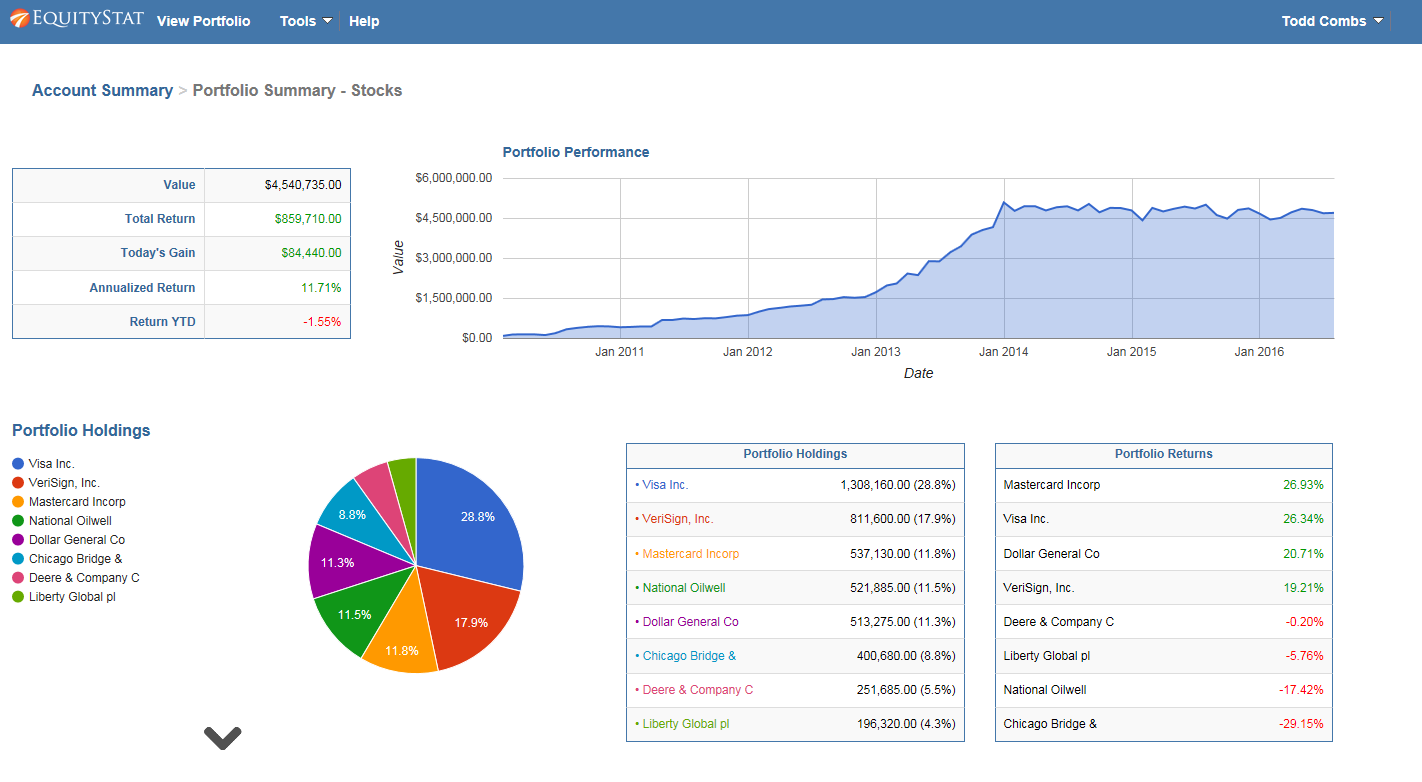
EquityStat Financial Portfolio Analysis
Portfolio Analysis Example

In addition EquityStat provides an analysis of your account and portfolios.  With our account/portfolio analysis you can get a graphical and tableuare view of the performance of your investments.  For example, you can see the performance of your account/portfolio overtime.  Using the account/portfolio analysis you can also see which investments were your best performing investments and which investments were your least performing investments.

Portfolio Analysis – New Feature

How to Analyze Your Investment Portfolio in EquityStat

EquityStat has introduced a powerful Portfolio Analysis tool that helps investors evaluate performance, track holdings, and compare returns across multiple portfolios. This feature gives you a clear, data‑driven view of how your investments are performing over time.

What the Portfolio Analysis Tool Does

The Portfolio Analysis page provides a complete performance overview of your account and individual portfolios. You can quickly see:

  • Overall account performance over time
  • Portfolio‑level performance metrics
  • Investment holdings and allocation
  • Daily, quarterly, and yearly performance rankings
  • Best‑ and worst‑performing investments

This makes it easy to understand which assets are driving your returns and where adjustments may be needed.

How to Access Portfolio Analysis in EquityStat

To run a portfolio analysis:

  1. Click the Tools menu at the top navigation bar.
  2. Select Analyze Portfolio from the dropdown.
  3. The system will generate a detailed analysis of your account and portfolios.

What You’ll See on the Portfolio Analysis Page

Analyze your investment portfolio using EquityStat.
Analyze Portfolio Example

1. Account‑Level Performance Overview

If you manage multiple portfolios, the analysis begins with a full account‑wide performance summary, including:

  • A performance graph showing account growth over time
  • A breakdown of each portfolio’s performance
  • A ranked list of investment returns
  • A summary of all holdings across your account

2. Portfolio‑Specific Analysis

Click any portfolio name in the summary table to view:

  • Portfolio‑specific performance charts
  • Individual investment metrics
  • Best and lowest performers for the day, quarter, and year
  • A complete holdings list for that portfolio

If you only have one portfolio, the system automatically displays its analysis.

Key Performance Metrics Provided

The analysis includes detailed metrics such as:

  • Total return
  • Daily return
  • Quarterly return
  • Year‑to‑date return
  • Investment rankings
  • Growth charts

These insights help you understand how each investment contributes to your overall performance.

Why This Matters for Investors

Whether you’re a beginner or an experienced investor, having a clear view of your portfolio’s performance is essential. EquityStat’s Portfolio Analysis tool helps you:

  • Track long‑term investment growth
  • Identify top‑performing investment
  • Spot underperforming investments
  • Make informed decisions based on real data
  • Manage multiple portfolios with ease
  • Track dividend income across all portfolios

5 Frequently Asked Questions About EquityStat’s Portfolio Manager

5 Frequently Asked Questions

  1. How do I add a new investment?
    Click the New Menu and then choose New Investment from the dropdown menuitem.  A popup dialog will appear where you can add your new investment.
  2. How do I add/remove a portfolio column?
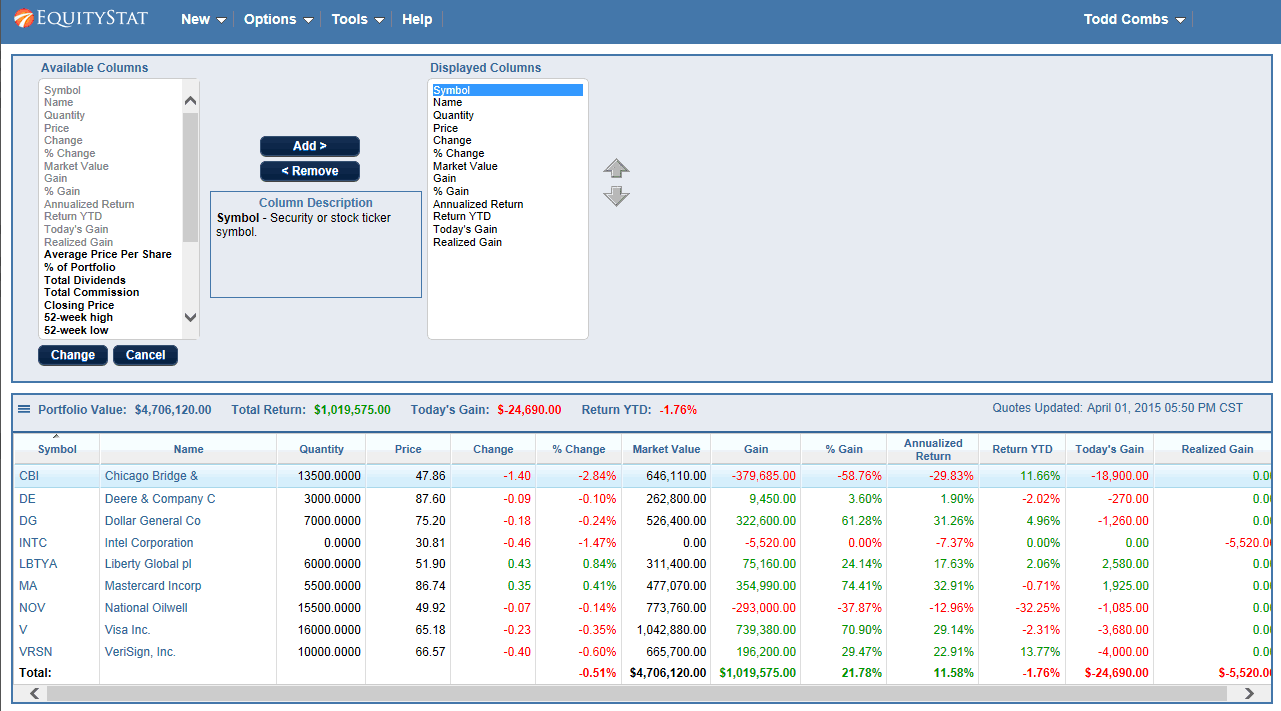
    Click the Options Menu and then choose Change Columns from the dropdown menuitem.  The Change Columns panel will appear.  To add a column select the column from the Available Columns list and click the Add button to add it to the Displayed Columns list.  To remove a column select the column from the Displayed Columns list and click the Remove button to remove it from the Displayed Columns list.  Click the Change button to save your columns.

    EquityStat Investment Portfolio Change Performance Metric Columns
    Change Stock Portfolio Columns
  3. How do I change the order of the displayed columns?
    Click the Options menu and choose the Change Columns dropdown menuitem.  The Change Columns panel will appear.  Select the column you want to change from the Displayed Columns list.  Use the up/down arrows on the right to change the order.   When finished click the Change button to save your changes.
  4. How do I sort the portfolio by Investment name?  How do I sort any column in the portfolio?
    To sort your portfolio by investment name, click on the Name column heading.  To sort any columns, such as Market Value, click on the column heading.  Clicking on the column heading will also toggle the sort between ascending and descending order.
  5. How do I sell an investment?
    To sell an investment add a “Sell” transaction.  To add a “Sell” Transaction, first select the investment you want to sell.  Next click the Add button in the Transactions section.  A popup panel will appear.  Enter your date, choose “Sell” from the Activity dropdown and enter how many shares you sold and the price you sold them at.  Click the Add button to save your changes.

    EquityStat Stock Market Portfolio Add Transaction
    Add Transaction Directions

New Column Options

We recently added two new column options to our portfolio manager.  You can now display the Ex-Dividend Date and Dividend Paid Date for each of your investments.  To display these columns in your portfolio, click the Options menu and then choose the Change Columns menuitem.  A drop down panel will then appear.  Select the column from the list of Available Columns and add it to the list of Displayed Columns.  Click the Change button and your new columns will display in the portfolio.

In addition to these two columns, we provide a whole range of other columns you can add to your portfolio.  These columns vary from information about your investment to performance metrics.  Just add/remove the columns to configure your portfolio to your specifications.

Yahoo Portfolio No Longer Supports Transactions

If you haven’t heard, Yahoo’s investment portfolio manager will no longer be supporting transactions. This means that if you want to record all of your buys, sells, dividends, etc., you can no longer do so with Yahoo’s investment portfolio.  In other words, you can no longer track the history of your investments.  Without a transaction history you cannot get an accurate performance return of your investment and you can’t calculate your gains and losses for your taxes.  If you are a user of Yahoo’s portfolio manager and want an alternative, consider EquityStat’s portfolio manager.

With EquityStat you can easily add, edit and delete your investment transactions. You can also easily view your transactions for each investment.  In addition you can import these transactions into your portfolio by either manually entering them or importing them from a spreadsheet. If you want to save your transactions to your computer, you can export the transactions for each investment to a spreadsheet.

If you are looking for  portfolio manager that supports transactions, checkout EquityStat.

New Feature in the Portfolio Manager

EquityStat Portfolio Manager Stock Performance Graph

We have recently added a performance graph in the portfolio manager. For each investment in your portfolio you can see how that investment has performed over time. To see the investment graph, just click on an individual investment and the graph will display at the bottom right next to your list of transactions for the investment.

Ditch the Stock Spreadsheet

Many investors keep their stock portfolios in a spreadsheet. With a spreadsheet they can keep track of their investments and also calculate some performance metrics. This is a quick and easy way to track their investment portfolio’s net-worth without having to go to the websites where their stocks or mutual funds are held. In addition a stock spreadsheet is secure where only the owner of the computer has access to the stock spreadsheet.

In spite of the convenience, there are several drawbacks to using a spreadsheet to track your investments. One drawback is how do you update the prices for each investment in your portfolio? If you manually enter the prices, this could be a daily chore that is time consuming. You could use a stock service to provide real-time stock quotes. However, implementing this in a spreadsheet is not trivial. Also, what do you do if the stock service changes their user interface or the stock service goes down?

Another drawback to stock portfolio spreadsheets is you can only view your portfolio on the computer where the spreadsheet is located. If you have the spreadsheet on a home computer, you can’t view your portfolio at work. In addition if you have multiple computers and tablets at home you can only view your spreadsheet on one computer.

EquityStat’s portfolio manager was created to alleviate the problems of a spreadsheet. With our portfolio manager you can instantly see the real-time value of your investment portfolio. There is no need to enter the daily prices and you can let us worry about interfacing with the stock quote service.

Also, with EquityStat you can view your investment portfolio on any computer or device that supports a web browser. You can view your portfolio from home or work 24 hours a day, seven days a week. In addition you can view your portfolio on a Windows or Apple computer as well as any tablets like iPads.

EquityStat’s portfolio manager also provides many performance metrics such as annualized return, year-to-date return, quarterly return and average price per share.

You can learn more about EquityStat’s features here.

2015 8949 IRS Tax Forms Released

We just released the 2015 8949 IRS tax forms. If you have sold any stocks or mutual funds in 2015, then you can generate IRS Form 8949 to calculate your gain or loss on a stock sale. EquityStat will automatically calculate your short-term gains and losses and long-term gains and losses and generate a PDF 8949 form. You can then save or print out this form and give it to your accountant or tax preparer. To generate Form 8949 click the Tools menu and then select the Generate Form 8949 menuitem.

Investor, Stock & Personal Finance Conferences 2016

Here is a schedule of investor, stock, money and personal finance conferences for 2016.

January 18-20, 2016

Advanced Personal Financial Planning Conference – Las Vegas
http://www.cpa2biz.com/AST/Main/CPA2BIZ_Primary/PersonalFinancialPlanning/PRDOVR~PC-PFP/PC-PFP.jsp

February 9 – 10, 2016

Finovate Europe – London
http://europe2016.finovate.com/

February 10-12, 2016

Technology Tools For Today (T3) – Ft. Lauderdale
http://www.technologytoolsfortoday.com/conferences

February 21-23, 2016

The Traders Expo New York
http://www.moneyshow.com/conferences.asp

February 26, 2016

MIT Sloan Investment Conference
http://www.sloaninvestmentconference.com/

March 2-5, 2016

The MoneyShow Orlando
http://www.moneyshow.com/conferences.asp

March 13-16, 2016

Mutual Funds and Investment Management Conference – Orlando
https://www.ici.org/events/upcoming/conf_16_mfimc

March 16-17, 2016

CFA Institute Conference: Wealth Management
https://www.cfainstitute.org/learning/events/Pages/03162016_118419.aspx

March 29-30, 2016

FinDevR New York
http://newyork2016.findevr.com/

April 28-29, 2016

Value Investor Conference – Omaha
http://www.valueinvestorconference.com/

April 25-28, 2016

FPA Retreat – Phoenix
http://fparetreat.org/

May 9-11, 2016

The MoneyShow Las Vegas
http://www.moneyshow.com/conferences.asp

May 10-11, 2016

Finovate Spring – San Jose
http://spring2016.finovate.com/

May 19-22, 2016

Better Investing National Convention – Washington DC
http://www.betterinvesting.org/public/singletabs/event+listings/nonmembereventdetail.htm?eventurl=%2fmembers%2ftools%2fevents%2fnational%2f2016binc.htm

May 24-27, 2016

Strategic Investor Conference – Dallas
http://www.mauldineconomics.com/sic-2016/

June 13-15, 2016

MorningStar Investment Conference – Chicago
http://corporate1.morningstar.com/Morningstar-Investment-Conference/

August 25-27, 2016

The MoneyShow San Francisco
http://www.moneyshow.com/conferences.asp

September 8-9, 2016

Finovate Fall – New York
http://fall2016.finovate.com/

September 13, 2016

Delivering Alpha – New York
http://www.deliveringalpha.com/delivering-alpha-ii/

September 16-17, 2016

The MoneyShow Toronto
http://www.moneyshow.com/conferences.asp

September 21-24, 2016

FinCon – San Diego
http://finconexpo.com/

September 22-23, 2016

The All-Stars of Options Trading
http://www.moneyshow.com/conferences.asp

October 20-21, 2016

The MoneyShow Dallas
http://www.moneyshow.com/conferences.asp

November 17-19, 2016

The Traders Expo Las Vegas
http://www.moneyshow.com/conferences.asp

Best and Worst Stocks of 2015

According to the Wall Street Journal the best stock of 2015 was Netflix.  It was up 134%.  The worst stock of 2015 was Chesapeake Energy.  It was down 77%.

You can see the list of best stocks here:

http://blogs.wsj.com/briefly/2015/12/31/5-best-performers-in-the-sp-500-in-2015/

You can see the list of worst stocks here:

http://blogs.wsj.com/briefly/2015/12/31/5-worst-performers-in-the-sp-500-we-only-counted-energy-stocks-once/

How did your investments do in 2015?  What was your best stock?  What was your worst? If you are not tracking your investment’s performance, consider using EquityStat.  With EquityStat you can track the overall performance of your portfolio as well as the performance of each individual investment.  EquityStat tracks the annualized return, year to date return, daily gain, overall gain and many other metrics of your investments.  With these metrics you can easily determine what are your best investments and what are your worst investments.

New and Improved Features in the EquityStat Portfolio Manager

Managing investments effectively requires tools that are flexible, intuitive, and powerful enough to handle real‑world portfolios. EquityStat has introduced several enhancements to its Portfolio Manager designed to give investors more control, better insights, and a smoother overall experience. These updates make it easier to organize multiple accounts, analyze performance, and view your investment data in a clean, streamlined layout.

Whether you’re tracking stocks, mutual funds, ETFs, or retirement accounts, these new features help you stay on top of your financial picture with greater accuracy and efficiency.

Create and Manage Multiple Portfolios with Ease

One of the most significant upgrades is the ability to create multiple portfolios within your EquityStat account. This feature is ideal for investors who want to separate or categorize their holdings across different accounts or investment strategies.

Why Multiple Portfolios Matter
  • Better organization — Keep your brokerage accounts, retirement accounts, and long‑term holdings separate.
  • Clearer insights — Compare performance between strategies (e.g., growth vs. income).
  • Simplified reporting — Generate cleaner summaries for taxes, advisors, or personal tracking.

How to Create a New Portfolio

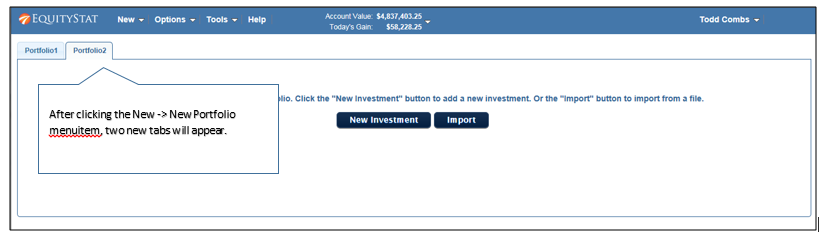
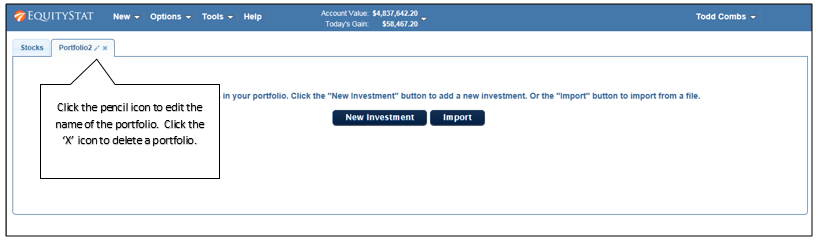
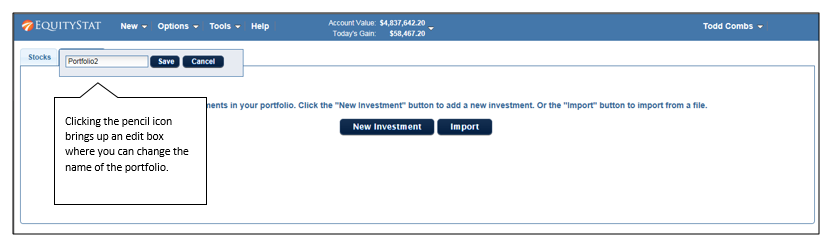
You can create a new portfolio directly from the New menu by selecting New Portfolio. Once created, each portfolio can be customized with its own set of investments, performance metrics, and display preferences.

New Performance Metrics for Deeper Investment Analysis

To help investors make more informed decisions, EquityStat has added several new performance‑focused data columns:

Newly Added Metrics

  • Quarterly Return — Track short‑term performance trends and identify momentum.
  • P/E Ratio (Price‑to‑Earnings) — Evaluate whether a stock is undervalued or overvalued.
  • Dividend Yield — Quickly see which holdings generate income and how much.

These metrics can be enabled from the Options menu under Change Columns, allowing you to tailor your dashboard to the data that matters most to you.

Maximize Your Portfolio View for Better Visibility

Large portfolios can sometimes require scrolling or navigating between panes to see all your holdings. To solve this, EquityStat now includes a Maximize Portfolio feature that expands your investment list to fill more of your screen.

What Maximize Mode Does

  • Expands the investment section to show more rows at once
  • Moves the transaction section downward for a cleaner layout
  • Reduces the need for scrolling and window adjustments

This is especially useful for investors with extensive holdings or those working on smaller screens.

To activate it, click the three‑line menu icon in the upper‑left corner of your portfolio and select Maximize. You can return to the default pane layout anytime by choosing Restore.

Why These Updates Matter for Investors

These enhancements aren’t just cosmetic — they’re designed to improve the way you interact with your financial data:

  • Faster decision‑making thanks to clearer metrics
  • More efficient navigation with customizable portfolios
  • Better organization for multi‑account investors
  • Improved user experience across devices

As the investing landscape becomes more complex, having a flexible and powerful portfolio tracker is essential. EquityStat continues to evolve its tools to support both new and experienced investors.

Have Ideas for Future Features?

EquityStat actively welcomes feedback from its users. If you have suggestions for new tools, metrics, or improvements, the team encourages you to reach out and share your ideas. User input plays a key role in shaping future updates.

Contact us and let us know.


Creating multiple portfolios – New Feature

We recently added a new feature to your EquityStat portfolio manager. You can now create multiple portfolios for your account. Having multiple portfolios gives you the ability to group and separate your investments. For example, you can have a portfolio for your individual stocks, a portfolio for your mutual funds and a portfolio for your 401K.

To add a new portfolio click the New menu and then chose the New Portfolio menuitem from the dropdown menu.

Create a New EquityStat Portfolio
How to create a new portfolio in EquityStat

You will then see two new tabs. A tab for your current portfolio and a tab for your new portfolio.

Change Portfolio Name EquityStat
How to change the portfolio name

To edit the name of your portfolio click the pencil icon, which will display an edit box.

Edit Portfolio Name
How to edit a portfolio name.

Next type over the current portfolio name with the new portfolio name and click the Save button.

View portfolio investments
View a specific portfolio

To view the investments of each portfolio click on the portfolio’s tab. From here you can also add new investments to the portfolio as well as edit investments.

To view the view the performance all your entire account (all portfolios) click the Account Value box at the top.

To delete a portfolio first delete all the investments in the portfolio. Once the portfolio is empty, click the ‘X’ icon in the portfolio tab.

Behind the Design

Behind the Design of EquityStat’s Portfolio Manager

EquityStat’s portfolio manager was built for investors by investors.  As investors we found many portfolio managers just didn’t work how we wanted them to.  Whether the portfolio manager was from a brokerage account, mutual fund or from a software company, many just didn’t work well.  This was a driving force for us building EquityStat’s portfolio manager.

One major problem of other portfolio managers is they don’t refresh your investment prices and portfolio value automatically.  To see your latest values, you have to manually refresh the page.

We didn’t want our portfolio manager to behave this way.  With our portfolio manager your prices and portfolio values are updated automatically without you having to refresh the page.  Every 15 minutes we query the latest prices of your investments and update your portfolio.  In the upper right hand corner, we even display the last time the quotes were updated.  All of this happens automatically without you having to constantly refresh the page to see how your investments are performing.

Another problem of other portfolio managers is entering transactions.  When entering transactions the portfolio manager will post back the transaction to the webserver and then do a page refresh with the new data. This is very cumbersome.

EquityStat’s portfolio manager does all of the saving in the background.  When you add or edit a transaction, the transaction is saved and updated behind the scene.  The only thing you see is notification at the top of the portfolio that the transaction has been saved.  The benefit of this is less page refreshing and a more natural, less cumbersome way of entering transactions.

In the coming weeks, we will highlight more design features or our portfolio manager and how it benefits our users.

If you bought Berkshire stock how rich would you be?

If you bought Berkshire Hathaway (BRK.A) stock instead of paying for college, how rich would you be?  Instead of having that fabulous wedding, what if you bought Berkshire?  How about if you owned a couple of shares of Berkshire instead of your dream home, how rich would you be?

Use our Berkshire Calculator to find out.  Just click this link

http://www.equitystat.com/pages/howrich.aspx

and then enter the year you went to college, had that fabulous wedding or bought your dream home.  Next, enter the amount you paid.  Click Go and you will see how rich you could be.

Warning: For those over 40 this calculator could make you sick to your stomach.


Changing Columns in Your Portfolio

By default we display a pre-configured set of columns for your portfolio.  If you desire you can easily change the columns that are displayed in your portfolio.  To do this click the Options link at the top of your portfolio and choose the Change Columns menuitem.

Change Performance Metrics in EquityStat's Investment Portfolio Manager
Change Columns In Your Portfolio

Clicking the Change Columns menuitem will display a list of columns that are available and a list of columns your are currently using.  You can add and remove columns as well as change the order of your columns.  If you want a description of a column, just click on the column in either of the lists.

When you are finished change your columns, click the Change button to save your changes and get back to your portfolio.

Importing your transactions into EquityStat

Do you have a lot of transactions that you need to import into EquityStat that you don’t want to manually enter? If so then you can use EquityStat’s import feature to import these transactions.

To import your transactions first get these transactions into a CSV (comma separated variable) file. The easiest way to generate a CSV file is to use Excel or any other spreadsheet application. With Excel you can enter your data into a spreadsheet and then save the file as a CSV file.

The CSV file must be in a certain format for you to import your transactions into your portfolio. The first line in the file must identify what each column is. The following column indentifiers are valid – Symbol, Date, TranType, Quantity, Price, Amount, Commission.

The valid values for the TranType column are Buy, Sell, Div, Rediv (Re-invested Dividend), Longcg (Long-Term Capital Gain), Shortcg (Short-Term Capital Gain), Relongcg (Re-Invest Long Term Capital Gain), Reshortcg (Re-Invest Short Term Capital Gain).

If you have a TranType value of Div then you will need an Amount column and you will not need the Quantity and Price column. If you have a TranType value of something other than a non re-invested dividend or non re-invested capital gain, you will need a Quantity and Price column. All rows must have a Symbol and Date column.

Here is a screen shot of a sample Excel file in the proper format.

Import Transactions into EquityStat's Stock Portfolio Tracker
Import transactions into EquityStat

Once you have your data entered in your spreadsheet, save it as a CSV file.

Next, login to your portfolio and  click the New menu and choose Import Transactions.  Then from the Import page, upload your CSV file from your computer.  The transactions that will be imported will then be displayed.  If everything is correct, continue the import process.

If you have any questions with how to do an import, feel free to contact our support desk by clicking the Help link from our home page.

Does Buffett think Berkshire stock is underpriced?

If you read Berkshire’s annual letter, you can gain a lot of insight as to what Buffett thinks of Berkshire. So based on the 2014 annual letter, does Buffett think Berkshire’s stock is undervalued, overvalued or just right?

First, Buffett has always said, over time Berkshire’s stock price will reflect the intrinsic value of the business. Calculating Berkshire’s intrinsic value is not a precise exercise but a lot of analysts do it, including Buffett and Munger.

In his 2014 annual letter, Buffett points out several times that the value of an asset on the books is a lot less than the true or intrinsic value of the asset. For example, when discussing Berkshire’s insurance float he says

Charlie and I believe the true economic value of our insurance goodwill – what we would happily pay for float of similar quality were we to purchase an insurance operation possessing it – to be far in excess of its historic carrying value. Under present accounting rules (with which we agree) this excess value will never be entered on our books. But I can assure you that it’s real. That’s one reason – a huge reason – why we believe Berkshire’s intrinsic business value substantially exceeds its book value.

When discussing the businesses that make up Berkshire, Buffett says

Furthermore, the intrinsic value of these businesses, in aggregate, exceeds their carrying value by a good margin, and that premium is likely to widen. Even so, the difference between intrinsic value and carrying value in both the insurance and regulated-industry segments is far greater. It is there that the truly big winners reside.

And finally, Buffett points out that the peculiarities of Marmon’s rail car business which causes Marmon’s book value to be undervalued.

One further fact about our rail operation is important for you to know: Unlike many other lessors, we manufacture our own tank cars, about 6,000 of them in a good year. We do not book any profit when we transfer cars from our manufacturing division to our leasing division. Our fleet is consequently placed on our books at a “bargain” price. The difference between that figure and a “retail” price is only slowly reflected in our earnings
through smaller annual depreciation charges that we enjoy over the 30-year life of the car. Because of that fact as well as others, Marmon’s rail fleet is worth considerably more than the $5 billion figure at which it is carried on our books.

Based on these quotes is Buffett hinting that book value is substantially under intrinsic value? And since Buffett believes stock price will eventually be the same as intrinsic value, does Buffett believe Berkshire’s stock price is undervalued?

I think the answer is a yes!

Best Quotes from Berskhire Letter

On Saturday Warren Buffett released his annual letter on Berkshire Hathaway.  If you are an investor it is a must read.  Here are the best quotes from the letter.

On Berkshire’s Investments

… stock repurchases at Coca-Cola, American Express and Wells Fargo raised our percentage ownership of each. Our equity in Coca-Cola grew from 9.1% to 9.2%, our interest in American Express increased from 14.2% to 14.8% and our ownership of Wells Fargo grew from 9.2% to 9.4%. And, if you think tenths of a percent aren’t important, ponder this math: For the four companies in aggregate, each increase of one-tenth of a percent in our ownership raises Berkshire’s portion of their annual earnings by $50 million.

On BNSF Railroad

BNSF, like all railroads, also moves its cargo in an extraordinarily fuel-efficient and environmentally friendly way, carrying a ton of freight about 500 miles on a single gallon of diesel fuel. Trucks taking on the same job guzzle about four times as much fuel.

Elephant Hunting or Tuna Fishing?

In past letters Buffett has said he is elephant hunting for new businesses.  He is now fishing.

With the acquisition of Van Tuyl, Berkshire now owns 9 1⁄2 companies that would be listed on the Fortune500 were they independent (Heinz is the 1⁄2). That leaves 490 1⁄2 fish in the sea. Our lines are out.

Investing Wisdom

… my experience in business helps me as an investor and that my investment
experience has made me a better businessman. Each pursuit teaches lessons that are applicable to the other. And some truths can only be fully learned through experience. (In Fred Schwed’s wonderful book, Where Are the Customers’ Yachts?, a Peter Arno cartoon depicts a puzzled Adam looking at an eager Eve, while a caption says, “There are certain things that cannot be adequately explained to a virgin either by words or pictures.”

For the great majority of investors, however, who can – and should – invest with a multi-decade horizon, quotational declines are unimportant. Their focus should remain fixed on attaining significant gains in purchasing power over their investing lifetime. For them, a diversified equity portfolio, bought over time, will prove far less risky than dollar-based securities.

Funny

The gecko, I should add, has one particularly endearing quality – he works without pay. Unlike a human spokesperson, he never gets a swelled head from his fame nor does he have an agent to constantly remind us how valuable he is. I love the little guy.

When I was a teenager– in my one brief flirtation with honest labor – I tossed about 500,000 papers.

Benjamin Franklin Wisdom

Buffett always has some common sense wisdom in his letters.

It’s better to have a partial interest in the Hope Diamond than to own all of a rhinestone.

In the world of business, bad news often surfaces serially: You see a cockroach in your kitchen; as the days go by, you meet his relatives.

Market forecasters will fill your ear but will never fill your wallet.

We’ve found that if you advertise an interest in buying collies, a lot of people will call hoping to sell you their cocker spaniels.

… never underestimate the man who overestimates himself.

Dividend?

Buffett has always said Berkshire won’t pay a dividend but hints that they might in the future.

Eventually – probably between ten and twenty years from now – Berkshire’s earnings and capital resources will reach a level that will not allow management to intelligently reinvest all of the company’s earnings. At that time our directors will need to determine whether the best method to distribute the excess earnings is through dividends, share repurchases or both.

Getting Started with EquityStat Portfolio Manager

Quick Start Guide

Here is a quick getting started guide for using EquityStat’s portfolio manager.

EquityStat Stock Portfolio Directions
Add transactions to EquityStat

After you join EquityStat, you will be logged into your account.  Since you have no investments in your portfolio, you will see the page above.  From this page you can click the New Investment button to add a new investment to your portfolio.

After clicking the New Investment button, you will be presented a dialog where you can enter a buy transaction for your investment.  Using the dialog, enter the symbol of your investment, the date the purchase took place, the amount of shares purchased and the price for each share.  When finished click the Save button.  Once you have entered your first purchase, you can then enter other transactions such as other buys, sells and dividends.

Getting Start With EquityStat Portfolio Tracker
Directions on EquityStat’s Portfolio Manager

The image above shows a portfolio with several investments already entered.  The top table will show all of your investments along with data about the investments.  Below the investment table are the transactions for the selected investment.  You can sort your investments and transactions by clicking on a column heading.  In addition you can expand a column by putting your mouse between columns and then drag to lengthen the width of the column.  Above the investment table is a summary of the portfolio which will show you the total portfolio value, the total dollar return, the gain/loss for the day and the year-to-date return.

Add Transactions to EquityStat's Investment Portfolio
How to add transactions to EquityStat

If you want to enter a new investment that is not in your portfolio, click the New menu and then choose the New Investment menuitem.  If you want to add transactions to an existing investment, go to the transaction table below the investment table and click the Add button.  A new row will then be added to the transaction table where you can add a new buy, sell, dividend transaction as well as many other transaction types.  You can also edit an individual transaction by selecting the transaction and clicking the Edit button.  If you want to remove a transaction, click the Delete button.

Hide Sold Investments in EquityStat's Stock Portfolio Tracker
How to hide sold investments in your portfolio

If you have investments in our portfolio that have been sold and you don’t want them to show, click the three line graphic at the left and choose Hide Sold Investments menuitem.  This will hide any sold investments.  To view your sold investments click the graphic again and choose View Sold Investments.

Cost Basis

What is Cost Basis?

Investopedia defines cost basis as:

The original value of an asset for tax purposes (usually the purchase price), adjusted for stock splits, dividends and return of capital distributions. This value is used to determine the capital gain, which is equal to the difference between the asset’s cost basis and the current market value. Also known as “tax basis”.

Why is it important?

The IRS is requiring more and more reporting of your cost basis of your investment.  They also require your report the capital gains/losses of your investments. To calculate your capital gains you need to know your cost basis.

How do you calculate it?

On the surface calculating cost basis sounds easy. Just use the price you paid for your stock. For example, if you purchased a 100 shares of XYZ company for $120 then your cost basis is $120. However, things get complicated if you had 3 for 2 stock split. Also, what if you purchase an additional 50 shares for $90? What if you have a split, reinvest capital gains and purchases in a given year? What is your cost basis? Now things get really complicated.

How EquityStat makes things easier

With EquityStat all you have to do is enter your purchases, splits, capital gains and we will calculate your cost basis. Then when you sell your stock whether all of your shares or just some of your shares, we can easily calculate your gain or loss. You can then generate IRS Form 8949 that will show your cost for each investment you sold in the last year.

TurboTax and Investment Taxes

Do you use TurboTax to calculate your investment gains and losses?  Do you use TurboTax to generate form Schedule D or Form 8949?  If so be aware that TurboTax is now charging extra for these features.

In addition to paying $59.99 for the Deluxe version of Turbo tax, if you want to calculate your investment capital gains or losses from stock, mutual fund or ETF sales you will have to pay an additional $20 or $30.

You can read more about the changes to TurboTax here.

http://www.latimes.com/business/hiltzik/la-fi-mh-intuits-catastrophic-turbotax-20150118-column.html

If you are looking for an alternative to TurboTax for calculating your capital gains or losses, checkout EquityStat.  With EquityStat you can generate IRS Form 8949 .  Form 8949 is used to report your short and long term capital gains and loses.  Once you enter your purchases and sales of your investments into EquityStat, you can then generate Form 8949 and use this form to fill out your Schedule D Form.

Investments, Taxes, Form 8949, Schedule D

Selling Investments and the IRS

The IRS is requiring more reporting when you sell your investments.  Specifically, they require you to report the investment cost, cost basis in investment terminology, and the gain/loss from the investment sale.  If you purchase 100 shares of a stock and sell 100 shares of the stock, your cost basis is easy to calculate.  Things get more difficult when you purchase shares in different lots.  For example, you purchase 100 shares in 2011, 50 shares in 2012, 200 shares in 2013 and sell 160 shares in 2014.

Form 8949

What is your cost basis in the above scenario?  This is not an easy calculation to do.  To make things even more difficult, you have to report both your short term gains and long term gains to the IRS separately.  Fortunately, EquityStat makes this easy.  EquityStat calculates your cost basis for each investment and can also generate IRS Form 8949 which is a report that shows your gain/loss on each investment sold.  Your tax preparer can then use Form 8949 to create the IRS Schedule D form.

To Generate Form 8949, click the Tools menu at the top of the portfolio and then click the Generate IRS Form 8949. Choose your tax year and EquityStat will generate the report showing both your short term and long term gain/loss on each investment you sold during the tax year.


How did your investments do in 2014?

According to the Wall Street Journal the best stock of 2014 was Southwest Airlines (LUV).  It was up 123%.  The worst stock of 2014 was Transocean (RIG).  It was down 62%.

You can see the list of best stocks here:

http://blogs.wsj.com/briefly/2014/12/31/5-best-stocks-of-2014/

You can see the list of worst stocks here:

http://blogs.wsj.com/briefly/2014/12/31/5-worst-stocks-of-2014/

How did your investments do in 2014?  What was your best stock?  What was your worst?

If you are not tracking your investment’s performance, consider using EquityStat.  With EquityStat you can track the overall performance of your portfolio as well as the performance of each individual investment.  EquityStat tracks the annualized return, daily gain, overall gain and many other metrics of your investments.  With these metrics you can easily determine what are your best investments and what are your worst investments.

Why Mutual Fund Investors Need a Portfolio Manager

If you own mutual funds why do you need a portfolio manager?  Why can’t you just use the tools your mutual fund provides?

Transaction History

Many mutual funds do not provide all of your transaction history.  They may provide up to 3 years of history but if you have owned your mutual fund longer than this, you do not have access to every transaction you have made.

Why is transaction history important?  One, you need a complete transaction history for tax purposes if you sell shares in your mutual fund.  Whenever you sell shares in a mutual fund you need to report to the IRS you gain or loss from to the sale.  Without a complete transaction history you cannot accurately report the gain or loss, which may effect your taxes.

You also want a complete transaction history so that you can track your mutual fund’s performance over the history of the investment, not just over a limited time.

Performance Evaluation

Many mutual funds will provide you the yearly return of the mutual fund but this may not be the return your investment has made.  For example, say you own the hypothetical mutual fund XRXRXR.  Let’s say XRXRXR price on January 1 is $100 a share and on December 31 it is $110 a share.  The mutual fund will report their yearly gain as 10%.  However, this does not take into account when you bought your shares.  Let’s say that on July 1 you buy shares at $90 a share.  Based on a closing price of $110/share, your gain is 22% and not 10%.  Or, let’s say you bought your shares at $120 a share.  Based on a closing price of $110/share, your loss is 8% and not a 10% gain.  If you rely on your mutual fund’s performance return it could be less or more than what you are actually earning.

EquityStat

With EquityStat you can view the complete history of your transactions.  In addition EquityStat gives you the ability to generate IRS form 8949 which will calculate any gains or losses on the sale of your mutual fund shares.

EquityStat will also calculate the annualized return on all of your investments.  This calculation is based on when you purchased and sold your shares, not what the mutual fund reports their return is.

Microsoft’s Portfolio Manager Discontinued — Best Alternative for MSN Money Users

Microsoft Has Shut Down Its MSN Money Portfolio Manager

Microsoft has officially discontinued the MSN Money investment portfolio manager, a tool that was once one of the most popular ways for investors to track stocks, ETFs, and mutual funds. If you previously relied on Microsoft’s portfolio tracker, you now need a modern, browser‑friendly alternative. EquityStat offers a powerful replacement with similar features — and far better compatibility.

Why Microsoft’s Portfolio Manager Stopped Working

Microsoft’s portfolio manager was built using Silverlight, a browser plugin that is no longer supported by most modern web browsers. Here’s what that means for investors:

  • Safari does not support Silverlight, so the tool cannot run on iMacs or iPads
  • Most modern browsers have removed plugin support entirely
  • The portfolio manager no longer functions on Apple devices or many Windows systems

As a result, former MSN Money users can no longer access or update their portfolios.

EquityStat: A Modern Alternative to Microsoft’s Portfolio Manager

EquityStat is built using HTML, not Silverlight — meaning it works on virtually any device with a modern web browser.

Works on All Major Platforms

You can use EquityStat on:

  • Windows PCs and tablets
  • Apple iMac and MacBook
  • iPad and iPhone
  • Android tablets and phones
  • Any device with a standard web browser

No plugins. No compatibility issues. No outdated technology.

Features Similar to MSN Money’s Portfolio Manager

EquityStat includes many of the same capabilities that made Microsoft’s tool popular:

  • Track stocks, ETFs, and mutual funds
  • View daily gain/loss
  • Monitor total return and annualized return
  • Review complete transaction history
  • Organize investments into multiple portfolios
  • Analyze performance with charts and holdings reports

If you liked MSN Money’s portfolio manager, you’ll feel right at home with EquityStat.

Key Differences That Make EquityStat Better

While EquityStat offers familiar features, it also improves on Microsoft’s discontinued tool:

  • Modern, plugin‑free design
  • Cross‑platform compatibility
  • Faster performance calculations
  • Cleaner, more intuitive interface
  • Ongoing updates and support

It’s everything the old MSN Money portfolio manager offered — without the limitations.

Looking for a Replacement? Try EquityStat

If you were a previous user of Microsoft’s portfolio manager and need a reliable, modern alternative, EquityStat is one of the best options available. It’s simple, accurate, and works on every major device.

Microsoft Retires MSN Money Portfolio Manager: What Investors Can Use Instead

Microsoft has officially discontinued the MSN Money Portfolio Manager, leaving many long‑time users searching for a dependable replacement. For years, the MSN Money tool was a popular way to track investments online, but changes in browser technology eventually made it impossible for Microsoft to continue supporting it.

Why the MSN Money Portfolio Manager Was Discontinued

The original MSN Money portfolio manager was built using Silverlight, a browser plugin that worked primarily with Internet Explorer. As major browsers phased out plugin support, Silverlight‑based applications stopped functioning.

This created several issues for investors:

  • Safari users on iMac and iPad could no longer access the tool
  • Chrome and Firefox removed plugin support
  • Mobile devices became incompatible
  • Microsoft eventually retired the service entirely

With Silverlight no longer supported, the portfolio manager could not operate on modern browsers or devices.

A Modern Replacement: EquityStat’s Online Portfolio Manager

EquityStat offers a fully web‑based portfolio manager built with HTML, not plugins. This means it works on virtually any device or browser, including:

  • Windows desktops and laptops
  • Apple iMac and iPad
  • Android phones and tablets
  • Chrome, Safari, Firefox, and Edge

Because it’s built on modern web standards, EquityStat provides a smooth, reliable experience without requiring downloads or extensions.

How EquityStat Compares to the Old MSN Money Tool

Investors who previously relied on MSN Money will find that EquityStat offers many of the same core features, including:

  • Portfolio tracking
  • Performance reporting
  • Real‑time market updates
  • Easy import and export options

In addition, EquityStat includes enhancements that weren’t available in the original Microsoft tool, making it a practical upgrade for users who want a familiar but more capable portfolio manager.

Looking for an Alternative to Microsoft’s Portfolio Manager?

If you used the MSN Money portfolio manager and need a modern replacement that works across all devices, EquityStat is a strong option. It delivers the functionality investors expect, without the compatibility issues that led to the retirement of Microsoft’s tool.

Microsoft Investment Portfolio Manager Discontinued — Best Alternative for Former MSN Money Users

Microsoft has officially discontinued the MSN Money Investment Portfolio Manager, leaving many long‑time users searching for a reliable replacement. The original MSN Money tool was once considered one of the best free portfolio managers available, but with its retirement, investors now need a modern solution that works across all browsers and devices.

If you previously relied on Microsoft’s portfolio manager, EquityStat offers a powerful, easy‑to‑use alternative with many of the same features — plus several important upgrades.

Why Microsoft’s Investment Portfolio Manager Was Discontinued

Microsoft’s portfolio manager was built on outdated technology that modern browsers no longer support. As a result:

  • Users could no longer access their portfolios
  • Data became difficult or impossible to retrieve
  • Microsoft retired the tool entirely

This left many investors without a way to track their holdings or view their historical performance.

A Modern Replacement: EquityStat’s Portfolio Manager

EquityStat provides a clean, browser‑based portfolio manager designed to be simple, fast, and accessible from any device. It includes many of the same features users loved in the MSN Money tool — along with several enhancements that make portfolio tracking easier and more intuitive.

Key Features in EquityStat You Won’t Find in Microsoft’s Old Portfolio Manager

1. Instant View of Portfolio Performance

At login, you immediately see:

  • Total portfolio value
  • Total return
  • Daily gain

No extra clicks. No searching through menus.

2. Detailed Performance Calculations

For each investment, EquityStat displays:

  • Current market value
  • Total gain
  • Daily gain
  • Annualized return
  • Additional performance metrics

This gives investors a clear, accurate picture of how each position is performing.

3. Easy Transaction Management

All transactions for each investment are grouped together, allowing you to:

  • View
  • Add
  • Edit
  • Delete

…with just a few clicks.

4. Hide or Show Sold Investments

Toggle between:

  • A historical view of your full portfolio
  • A clean view of only your currently held investments

This makes portfolio analysis much easier.

5. Customizable Columns

You can add or remove data columns, such as:

  • 52‑week high
  • 52‑week low
  • Additional performance metrics

This lets you tailor the portfolio view to your needs.

6. Less Scrolling, More Data

EquityStat automatically adjusts to your screen size, reducing unnecessary scrolling and making better use of available space.

7. Import From Spreadsheet or CSV

If your investment history is stored in a spreadsheet, you can import it directly — no manual re‑entry required.

8. Generate Tax Forms

For sold investments, EquityStat can generate IRS Form 8949, which tax preparers use to calculate capital gains.

9. Export Your Data Anytime

Unlike Microsoft’s discontinued tool, EquityStat lets you export your transactions to a spreadsheet for permanent backup and safekeeping.

10. Works on Any Device

Because EquityStat is built using HTML, not proprietary technology, it works on:

  • Windows
  • macOS
  • iPad
  • Android
  • Any modern web browser

No plugins. No compatibility issues.

11. Simple, Focused, and User‑Driven

EquityStat is designed with a single purpose: Provide a powerful, easy‑to‑use portfolio manager without distractions or unnecessary features.

Looking for a Replacement for Microsoft’s Portfolio Manager?

If you were a user of the discontinued MSN Money portfolio manager, EquityStat offers a modern, reliable, and intuitive alternative with all the essential features — and more.

$72 million High School Stock Investor Hoax

This week New York magazine reported that a New York high school student made $72 million investing in the stock market.

For a 17 year old to make $72 million from a $1000 investment, many experts calculated he would have to have returns in excess of 500% for 7 straight years. That means he would have to double his money every one to two months for 7 years straight. Yahoo Finance analyzes these returns in the article below.

http://finance.yahoo.com/news/a-high-school-senior-did-not-make–72-million–jeff-make-164536104.html

How is your investment portfolio performing? Do you know what your annualized return is? Do you have your investments scattered among brokerages and mutual funds and are unable to view your entire portfolio at once?

Check out EquityStat’s portfolio manager and get up to the minute analysis of your entire investment portfolio’s performance.

MSN Money Portfolio Manager Discontinued — Here’s the Best Alternative for Former Users

Microsoft retired the MSN Money portfolio manager, leaving many users unable to access their previously entered investment data. Because the tool is no longer supported, investors needed a new way to track:

  • Portfolio value
  • Daily gain/loss
  • Long‑term performance
  • Individual investment returns

This sudden loss of access has pushed many users to look for a more dependable, browser‑friendly solution.

A Better Alternative: EquityStat’s Online Portfolio Manager

EquityStat offers many of the same features that MSN Money users relied on — plus several improvements designed for modern investors.

Key benefits include:

1. Complete Portfolio Overview

See your entire portfolio’s:

  • Total value
  • Current gain/loss
  • Daily performance

All displayed clearly on your dashboard.

2. Detailed Investment Calculations

For each stock, mutual fund, or ETF, EquityStat shows:

  • Today’s gain/loss
  • Percentage gain since purchase
  • Realized gains
  • Annualized return
  • Additional performance metrics

This gives you a deeper understanding of how each investment is performing.

3. Full Transaction History

EquityStat displays all transactions for each investment, allowing you to:

  • Add
  • Edit
  • Delete

…any entry with ease.

You can enter transactions manually or import them from a spreadsheet.

4. Permanent Data Control

One of the biggest frustrations with MSN Money’s shutdown is that many users lost access to their data.

EquityStat prevents this problem by allowing you to:

  • Export each investment’s transactions
  • Save them as a spreadsheet
  • Maintain a permanent backup

Your data stays in your control — always.

5. Simple, Reliable, and Easy to Use

EquityStat focuses on delivering a clean, intuitive portfolio manager without unnecessary complexity. It’s designed for investors who want accurate tracking, clear reporting, and dependable access to their information.

Miss MSN Money’s Portfolio Manager? Try EquityStat

If you were disappointed to see Microsoft retire its portfolio manager, EquityStat offers a strong, modern replacement with the features you need to track your investments confidently.

EquityStat – Who, What and Why?

Who is EquityStat?

EquityStat is a powerful yet easy to use investment portfolio application. It was developed by investors for investors. The old adage “necessity is the mother of invention” was the driving force behind the founding of EquityStat. We found that the existing tools necessary to track, manage and financially evaluate investments were inadequate.

Why EquityStat?

EquityStat wanted a way to track and manage all of our investments in one application from the cloud. As many investors know, your investments are scattered about many brokerages, mutual funds and retirement plans. Our goal was to create an application where investors could manage all of their investments in a single location. In addition we wanted to be able to access investments from any computer or device. Whether at home, work or at the accountant’s office, we wanted to be able to access our investment portfolio.

What is EquityStat?

  • Manage all of your Financial InvestmentsHandles all of your stock, bond, ETF and mutual fund investments from all of your brokerages
  • Track the Performance of your InvestmentsAnalyze your individual investments and your overall portfolio
  • Generate Tax ReportsSupports IRS tax reporting requirements
  • View your Investment Portfolio on all of your DevicesWeb based portfolio management tool that you can view on any computer or tablet