Monster Beverage Is Splitting 2-for-1 on Aug. 11

Monster Beverage (NASDAQ: MNST) is splitting its stock 2-for-1, with shares beginning to trade at their new, split-adjusted price on August 11, 2026. Shareholders of record as of July 24 will see the additional shares credited to their accounts after the market closes on August 10. It is not the company’s first split. Monster’s share price has climbed substantially over the years, and splits like this one are typically how a company keeps its per-share price more accessible as growth continues.

What the Split Actually Means for Shareholders

A 2-for-1 split doubles your share count and roughly halves the price per share, but it does not change the total value of your position. If you owned 100 shares of Monster before the split, you’ll own 200 shares afterward, at approximately half the per-share price. Your overall stake in the company is unchanged, only the number of shares and the price tag on each one are different.

Why You Still Need to Record It

Even though a split does not change what your position is worth, it does change your share count and your cost basis per share going forward. If a split is not recorded in your stock portfolio tracker, your holdings will show the wrong number of shares and an inflated cost basis, which throws off both your ongoing performance numbers and your eventual capital gains calculations when you sell.

How to Record the Split in EquityStat

Recording a split in EquityStat takes just a few steps – select the stock, add a new transaction, choose Split as the activity type, and enter the split ratio, 2 for 1 in Monster’s case. EquityStat then automatically adjusts your share count and cost basis for every prior transaction on that stock.

For the full walkthrough with screenshots, see our guide on how to record a stock split in EquityStat, which covers the exact steps using Tesla’s split as a worked example. The same process applies to Monster Beverage, or any other stock split, regardless of the ratio.

Who Is EquityStat, What Does It Do, and Why Do You Need It?

Most investors don’t have one account. They have a brokerage account, maybe a 401(k) from work, an IRA, a handful of mutual funds picked up over the years. Each one lives on a different platform, with a different login, showing a different slice of the picture, and none of them show the whole thing. EquityStat exists to answer a simple question: what if you could see all of it in one place?

Who is EquityStat?

EquityStat is a stock portfolio tracker built by investors, for investors. It wasn’t designed by a bank or a brokerage trying to keep you inside their ecosystem, but was built instead by people who were managing their own investments and got tired of the tools available to them. That distinction matters. A stock portfolio manager built by someone with a brokerage relationship to protect has a reason to keep your data siloed. A stock portfolio tracker application built by investors, for investors, doesn’t, since its only job is to give you an accurate, complete view of what you own.

That independence is also why EquityStat doesn’t ask for your brokerage passwords or sell your information. You enter your own holdings and transactions, and the platform’s only incentive is to represent them accurately. It’s a meaningfully different relationship than tools built around monetizing your financial data.

EquityStat’s reputation has grown the same way most trustworthy financial tools do: one investor at a time, through word of mouth and results. Customers describe it as more complete than their brokerage’s own software, better than other trackers they’d tried, and easier to log into than jumping through their broker’s site. That kind of comparative praise, from people who tried alternatives first, carries real weight. It’s also drawn outside recognition: Kiplinger’s Personal Finance featured EquityStat in a 2024 roundup of tools for do-it-yourself stock investors, specifically as a pick for portfolio tracking.  You can read the full Kiplinger Magazine names EquityStat a top stock portfolio manager.

What is EquityStat?

EquityStat is a stock portfolio tracker application that consolidates every investment account you have, including brokerage accounts, 401(k)s, IRAs, and more, and every asset type you hold in them, including stocks, bonds, ETFs, and mutual funds, into a single dashboard. Instead of multiple logins and multiple different partial pictures, you get one.

Once your accounts are in, EquityStat goes well beyond just listing what you own. As a full stock portfolio manager, it calculates gain, quarterly return, year-to-date return, and annualized return for each holding, portfolio, and account. It works as a dedicated stock dividend tracker, logging dividends down to the individual investment level, and it lets you record buys, sells, and splits for each holding. You can even go back in time and see exactly what your portfolio looked like on any past date, something a spreadsheet or a single brokerage login simply can’t do across accounts.

On the analysis side, EquityStat delivers summary performance graphs, individual investment performance graphs, and benchmark comparisons against the S&P 500, Dow Jones, and Nasdaq, at the account level, the portfolio level, or drilled down to a single holding. It also generates IRS Form 8949 and calculates cost basis, gains, and losses, so tax season doesn’t mean reconstructing a year of transactions by hand.

And because it’s built for how people actually check their investments, it’s accessible on desktop, tablet, or smartphone, with a responsive interface you can customize, choosing which metrics and columns display, and sorting holdings or transactions by the order that works best for you.

Why EquityStat?

Here’s the core problem EquityStat solves: if your investments are spread across multiple accounts, you cannot actually see your real financial picture without aggregating them somewhere. Your brokerage app only knows about your brokerage account. Your 401(k) provider only knows about your 401(k). Neither one can tell you your total return across everything you own, your combined dividend income, or how your overall asset allocation looks once every account is counted together. That picture only exists if something pulls all the pieces into one place, and that’s exactly what a good stock portfolio tracker is for.

This is the reason a spreadsheet isn’t really a solution, either. Building one manually means looking up prices by hand, recalculating returns yourself, and updating the whole thing every time you make a trade. EquityStat handles the price side of that automatically, pulling current stock, mutual fund, and ETF quotes and recalculating your returns in real time, so once you’ve logged a trade, your performance numbers stay current without any extra work.

The payoff is real financial clarity. When every account rolls up into one stock portfolio manager, you can finally answer the questions that actually matter: Is my overall net worth going up? Which of my accounts is actually performing best? How much am I really earning in dividends across everything I own? Am I overexposed to one sector once you count my 401(k) alongside my brokerage account? None of those questions can be answered by looking at accounts one at a time, they require aggregation, which is the entire reason EquityStat exists.

For investors who’ve been checking three or four different logins just to get a partial sense of where they stand, that single consolidated view is the difference between managing your investments and merely monitoring pieces of them. That’s why EquityStat is built the way it is, as one place to aggregate everything, so you always know exactly where you stand.

Frequently Asked Questions

Who built EquityStat? EquityStat was built by investors who were managing their own portfolios and found the available tracking tools incomplete.

What accounts can EquityStat track? Brokerage accounts, 401(k)s, IRAs, and other account types can all be tracked side by side, and organized into separate portfolios if you want to keep them distinct.

Why do I need to aggregate my investment accounts in one place? Because no single brokerage or plan provider can show you your total return, combined dividend income, or overall asset allocation across accounts they don’t have visibility into. Only a consolidated stock portfolio tracker can show you that complete picture.

Has EquityStat been reviewed by any outside publications? Yes. Kiplinger Magazine names EquityStat a top stock portfolio tracker covering top tools for DIY stock investors, specifically recommending it as a portfolio tracker.

EquityStat Named a Top Tool for DIY Investors by Kiplinger Magazine

A Trusted Recommendation for Individual Investors

Kiplinger Magazine Names EquityStat A Great Tool For DIY Investors

Kiplinger Magazine, one of the most respected names in personal finance, recently recognized EquityStat as one of the top tools for DIY stock investors. To build their list, Kiplinger consulted seasoned investors and long‑time Wall Street observers, selecting only platforms that deliver real value, clarity, and actionable insights.

Their verdict: EquityStat stands out as a powerful, easy‑to‑use portfolio tracking software for everyday investors.

Why Kiplinger Highlighted EquityStat

In their review of top investing tools, Kiplinger emphasized several strengths that make EquityStat especially useful for self‑directed investors:

1. Fast, Simple Portfolio Setup

Kiplinger noted that EquityStat makes it incredibly easy to build a stock‑tracking portfolio. Investors can add holdings quickly, organize multiple portfolios, and start analyzing performance in minutes, without the clutter or complexity found in many other tools.

2. Robust Performance Metrics

According to Kiplinger’s analysis, EquityStat provides a wide range of performance indicators that help investors understand how their stocks, ETFs, and mutual funds are truly performing. These include:

  • Daily gain/loss
  • Total return
  • Annualized return
  • Realized gains
  • Cost basis
  • Long‑term performance trends

These metrics give DIY investors the clarity they need to make informed decisions.

3. Clean, Intuitive Interface

Kiplinger also praised EquityStat’s clean, streamlined design. The interface avoids unnecessary distractions and focuses on what matters most: clear data, easy navigation, and fast access to performance insights.

Why This Recognition Matters

Being named one of Kiplinger’s top tools reinforces what many investors already know: EquityStat is a reliable, transparent, and user‑friendly platform for tracking investments.

For individual investors, especially those managing their own portfolios without an advisor, having a tool that is both powerful and easy to use is essential. Kiplinger’s endorsement highlights EquityStat’s ability to deliver exactly that.

You can read the article here.

https://www.kiplinger.com/investing/great-tools-for-diy-stock-investors

Explore Your Past Portfolio Performance with EquityStat’s “View On Date” Feature

Investing is not just about tracking today’s number, it’s about understanding your portfolio’s journey over time. That’s why EquityStat, your all-in-one stock portfolio tracker, is excited to introduce a powerful new feature: View On Date. Now, you can look back at your holdings and portfolio performance on any past date, giving you deeper insight into your investment strategy.

Introducing “View On Date”

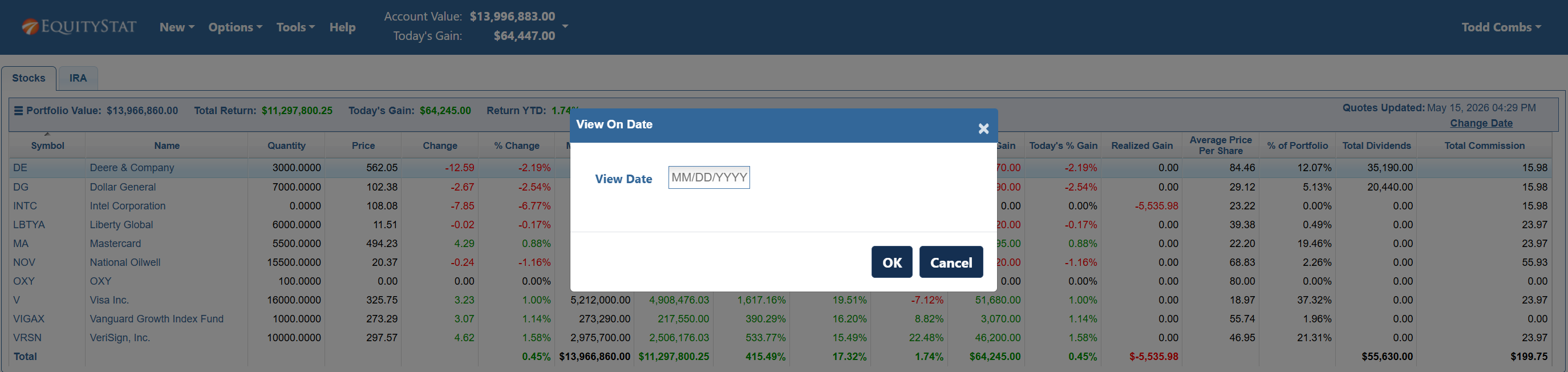
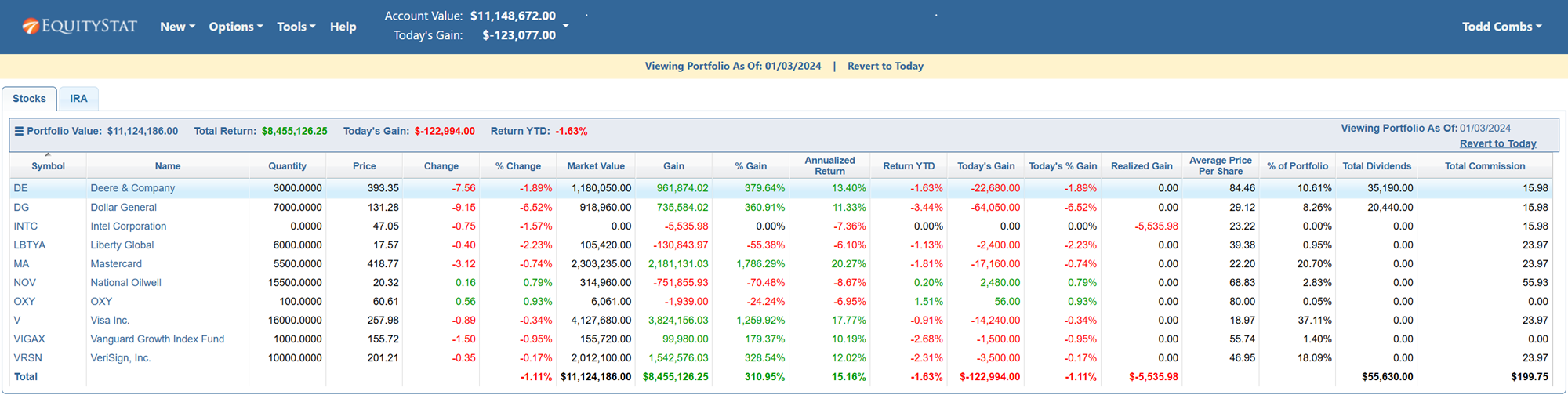
The View On Date feature allows you to examine your portfolio exactly as it appeared on a specific past date. When you select a past date:

  • Only the investments you held on that date will be displayed.
  • Performance metrics are calculated using the closing prices from that date, giving you an accurate snapshot of your historical portfolio performance.

Whether you’re reviewing historical performance, analyzing past trades, or comparing growth over time, this tool gives you precise insight into your investment history.

How to Use “View On Date”

View your EquityStat stock portfolio on a past date.
  1. Via the Options Menu:
    • Click the Options menu at the top of your portfolio dashboard.
    • Select View On Date from the dropdown.
    • Enter the past date you want to review in the dialog box.

  2. Using the Change Date Link:
    • Underneath the “Quotes Updated” date, click Change Date to select a past date.

  3. Portfolio Analysis for Past Dates:
    • In the upper right-hand corner of your portfolio dashboard, click the View On Date link to access historical portfolio analysis.

Once you’re viewing your portfolio on a past date, a banner message at the top of the page will show the date you’re analyzing. To return to your current holdings, simply click Revert To Today.

View your EquityStat stock portfolio on a past date.

Why Investors Will Love This Feature

  • Historical Insights: Understand how your portfolio has performed over weeks, months, or even years.
  • Performance Analysis: Evaluate the impact of past decisions to refine your investment strategy.
  • Simplified Tracking: No more manual tracking or spreadshee, see past performance directly in EquityStat.

This feature makes EquityStat not just a real-time portfolio tracker, but a historical analysis tool that empowers investors to make smarter decisions.

Start Exploring Your Portfolio History Today

With EquityStat’s View On Date feature, you have complete control over your portfolio insight, past, present, and future. Stay informed, track your progress, and make confident investment decisions all from a single platform.

2025 IRS Form 8949: How to Quickly Generate Your Capital Gains Report with EquityStat

If you sold stocks, ETFs, mutual funds, or other investments during 2025, you’ll need to report your gains and losses on IRS Form 8949 when filing your 2025 tax return. To make this process faster and more accurate, EquityStat now provides an automated Form 8949 generator.

What Is IRS Form 8949?

IRS Form 8949 is the official document used to report:

  • Short‑term capital gains and losses (assets held for one year or less)
  • Long‑term capital gains and losses (assets held for more than one year)

If you sold any taxable investment in 2025, including stocks, mutual funds, ETFs, this form will help your tax preparer produce your tax return.

Generate tax form 8949 with EquityStat

Generate Your 2025 Form 8949 Automatically in EquityStat

EquityStat’s updated tools now support instant creation of the 2025 Form 8949, helping you avoid manual calculations and spreadsheet errors.

How to Generate Form 8949 in EquityStat

  1. Open the Tools menu in your EquityStat dashboard
  2. Select Generate IRS Form 8949
  3. Choose the tax year you want to generate Form 8949 for
  4. Click Generate on the Form 8949 page

Within seconds, EquityStat calculates:

  • Short‑term gains and losses
  • Long‑term gains and losses
  • Adjusted cost basis
  • Totals required for Schedule D

A PDF formatted exactly to IRS specifications is created and ready for download.

What You Can Do With Your Generated Form 8949

Your completed PDF can be:

  • Uploaded directly into your tax software
  • Sent to your accountant or tax preparer
  • Printed and included with a paper tax return

This ensures your capital‑gains reporting is complete, accurate, and compliant.

Why Investors Choose EquityStat for Form 8949

EquityStat is built for both high‑volume traders and long‑term investors who want reliable tax reporting. Key benefits include:

  • Accurate cost‑basis tracking
  • Automatic gain/loss calculations
  • Fast PDF generation
  • Support for stocks, ETFs, and mutual funds
  • Ideal for 2025 tax‑filing deadlines

Who Should Generate Form 8949?

You should create Form 8949 if you:

  • Sold stocks or ETFs in 2025
  • Sold mutual funds or index funds
  • Need a clean, IRS‑ready summary of gains and losses

If you had any investment sales in 2025, EquityStat’s Form 8949 generator saves time and reduces the risk of filing errors.

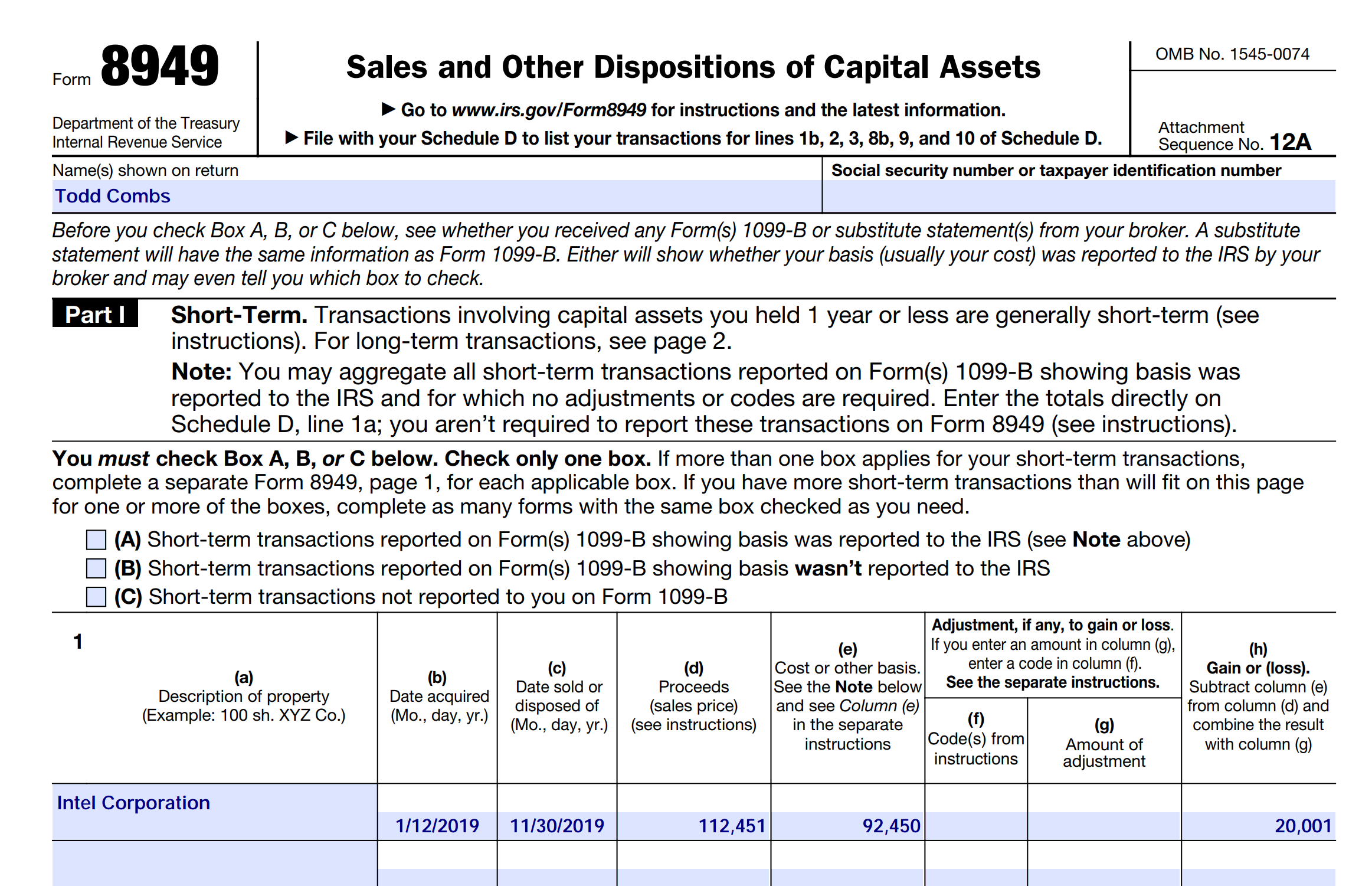
Example: What Your Form 8949 Output Includes

Your generated PDF contains:

  • Part I: Short‑term transactions
  • Part II: Long‑term transactions
  • Totals for gains and losses
  • IRS‑compliant formatting and layout

This ensures your tax return is complete and ready for submission.

2024 8949 IRS Tax Form Released

How to Generate Your Capital Gains and Losses Report

If you sold stocks or other investments in 2024, the IRS requires you to report your short‑term and long‑term capital gains and losses using IRS Form 8949. EquityStat now offers a fast, accurate way to generate this form automatically, perfect for tax filing season.

What is IRS Form 8949

IRS Form 8949 is used to report:

  • Short‑term capital gains/losses (assets held 1 year or less)
  • Long‑term capital gains/losses (assets held more than 1 year)

If you sold stocks, ETFs, mutual funds, crypto, or other investments in 2024, you must include this form with your tax return.

Generate the 2024 IRS Form 8949

EquityStat supports automatic creation of the 2023 Form 8949, making tax prep easier and more accurate.

How to Generate Form 8949 in EquityStat

  1. Open the Tools menu.
  2. Select Generate Form 8949.
  3. On the Form 8949 page, click Generate.
  4. EquityStat instantly calculates:
    • Short‑term gains/losses
    • Long‑term gains/losses
  5. A PDF version of IRS Form 8949 is created for download.

This PDF is formatted exactly as required by the IRS.

What You Can Do With the Generated Form 8949

  • Send it directly to your tax preparer
  • Upload it to your tax software
  • Print and include it with your paper tax return

Why Use EquityStat for Form 8949?

  • Accurate capital gains calculations
  • Automatic cost‑basis tracking
  • Fast PDF generation
  • Ideal for active traders and long‑term investors
  • Perfect for 2023 tax filing deadlines

Who Should Generate Form 8949?

You should generate this form if you:

  • Sold stocks in 2023
  • Sold ETFs or mutual funds
  • Sold crypto assets
  • Need a clean, IRS‑ready gains/losses report

If you had any investment sales in 2024, EquityStat’s Form 8949 generator saves time and reduces errors.

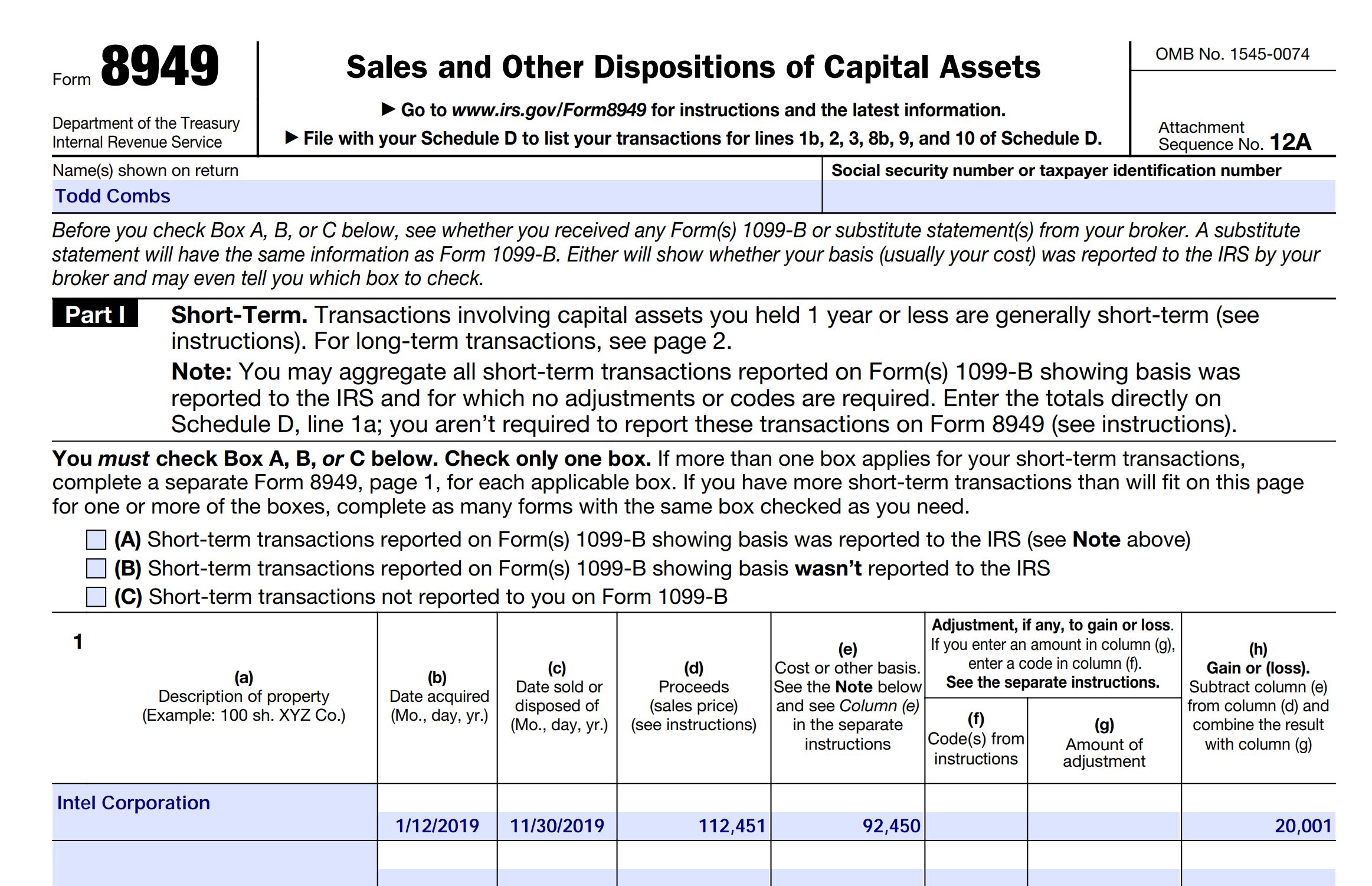
Example: IRS Form 8949 Output

Generate IRS Form 8949 to track your investment gains and losses for your taxes.
Form 8949 Example

Your generated PDF includes:

  • Short‑term transactions (Part I)
  • Long‑term transactions (Part II)
  • Totals for gains and losses
  • IRS‑compliant formatting

This ensures your tax filing is complete and accurate.

Start Your 2024 Form 8949 Now

If you sold investments in 2023 and need to calculate your gains or losses, use EquityStat’s Generate Form 8949 tool today.

Best and Worst Stocks of 2024

The stock market ended 2024 near record highs. The Nasdaq Composite rallied by 30%, while the S&P 500 climbed over 24%. The blue-chip Dow Jones rose a more modest 13%. The S&P 500 clinched 57 records, making it one of the top five years for most all-time highs recorded by the benchmark index.

Technology and Communications Services were the standout sectors, thanks to the artificial intelligence boom. Big Tech stocks, including Nvidia, Tesla, Alphabet, Amazon, Apple, Microsoft, and Meta, posted significant gains. Nvidia, in particular, rallied more than 175%

Here are the best performing stocks of 2024.

Best performing stocks of 2024

Here are the worst performing stocks of 2024.

Worst performing stocks of 2024

You can read more about the best and worst performing stocks here and here.

Note, if you want to share your portfolio in image format like you see above, go to here.

Tech Times Recognizes EquityStat as the Best Investment Portfolio Management Software

In its annual review of financial technology tools, Tech Times named EquityStat the Best Investment Portfolio Management Software. This recognition highlights EquityStat’s growing influence in the fintech space and its commitment to helping investors make smarter, data‑driven decisions. As more individuals seek reliable tools to track and optimize their investments, EquityStat continues to stand out as a trusted platform for both new and experienced investors.

A Modern Solution for Today’s Investors
The investment landscape has changed dramatically over the past decade. With market volatility, rapid economic shifts, and an increasing number of retail investors entering the market, the need for accurate, real‑time portfolio tracking has never been greater. EquityStat addresses these challenges by offering a streamlined, intuitive platform that gives investors the insights they need to stay ahead.

Tech Times highlighted several reasons why EquityStat earned the top ranking:

Clean, user‑friendly interface Whether you’re a beginner or a seasoned investor, EquityStat makes portfolio management simple and accessible.

Real‑time market and portfolio data Investors can monitor performance instantly, allowing them to react quickly to market changes.

Advanced performance analytics EquityStat provides detailed metrics, trend analysis, and historical comparisons that help users understand how their investments are performing over time.

Personalized portfolio insights The platform adapts to each user’s investment style, risk tolerance, and long‑term goals.

Designed for Investors at Every Level

One of the reasons EquityStat has gained such a strong following is its ability to serve a wide range of investors. Beginners appreciate the platform’s simplicity and educational value, while experienced investors rely on its precision and analytical depth.

EquityStat is especially valuable for:

  • Long‑term investors tracking retirement portfolios
  • Active traders monitoring daily performance
  • Tech‑sector investors who need fast, accurate data
  • Individuals managing multiple brokerage accounts
  • Anyone seeking a clearer picture of their financial progress

By consolidating data and providing actionable insights, EquityStat helps users make informed decisions that support long‑term financial growth.

Why Tech Times’ Recognition Matters

Tech Times is known for its in‑depth reviews of technology products and software solutions. Its annual rankings influence consumer decisions and highlight the tools that deliver real value. Being named the best investment portfolio management software places EquityStat among the most trusted and innovative platforms in the fintech industry.

This recognition also reinforces EquityStat’s mission: to empower everyday investors with the same level of insight and clarity that professional analysts rely on.

You can read the entire article here.

https://www.techtimes.com/articles/294138/20230724/top-5-best-investment-portfolio-management-software-2023.htm

Automatic Stock Price Lookup: A New Way to Log Trades Faster in EquityStat

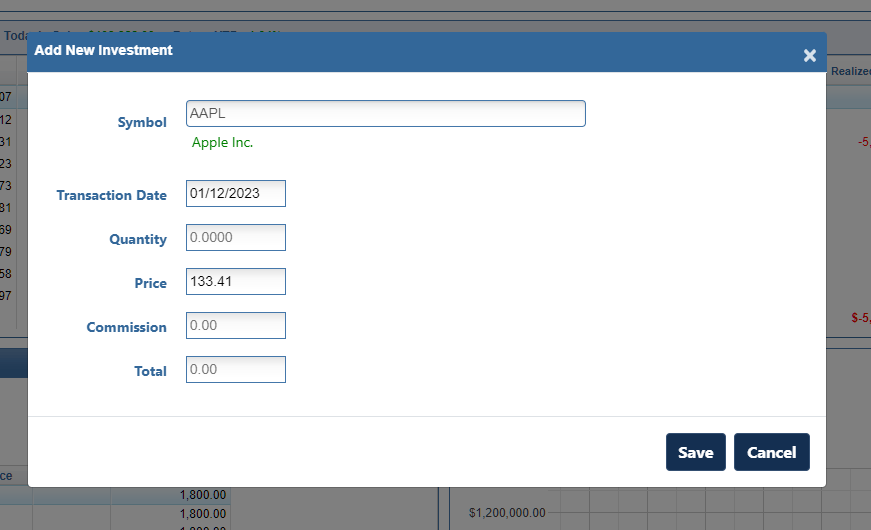
EquityStat’s stock portfolio tracker now fills in the price of a stock automatically whenever you add a new investment or log a transaction, so you no longer have to look up the exact price of a stock on a specific day by hand.

How Automatic Stock Price Entry Works

When you enter a new stock, ETF, or add a transaction to an investment you already track, EquityStat pulls the closing price, or the current price if the market is still open, for that exact date and places it in the Price field for you. You do not have to search another site or dig through old statements to find the number.

If the price shown is not the one you actually paid or received, you can simply type over it. The automatic price is a starting point, not a requirement.

Example of the auto price feature in EquityStat's portfolio tracker
Example of the auto price feature in EquityStat’s portfolio tracker

Why This Feature Matters for Investors

Many investors do not remember the exact price they paid for a stock, months or years earlier. This feature was built for that exact situation. If you know you bought Apple stock on January 12, 2023 but cannot recall the price, EquityStat fills in the closing price from that date, $134.56, without any extra effort on your part. If your actual purchase price was different, you can adjust it in seconds.

This makes it much easier to keep an accurate, up to date portfolio tracker, even when you are recording trades after the fact or catching up on transactions from earlier in the year.

Look Up Historical Stock Prices in Seconds

The same feature also works as a quick way to check what a stock was trading for on any past date. Select the stock, enter the date, and the price appears immediately. This is useful for confirming cost basis, checking historical performance, or simply satisfying curiosity about how a stock has moved over time.

Start Tracking Your Portfolio More Efficiently

Automatic price entry is one more way EquityStat helps investors manage their stocks, ETFs, mutual funds, and other holdings without unnecessary manual work. If you have not tried EquityStat’s portfolio tracker yet, see how it works and start tracking your investments with less effort and more accuracy.

EquityStat: The Best Alternative to Morningstar’s Legacy Portfolio Manager

Looking for an Alternative for Morningstar’s Legacy Portfolio Manager?

Morningstar has discontinued its legacy portfolio tracker, leaving many investors searching for a reliable, easy‑to‑use alternative. EquityStat is a powerful, intuitive stock portfolio tracker built by investors for investors and it’s one of the best replacements available today.

Why EquityStat Is the Ideal Morningstar Legacy Portfolio Alternative

EquityStat offers a clean, simple interface and robust performance tracking tools designed for everyday investors and active traders.

Key Benefits

  • Aggregate all your investment accounts in one place
  • Track your dividends and capital gains
  • View account and portfolio value and gain/loss
  • Analyze individual stocks, ETFs, and mutual funds
  • See today’s gain/loss, annualized return, realized gains, and return ytd
  • Review every transaction for each investment
  • Import transactions manually or via spreadsheet
  • Create multiple portfolios for better organization
  • View performance graphs and compare to stock market indexes
  • View your portfolio on a previous date

What You Can Track With EquityStat

EquityStat provides detailed analytics for each investment, including:

  • Daily gain/loss
  • Annualized return
  • Return YTD
  • Realized gains
  • Transaction history
  • Portfolio‑level and account‑level value and performance

Portfolio Analysis Tools

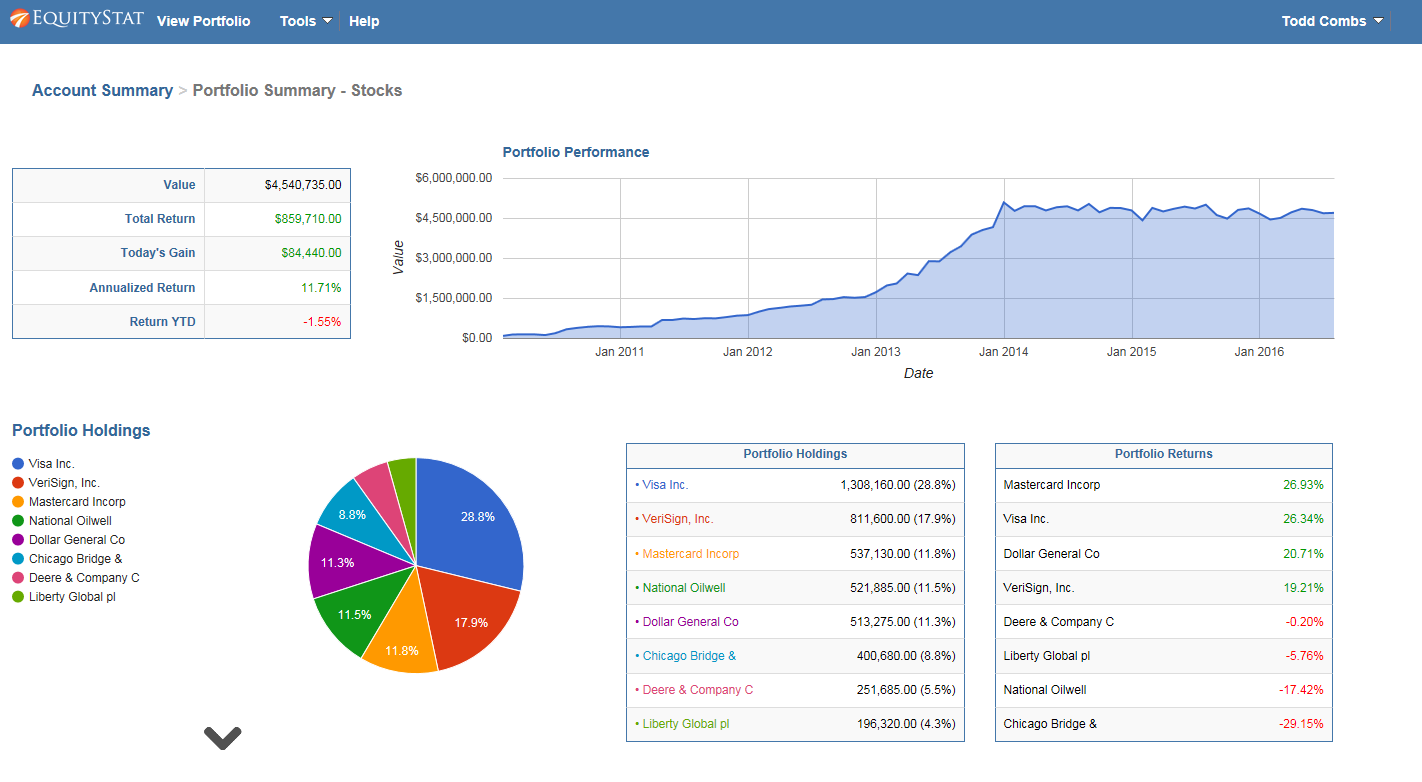
EquityStat includes a powerful Portfolio Analysis page that helps you:

  • Compare performance across multiple portfolios
  • Identify top‑ and bottom‑performing investments
  • View performance charts over time and compare to stock indexes
  • Analyze holdings and allocation

This is especially useful for investors managing multiple accounts or diversified portfolios.

Analyze your stock portfolio
Example of EquityStat’s Portfolio Analyze Page

Importing Your Morningstar Legacy Portfolio

If you previously used Morningstar’s legacy portfolio manager, EquityStat makes it simple to transition.

You’ll be up and running quickly with your full investment history intact.

Why Investors Choose EquityStat

  • Built by investors, for investors
  • Simple, intuitive interface
  • Accurate performance calculations
  • Fast, reliable, and easy to use
  • Ideal for stock, ETF, and mutual fund tracking
  • A strong alternative to Morningstar’s Legacy Portfolio manager discontinued tool

If you’re disappointed to see Morningstar’s legacy portfolio manager go, EquityStat is the perfect replacement.

If you need help importing your Morningstar Legacy portfolio manager into EquityStat, contact our support staff here.

Refresh User Interface For Mobile Phones

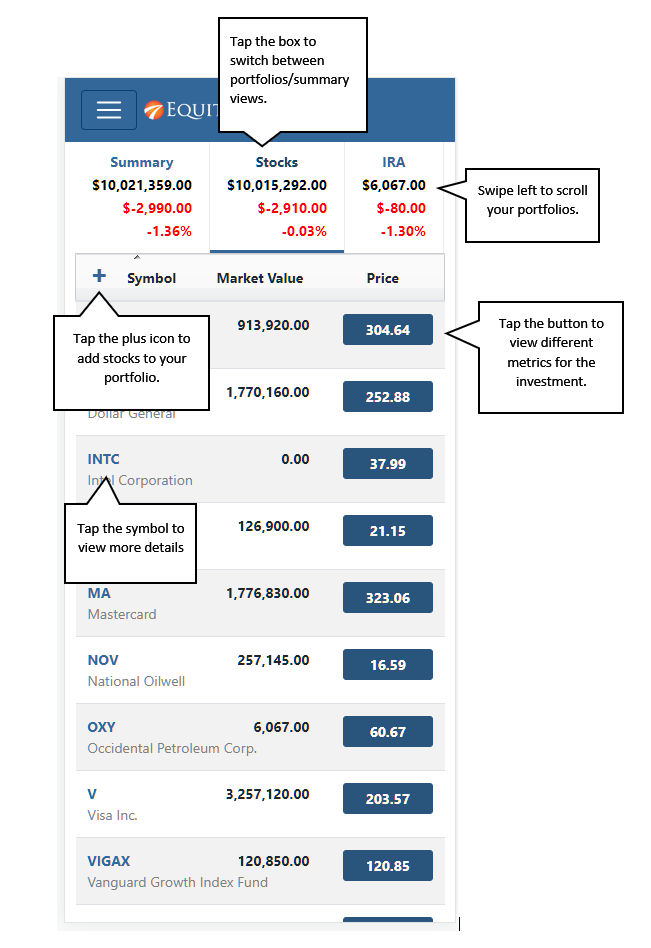
We have recently refreshed the user interface of your EquityStat portfolio on mobile devices. The user interface now looks, feels and works like a mobile app. If you have ever used the Weather Channel App or the ESPN App on your mobile phone, EquityStat works very similar.

To view your EquityStat account on a mobile phone, open up the phone’s web browser, go to www.equitystat.com and login to your account.

EquityStat stock portfolio tracker on a mobile phone.
Example EquityStat Account on a Mobile Phone.

You will then see a list of all your portfolios at the top. You can swipe left at the top to scroll through all of your portfolios. Tap a “portfolio box” to see the investments in each portfolio.

To see details about a specific investment, tap the symbol for the investment. To view metrics about a specific investment tap the price button. Continue tapping the button to cycle through all of the investment metrics.

To add a new investment to your portfolio, tap the plus icon.

Google Finance Portfolio Is Gone, Here’s What to Do

If you’re searching for your Google Finance portfolio and can’t find it, you are not alone. Google discontinued the portfolio tracking feature inside Google Finance, and searches for “my portfolio” on Google Finance now come up empty for a lot of former users. This guide covers what happened, whether your data is still accessible, and how to move your investment history into a dedicated stock portfolio tracker like EquityStat.

What Happened to Google Finance’s Portfolio Feature?

Google Finance used to let you build and track an investment portfolio directly on the site, logging your holdings and watching their performance alongside market data. That feature has been discontinued. Google Finance today still shows stock quotes, charts, and market news, but it no longer supports the portfolio tracking tool that many investors relied on for years.

Can You Still View or Access Your Google Finance Portfolio?

If you built a portfolio in Google Finance before the feature was removed, you generally can no longer view or manage it through the Google Finance interface itself. There isn’t a way to log back in and see your old portfolio the way it used to appear. The good news is that your underlying transaction data isn’t necessarily lost. If you exported or downloaded your transactions before the feature was removed, or if you still have access to the export tool, you can use that data to rebuild your portfolio somewhere else, which is exactly what the steps below walk through.

What Data Transfers When You Export From Google Finance

When you export your Google Finance transactions, you’re getting a spreadsheet of your recorded buys, sells, and other transaction history, not a full copy of your account or your original portfolio layout. That means things like custom watchlist groupings or notes you may have added won’t carry over. What does carry over, and what actually matters for tracking performance going forward, is your transaction history: the trades that determine your holdings, cost basis, and gains or losses. That’s the data EquityStat needs to rebuild an accurate portfolio on your behalf.

How to Import Your Google Finance Portfolio into EquityStat

If you’re looking for an alternative to Google Finance’s discontinued portfolio manager, you can import your existing transaction history directly into EquityStat. Here’s how.

Step 1: Export your transactions from Google Finance

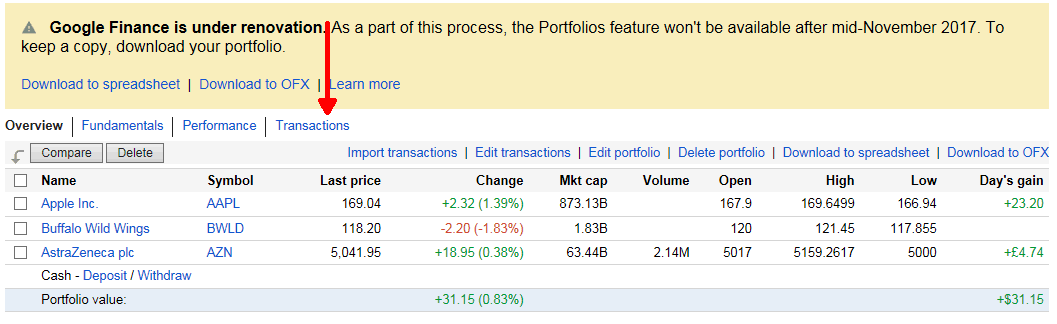
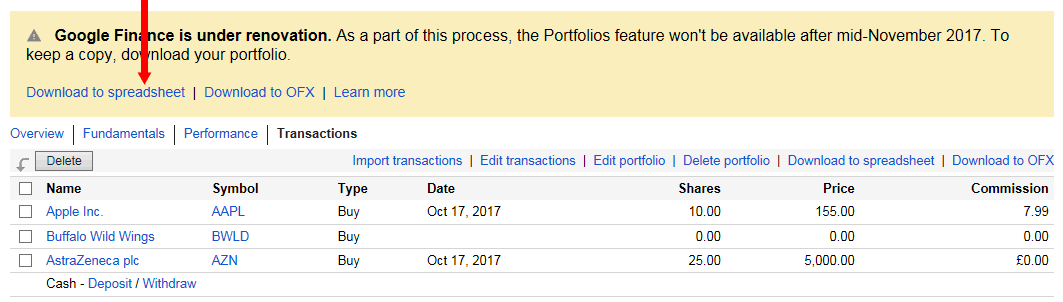
Log in to your Google Finance portfolio and locate the Transactions link. From there, use the download or export option to save your transaction history as a spreadsheet file to your computer.

On the Google Finance transactions page, click the Download to Spreadsheet link and save the downloaded file to your hard drive.

Step 2: Log in to your EquityStat account

If you don’t already have an EquityStat account, you can create one for free before continuing.

Step 3: Start the import

In EquityStat, click the New menu at the top of the screen and choose Import Transactions from the dropdown.

Step 4: Upload your file

On the import page, click Browse to locate the spreadsheet file you saved in Step 1, then click Import to load it.

Step 5: Review and confirm

EquityStat will show you a summary of the transactions it’s about to import. Review the summary, correct any errors it flags, and once everything looks right, click Import Data to finish bringing your Google Finance transaction history into EquityStat.

What You Get Once Your Data Is Imported

Once your transaction history is in EquityStat, you are not just looking at a static copy of your old Google Finance portfolio. You get a working stock portfolio tracker – real-time price updates, performance metrics like annualized return and year-to-date return, dividend tracking, and benchmark comparisons against the S&P 500, Dow Jones, and Nasdaq, all of which Google Finance’s portfolio tool never offered.

Print Your Stock Portfolio

How to Print Your Portfolio

To begin, open your EquityStat account and navigate to the Tools menu located at the top of the screen. From the dropdown list, select Print Portfolio. This will take you to a dedicated printing page designed specifically for generating portfolio reports.

Choose What You Want to Print

On the print page, you’ll see options that let you decide exactly which portfoli, or portfolio you want to include.

  • You can print a single portfolio if you only need information for one set of investments.
  • Or, if you manage several portfolios, you can choose to print all of them at once, making it easy to create a complete snapshot of your entire investment landscape.

This flexibility is especially helpful for users who track different strategies, accounts, or goals and want a consolidated view.

Generate a PDF

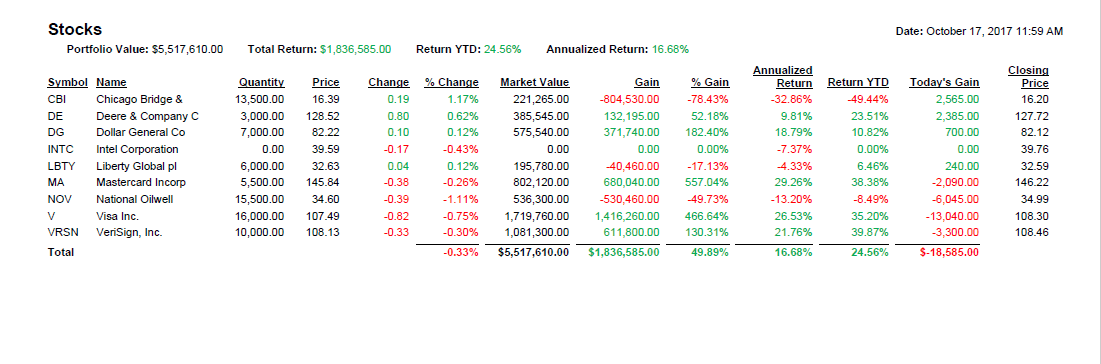
Print your EquityStat Stock Portfolio to a pdf and send to your printer.
Print Portfolio Screenshot

Once you’ve selected your portfolio(s), click the Print button. EquityStat will automatically generate a PDF file containing your portfolio details. From there, you can:

  • Print the PDF directly to your home or office printer
  • Save the file to your computer for record‑keeping
  • Email or share the PDF with advisors, accountants, or anyone else who needs access

The PDF format ensures your portfolio is neatly formatted, easy to read, and consistent every time you print it.

Enhancing EquityStat to Better Support Modern Investors

The addition of this print feature is just one example of how we continue to evolve EquityStat to meet the needs of modern investors. Many users rely on printed reports for meetings, tax preparation, long‑term planning, or simply for peace of mind. By offering a fast, reliable way to generate PDFs or hard copies of your portfolios, we aim to make your investment management experience smoother, more flexible, and better aligned with the way you prefer to work.


EquityStat: The Best Alternative to the Yahoo Finance Portfolio Manager

Many investors today are searching for a reliable alternative for the Yahoo Finance portfolio manager. Over the years, Yahoo Finance has made several changes to its stock tracking tools, changes that have frustrated long‑time users who depend on accurate, fast, and intuitive portfolio tracking. If you’ve been struggling with the Yahoo Finance stock portfolio tracker, you are not alone. Thousands of investors are looking for a better solution.

That’s exactly where EquityStat stands out.

EquityStat was built by investors, for investors. Our goal has always been to create a powerful, clean, and easy‑to‑use portfolio manager that gives you more control, more data, and a better overall experience than Yahoo Finance.

EquityStat was founded by investors. As investors we understand what other investors are looking for in a portfolio manager. For example, one of our goals was to make EquityStat’s Portfolio manager show as much information on your screen without you having to constantly scroll around to see your data. Unlike Yahoo, EquityStat does not show ads, so this gives us more room to show more information about your investments and how they are performing.

EquityStat Financial Stock Portfolio
Stock Portfolio Example

Why Investors Are Moving Away from the Yahoo Finance Portfolio Manager

The Yahoo Finance portfolio manager has historically been popular, but recent updates have made the tool less efficient for serious investors. Common complaints include:

  • Cluttered screens filled with ads
  • Slow loading times
  • Missing or removed features
  • Limited customization
  • Reduced visibility of important data

For investors who track multiple stocks, ETFs, mutual funds, or long‑term positions, these limitations can make daily portfolio management frustrating.

This is why so many users are actively searching for a better Yahoo Finance stock portfolio tracker alternative—and discovering EquityStat.

EquityStat: A Better, Smarter Stock Portfolio Tracker

EquityStat’s portfolio manager was designed to solve the problems investors face with Yahoo Finance. Instead of ads, clutter, and limited data, EquityStat focuses on clarity, speed, and usability.

1. A Clean, Ad‑Free Interface

Unlike the Yahoo Finance portfolio manager, EquityStat does not display ads. This gives you more screen space, faster load times, and a cleaner view of your investments.

2. More Data on Your Screen

One of the biggest complaints about Yahoo Finance is how much scrolling is required to see your full portfolio. EquityStat solves this by displaying more information at once, allowing you to analyze your holdings without constantly moving around the page.

3. Built by Investors Who Understand Your Needs

EquityStat was created by people who actively invest. We know what matters:

  • Clear performance metrics
  • Easy navigation
  • Fast updates
  • Accurate data
  • Customizable portfolio columns

Every feature is designed to help you make smarter investment decisions.

4. A Better Long‑Term Portfolio Tracking Experience

EquityStat gives you the tools you need to track performance over time, monitor gains and losses, and understand how your investments are performing, without the limitations of the Yahoo Finance stock portfolio tracker.

We Want to Improve Even More — Tell Us What You Need

If there is a feature you liked in the Yahoo Finance portfolio manager that EquityStat does not yet include, we want to hear about it. Our development roadmap is driven by user feedback, and we take every suggestion seriously.

Our mission is simple: Build the best stock portfolio tracker for investors who want accuracy, clarity, and control.

Try EquityStat Today — A Better Alternative to Yahoo Finance

If you’re looking for a powerful, clean, and reliable replacement for the Yahoo Finance stock portfolio tracker, EquityStat is ready for you. Experience a portfolio manager that actually works the way investors need it to.

Yahoo Finance Stock Portfolio Tracker Changes, Best Alternatives and How EquityStat Compares

Yahoo Finance Has Changed Its Stock Portfolio Tracker

Yahoo Finance recently updated its stock portfolio tracker, and many long‑time users are finding the new version harder to use or missing key features. If you relied on Yahoo Finance to track your stocks, ETFs, or mutual funds, EquityStat offers a powerful, easy‑to‑use alternative with more flexibility and better performance tracking.

Why Many Investors Are Looking for a Yahoo Finance Alternative

Yahoo Finance’s portfolio manager was once one of the most popular online tools for tracking investments. But recent changes have removed features, altered layouts, and made the interface less intuitive for many users.

If you’re searching for a replacement that feels familiar but offers more control, EquityStat is designed for exactly that.

EquityStat: A Modern, Feature‑Rich Alternative to Yahoo Finance Portfolio Tracker

EquityStat includes many of the same features Yahoo Finance users expect, plus several advanced tools Yahoo does not offer.

Core Features Similar to Yahoo Finance

  • Track stocks, ETFs, and mutual funds
  • View current portfolio value
  • Monitor daily gain/loss
  • See percentage gain since purchase
  • Review realized gains
  • Access full transaction history
  • View your portfolio on a previous date

These features make the transition from Yahoo Finance smooth and familiar.

Features EquityStat Offers That Yahoo Finance Investment Portfolio Does Not

EquityStat includes several powerful tools that go beyond Yahoo’s capabilities:

1. Clear, At‑a‑Glance Portfolio Performance

At the top of your dashboard, you immediately see:

  • Total portfolio value
  • Total return
  • Today’s gain/loss

No extra clicks. No digging through menus.

2. Create Multiple Portfolios

Organize your investments into separate portfolios such as:

  • Personal brokerage
  • 401(k) or IRA
  • Joint accounts
  • Taxable vs. tax‑advantaged accounts

Track each portfolio individually or view your entire account’s performance.

3. Less Scrolling, More Data

EquityStat automatically adjusts to your screen size, making it easier to view all your data without endless scrolling, something Yahoo’s layout struggles with.

4. Detailed Performance Calculations

For each investment, portfolio, and your overall account, you can view:

  • Current market value
  • Total gain
  • Today’s gain
  • Annualized return
  • Cost basis
  • And more

These metrics help you understand exactly how your investments are performing.

5. Full Transaction Management

For each investment, you can easily:

  • View all transactions
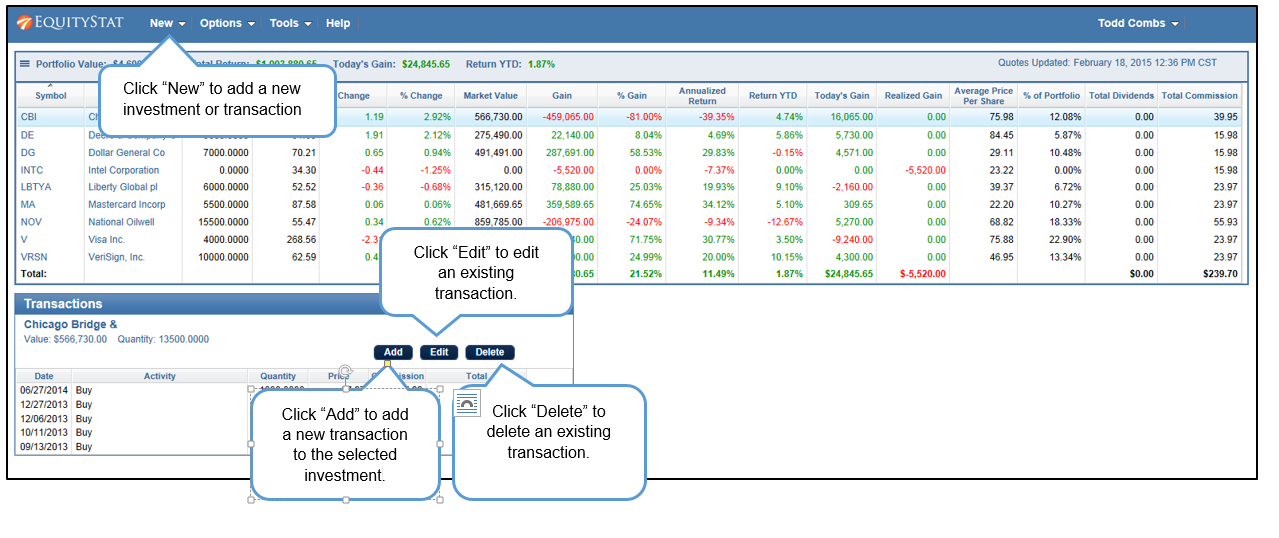
  • Add new transactions
  • Edit existing entries
  • Delete incorrect entries

Everything is grouped neatly for fast access.

6. Hide or Show Sold Investments

Toggle between:

  • A clean view of current holdings, or
  • A full historical view including sold positions

Perfect for tax planning and performance review.

7. Customize Your Portfolio Columns

Add or remove data columns such as:

  • Return YTD
  • Annualized Return
  • Dividend yield
  • Market value
  • Cost Basis

Build the exact view you want, something Yahoo Finance does not allow.

8. Import Your Data Easily

Upload your transactions using:

  • A spreadsheet
  • A CSV file

No need to re‑enter years of history manually.

9. Generate IRS Tax Forms

If you sold investments, EquityStat can generate IRS Form 8949, which tax preparers use to calculate capital gains. Yahoo Finance does not offer this.

10. Export Your Data for Safekeeping

Download your transactions to a spreadsheet for backup or offline analysis.

11. 24/7 Support

Have a question? EquityStat’s support team is available 24 hours a day, 7 days a week.

12. Works on Any Device

Because EquityStat is built with modern web technology, you can access your portfolio on:

  • Desktop
  • Laptop
  • Tablet
  • Mobile phone

No plugins. No compatibility issues.

2016 8949 IRS Tax Form Released

We just released the 2016 8949 IRS tax forms.  IRS Form 8949 is a form that reports your short and long term gains for any sold investments in the tax year.  You can give Form 8949 to your tax preparer which assists in preparing Schedule D on your tax return.  To generate Form 8949 click the Tools menu and choose the “Generate Form 8949” menuitem.

Print IRS Form 8949 with EquityStat's Investment Portfolio Manager
IRS Form 8949

EquityStat Receives Nomination for Benzinga Fintech Award

EquityStat is proud to announce that it has been nominated for a technology award in the annual Benzinga Fintech Awards, a nationally recognized program that highlights the most innovative companies shaping the future of financial technology. This nomination reflects EquityStat’s commitment to delivering a clear, unified, and accessible portfolio‑tracking experience for investors.

About Benzinga

Benzinga is one of the leading financial media and data companies in the United States. Known for its fast, actionable market news and deep coverage of fintech innovation, Benzinga reaches millions of investors, traders, and financial professionals every month. The platform is widely respected for identifying emerging technologies and spotlighting companies that are transforming how people interact with financial markets.

About the Benzinga Fintech Awards

The Benzinga Fintech Awards recognize companies that are redefining the financial services industry through technology, accessibility, and user‑focused design. The awards highlight platforms that:

  • Improve the investing experience
  • Increase financial transparency
  • Simplify complex financial tasks
  • Empower everyday investors
  • Advance innovation in fintech

A nomination places a company among the most forward‑thinking and impactful fintech innovators in the market.

Why EquityStat Was Nominated

EquityStat was nominated for its ability to solve one of the most persistent challenges facing modern investors: fragmented investment data spread across multiple accounts and institutions. The platform provides a unified, real‑time portfolio‑tracking solution that allows users to view all their holdings in one place.

Key capabilities highlighted in the nomination include:

  • A single dashboard for all investment accounts
  • Real‑time stock, ETF, and mutual fund quotes
  • Automatic portfolio valuation
  • Performance tracking for each individual investment
  • Historical charts and long‑term performance trends
  • A clean, intuitive interface accessible from any device

This nomination underscores EquityStat’s mission to make investment tracking simple, accurate, and accessible for all investors.

Click here to read the full article.


New Feature – Cash Transactions

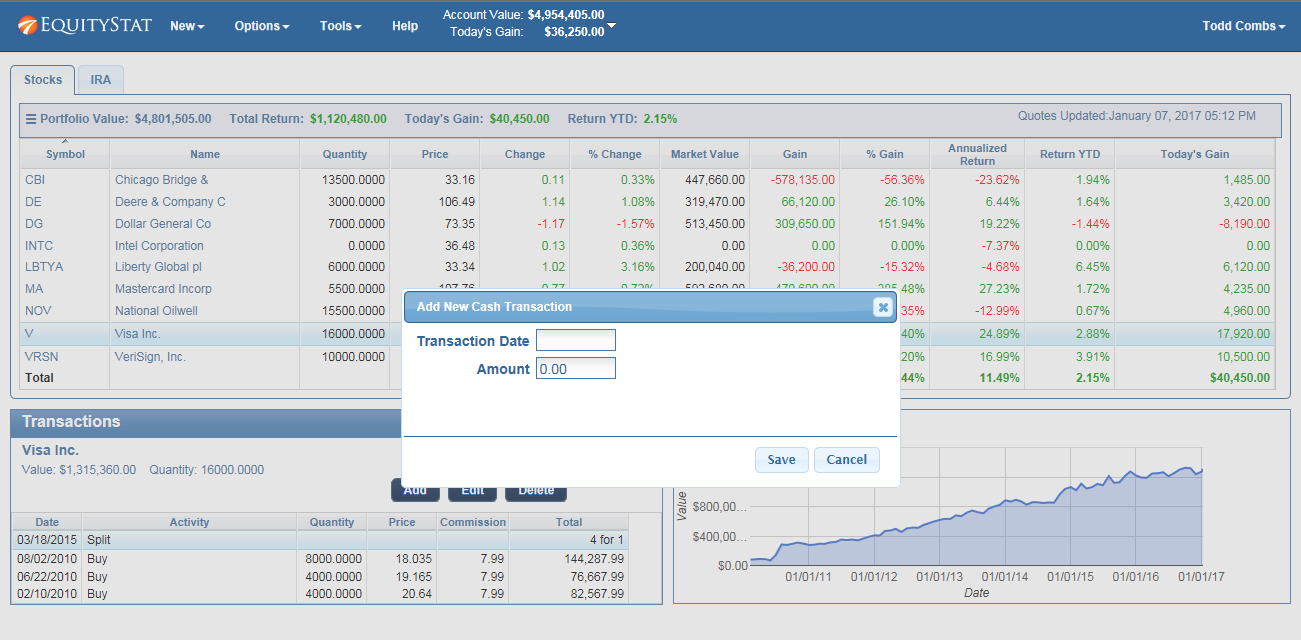
We have recently added a new feature.   You can now add cash transactions to your portfolio.  To add a cash transaction, click the New menu and then choose the “New Cash Transaction” menuitem from the drop down menu.  In the popup dialog, add the date of the cash transaction and the amount of the transaction.

Add Cash to Your EquityStat Portfolio
Add Cash To Your Investment Portfolio

Once you have added a cash transaction, any non-reinvested dividends added to your other investments will be added to your cash.

Portfolio Analysis – New Feature

How to Analyze Your Investment Portfolio in EquityStat

EquityStat has introduced a powerful Portfolio Analysis tool that helps investors evaluate performance, track holdings, and compare returns across multiple portfolios. This feature gives you a clear, data‑driven view of how your investments are performing over time.

What the Portfolio Analysis Tool Does

The Portfolio Analysis page provides a complete performance overview of your account and individual portfolios. You can quickly see:

  • Overall account performance over time
  • Portfolio‑level performance metrics
  • Investment holdings and allocation
  • Daily, quarterly, and yearly performance rankings
  • Best‑ and worst‑performing investments

This makes it easy to understand which assets are driving your returns and where adjustments may be needed.

How to Access Portfolio Analysis in EquityStat

To run a portfolio analysis:

  1. Click the Tools menu at the top navigation bar.
  2. Select Analyze Portfolio from the dropdown.
  3. The system will generate a detailed analysis of your account and portfolios.

What You’ll See on the Portfolio Analysis Page

Analyze your investment portfolio using EquityStat.
Analyze Portfolio Example

1. Account‑Level Performance Overview

If you manage multiple portfolios, the analysis begins with a full account‑wide performance summary, including:

  • A performance graph showing account growth over time
  • A breakdown of each portfolio’s performance
  • A ranked list of investment returns
  • A summary of all holdings across your account

2. Portfolio‑Specific Analysis

Click any portfolio name in the summary table to view:

  • Portfolio‑specific performance charts
  • Individual investment metrics
  • Best and lowest performers for the day, quarter, and year
  • A complete holdings list for that portfolio

If you only have one portfolio, the system automatically displays its analysis.

Key Performance Metrics Provided

The analysis includes detailed metrics such as:

  • Total return
  • Daily return
  • Quarterly return
  • Year‑to‑date return
  • Investment rankings
  • Growth charts

These insights help you understand how each investment contributes to your overall performance.

Why This Matters for Investors

Whether you’re a beginner or an experienced investor, having a clear view of your portfolio’s performance is essential. EquityStat’s Portfolio Analysis tool helps you:

  • Track long‑term investment growth
  • Identify top‑performing investment
  • Spot underperforming investments
  • Make informed decisions based on real data
  • Manage multiple portfolios with ease
  • Track dividend income across all portfolios

Yahoo Portfolio No Longer Supports Transactions

If you haven’t heard, Yahoo’s investment portfolio manager will no longer be supporting transactions. This means that if you want to record all of your buys, sells, dividends, etc., you can no longer do so with Yahoo’s investment portfolio.  In other words, you can no longer track the history of your investments.  Without a transaction history you cannot get an accurate performance return of your investment and you can’t calculate your gains and losses for your taxes.  If you are a user of Yahoo’s portfolio manager and want an alternative, consider EquityStat’s portfolio manager.

With EquityStat you can easily add, edit and delete your investment transactions. You can also easily view your transactions for each investment.  In addition you can import these transactions into your portfolio by either manually entering them or importing them from a spreadsheet. If you want to save your transactions to your computer, you can export the transactions for each investment to a spreadsheet.

If you are looking for  portfolio manager that supports transactions, checkout EquityStat.

How to Track Your Stock’s Performance Over Time in EquityStat

A single number can only tell you so much about an investment. Knowing that a stock is up twelve percent this year does not tell you whether it climbed steadily or whether it dropped hard in the spring and clawed its way back by December. To really understand how an investment has behaved, you need to see it over time, not just where it stands today.

That is what a performance graph gives you, and it is built right into the EquityStat portfolio manager for every stock, ETF, and mutual fund you track.

Why a Graph Tells You More Than a Return Percentage

A return percentage answers one question. It tells you where you ended up. It does not tell you how bumpy the ride was to get there, whether the gains came early or late, or how the investment behaved during a market pullback. A performance graph fills in that missing context. You can see the shape of an investment’s history at a glance, which makes it much easier to judge how it actually fits your goals and how comfortable you are holding it through the next downturn.

How to View a Performance Graph in EquityStat

Pulling up the graph for any investment takes only a couple of clicks.

  1. Open the portfolio that contains the investment you want to review.
  2. Click on the individual stock, ETF, or mutual fund in the investment pane.
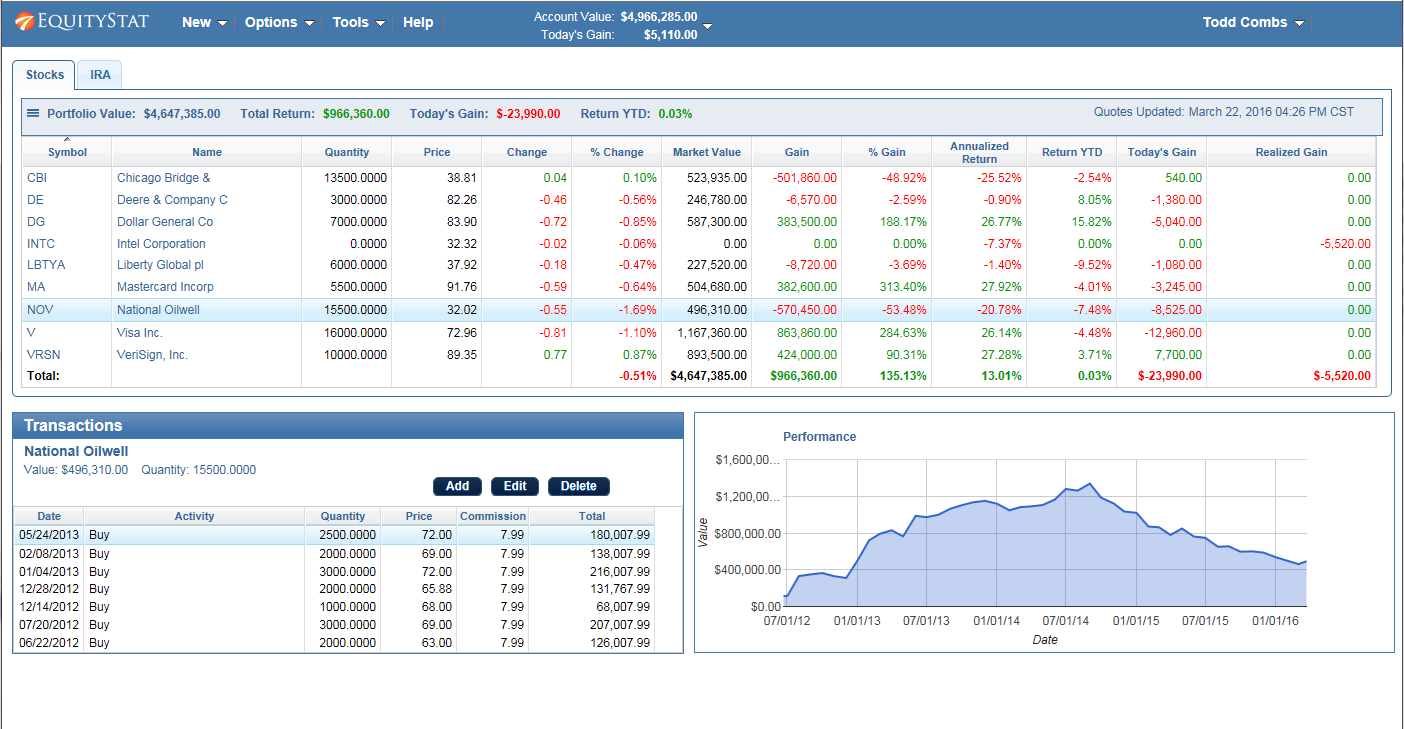
  3. The performance graph appears at the bottom right of the screen, right next to transaction pane.
EquityStat Portfolio Manager Stock Performance Graph
Performance graph for an individual stock in the EquityStat portfolio manager, shown next to the transaction history for that investment


From there you can see the investment’s price movement over time without leaving the page or pulling up a separate chart tool.

Compare Your Investments to the Market

Seeing a graph in isolation only tells part of the story. EquityStat also lets you compare the performance of an individual investment against the S&P 500, the Dow Jones, and the Nasdaq indexes, so you can quickly tell whether a stock is genuinely outperforming the market or simply moving with it. This kind of comparison is one of the fastest ways to separate a truly strong pick from one that just happened to rise along with everything else.

See Your Whole Portfolio’s Performance at Once

Individual investment graphs are useful, but sometimes you want the bigger picture. EquityStat also provides summary performance graphs for your entire account, along with the same kind of market comparison against major indexes, so you can judge how your overall strategy is doing, not just how one holding is doing.

Pulling it up takes only a couple of clicks as well.

  1. Click the Tools menu at the top of the page.
  2. Choose Analyze Portfolio from the drop down menu.
  3. The account performance graph will be at the top of the page.

From there you can see how your entire account has moved over time, right alongside the same kind of index comparison available for individual investments.

Why This Matters for Long Term Investors

If you hold investments for years rather than days, a single snapshot of your returns will only tell you so much. Watching how an investment has actually moved, and how it stacks up against the broader market, gives you a much clearer sense of whether it deserves a place in your portfolio going forward. It also makes it easier to stay calm during a rough stretch, since you can see that a dip today is often just one point on a much longer line.

Frequently Asked Questions

How do I see the performance graph for a specific stock in EquityStat? Open the portfolio that contains the investment, click on that investment in your list, and the performance graph will appear next to its transaction history.

Can I compare my investments to the S&P 500 or other indexes? Yes. EquityStat lets you compare the performance of an individual investment, as well as your entire portfolio, against the S&P 500, the Dow Jones, and the Nasdaq.

Does EquityStat show performance for my whole portfolio, not just one stock? Yes. In addition to graphs for individual investments, EquityStat provides a summary performance graph for your entire account.

How do I see the performance graph for my whole account? Click the Tools menu at the top of the page, choose Analyze Portfolio from the drop down menu, and the account performance graph will be at the top of the page.

2015 8949 IRS Tax Forms Released

We just released the 2015 8949 IRS tax forms. If you have sold any stocks or mutual funds in 2015, then you can generate IRS Form 8949 to calculate your gain or loss on a stock sale. EquityStat will automatically calculate your short-term gains and losses and long-term gains and losses and generate a PDF 8949 form. You can then save or print out this form and give it to your accountant or tax preparer. To generate Form 8949 click the Tools menu and then select the Generate Form 8949 menuitem.

New in EquityStat: Multiple Portfolios, Expanded Performance Metrics, and a Maximize View

Managing investments effectively requires tools that are flexible, intuitive, and powerful enough to handle real-world portfolios. These enhancements to EquityStat’s Portfolio Manager adds three specific improvements: the ability to create multiple portfolios, three new performance metrics (quarterly return, P/E ratio, and dividend yield), and a Maximize Portfolio view that expands your investment list to fill more of the screen. Together, these changes make it easier to organize multiple accounts, analyze performance more deeply, and view your investment data in a cleaner, more streamlined layout.

Whether you’re tracking stocks, mutual funds, ETFs, or retirement accounts, these new features help you stay on top of your financial picture with greater accuracy and efficiency.

Create and Manage Multiple Portfolios with Ease

One of the most significant upgrades is the ability to create multiple portfolios within your EquityStat account. This feature is ideal for investors who want to separate or categorize their holdings across different accounts or investment strategies.

Why Multiple Portfolios Matter
  • Better organization – Keep your brokerage accounts, retirement accounts, and long‑term holdings separate.
  • Clearer insights – Compare performance between strategies (e.g., growth vs. income).
  • Simplified reporting – Generate cleaner summaries for taxes, advisors, or personal tracking.

How to Create a New Portfolio

You can create a new portfolio directly from the New menu by selecting New Portfolio. Once created, each portfolio can be customized with its own set of investments, performance metrics, and display preferences.

New Performance Metrics for Deeper Investment Analysis

To help investors make more informed decisions, EquityStat has added several new performance‑focused data columns:

Newly Added Metrics

  • Quarterly Return – Track short‑term performance trends and identify momentum.
  • P/E Ratio (Price‑to‑Earnings) – Evaluate whether a stock is undervalued or overvalued.
  • Dividend Yield – Quickly see which holdings generate income and how much.

These metrics can be enabled from the Options menu under Change Columns, allowing you to tailor your dashboard to the data that matters most to you.

Maximize Your Portfolio View for Better Visibility

Large portfolios can sometimes require scrolling or navigating between panes to see all your holdings. To solve this, EquityStat now includes a Maximize Portfolio feature that expands your investment list to fill more of your screen.

What Maximize Mode Does

  • Expands the investment section to show more rows at once
  • Moves the transaction section downward for a cleaner layout
  • Reduces the need for scrolling and window adjustments

This is especially useful for investors with extensive holdings or those working on smaller screens.

To activate it, click the three‑line menu icon in the upper‑left corner of your portfolio and select Maximize. You can return to the default pane layout anytime by choosing Restore.

Why These Updates Matter for Investors

These enhancements aren’t just cosmetic, they are designed to improve the way you interact with your financial data:

  • Faster decision‑making thanks to clearer metrics
  • More efficient navigation with customizable portfolios
  • Better organization for multi‑account investors
  • Improved user experience across devices

As the investing landscape becomes more complex, having a flexible and powerful portfolio tracker is essential. EquityStat continues to evolve its tools to support both new and experienced investors.

Have Ideas for Future Features?

EquityStat actively welcomes feedback from its users. If you have suggestions for new tools, metrics, or improvements, the team encourages you to reach out and share your ideas. User input plays a key role in shaping future updates.

Contact us and let us know.


Importing your transactions into EquityStat

Do you have a lot of transactions that you need to import into EquityStat that you don’t want to manually enter? If so then you can use EquityStat’s import feature to import these transactions.

To import your transactions first get these transactions into a CSV (comma separated variable) file. The easiest way to generate a CSV file is to use Excel or any other spreadsheet application. With Excel you can enter your data into a spreadsheet and then save the file as a CSV file.

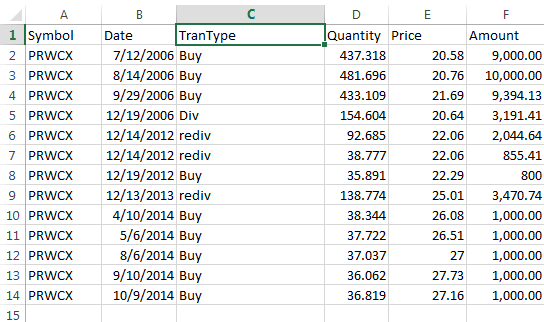
The CSV file must be in a certain format for you to import your transactions into your portfolio. The first line in the file must identify what each column is. The following column indentifiers are valid – Symbol, Date, TranType, Quantity, Price, Amount, Commission.

The valid values for the TranType column are Buy, Sell, Div, Rediv (Re-invested Dividend), Longcg (Long-Term Capital Gain), Shortcg (Short-Term Capital Gain), Relongcg (Re-Invest Long Term Capital Gain), Reshortcg (Re-Invest Short Term Capital Gain).

If you have a TranType value of Div then you will need an Amount column and you will not need the Quantity and Price column. If you have a TranType value of something other than a non re-invested dividend or non re-invested capital gain, you will need a Quantity and Price column. All rows must have a Symbol and Date column.

Here is a screen shot of a sample Excel file in the proper format.

Import Transactions into EquityStat's Stock Portfolio Tracker
Import transactions into EquityStat

Once you have your data entered in your spreadsheet, save it as a CSV file.

Next, login to your portfolio and  click the New menu and choose Import Transactions.  Then from the Import page, upload your CSV file from your computer.  The transactions that will be imported will then be displayed.  If everything is correct, continue the import process.

If you have any questions with how to do an import, feel free to contact our support desk by clicking the Help link from our home page.